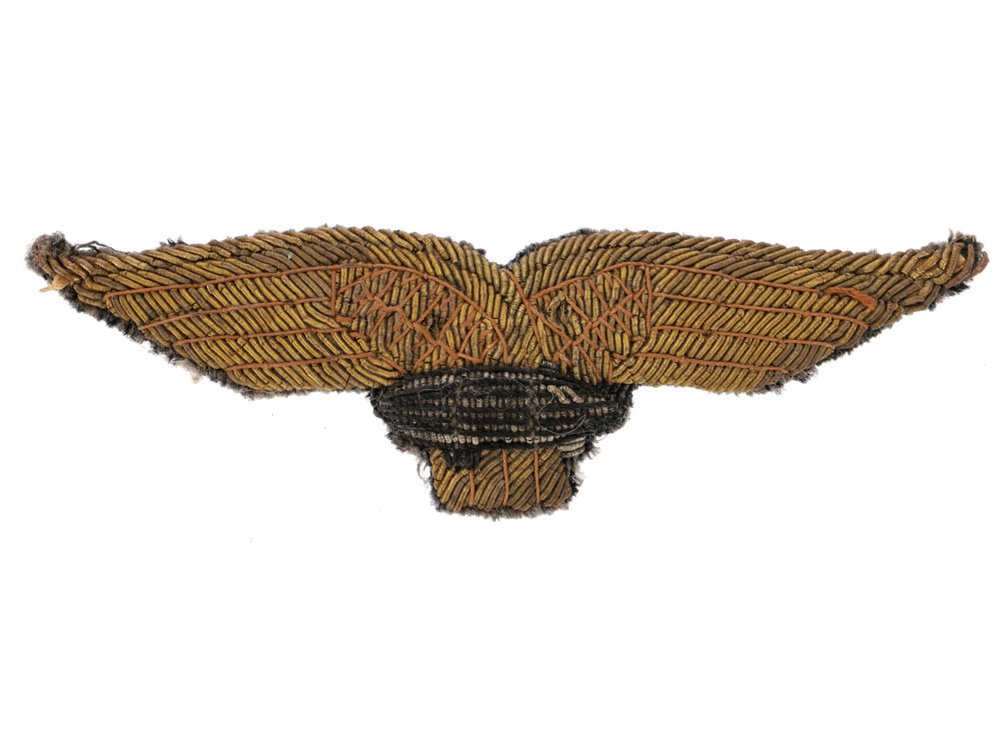
#269 • Italian WWI Dirigibili Airship Officer's Cap Insignia
Part of TRENCH ART & WWI Memorabilia (live auction by Bannerman Auctions)
High bid $200.00
Status: SOLD
Category: Italy
Italian WWI Dirigibili Airship Officer's Cap Insignia. 11cm x 3.5cm bullion insignia features the Italian eagle with a dirigible in the center, on green-gray wool with an unreinforced back. The Italian Army was an early adopter of lighter-than-air technology, beginning with tethered balloons in the late 19th century and moving into powered airships in the first decade of the 20th century. In the years immediately before the First World War, the Regio Esercito introduced domestically designed semi-rigid airships, particularly those by Enrico Forlanini, and began using them operationally. During the war, roughly from 1914 to 1918, Italian Army airships carried out reconnaissance and bombing missions against Austro-Hungarian targets on the Isonzo front and along the Adriatic coast, including night raids on rail junctions, ammunition depots, and port facilities that were otherwise difficult to reach. Their effectiveness was mixed: in favorable weather they could provide valuable intelligence and harassment over a broad area, but they proved vulnerable to ground fire, emerging fighter aircraft, and the demanding wind conditions of the alpine and coastal theaters. As heavier-than-air aviation matured and Italy’s air arm expanded, the role of Army airships narrowed, and by the end of the First World War their frontline employment had essentially ended, leaving them as a transitional step in Italy’s development of modern air power. Estimate $400 - $600 In the immediate postwar period, Italian military authorities quickly judged the dirigible too vulnerable to fighters and anti-aircraft fire to justify its retention as a front-line weapon, even though it still held promise for civilian and scientific work, such as Umberto Nobile’s later polar expeditions. Militarized dirigible units, including any formations organized as a Gruppo Dirigibili, were therefore wound down in the early 1920s, with effective military use of such grouped dirigible formations ending around 1920–1921 rather than continuing as robust operational units into the middle of the decade. Subsequent Italian airship activity in the 1920s, particularly the high-profile polar flights, represented exploratory or civil-scientific ventures and not a direct continuation of a wartime dirigible group in a combat role.