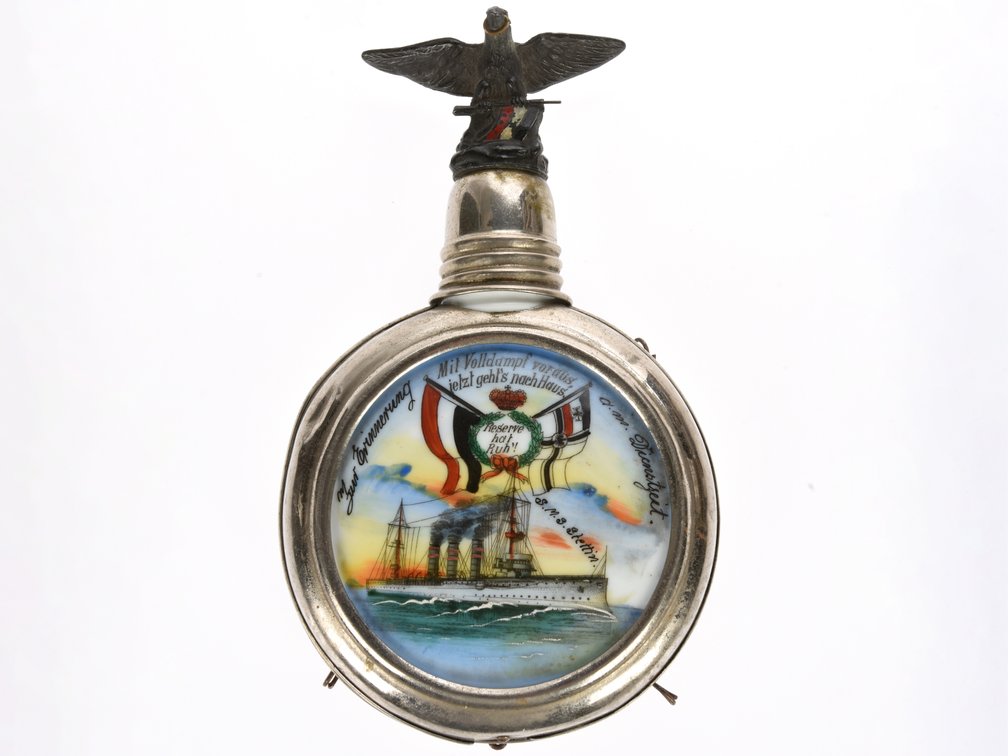
#193 • Imperial Kaiserliche Marine Reservist Flask: SMS Stettin 1909-1912
Part of TRENCH ART & WWI Memorabilia (live auction by Bannerman Auctions)
High bid $170.00
Status: SOLD
Category: Trench Art
Imperial Kaiserliche Marine Reservist Flask: SMS Stettin 1909-1912 Plated metal frame lacks the cloth suspension cords but retains all but one of the rings. Drinking cup cap with German eagle top piece. The white porcelain flask is painted on one side with a vignette of the S.M.S. Settin at sea; opposite side has home port Keil listed and service dates 1909-1912. No visible cracks or damage. From the net: Settin was a Königsberg-class light cruiser of the Kaiserliche Marine. She had three sister ships: Königsberg, Nürnberg, and Stuttgart. Laid down at AG Vulcan Stettin shipyard in 1906, Stettin was launched in March 1907 and commissioned into the High Seas Fleet seven months later in October. Like her sisters, Stettin was armed with a main battery of ten 10.5 cm (4.1 in) guns and a pair of 45 cm (18 in) torpedo tubes, and was capable of a top speed in excess of 25 knots (46 km/h; 29 mph). In 1912, Stettin joined the battlecruiser Moltke and cruiser Bremen for a goodwill visit to the United States. After the outbreak of World War I, Stettin served in the reconnaissance forces of the German fleet. She saw heavy service for the first three years of the war, including at the Battle of Heligoland Bight in August 1914 and the Battle of Jutland in May – June 1916, along with other smaller operations in the North and Baltic Seas. In 1917, she was withdrawn from frontline service and used as a training ship until the end of the war. In the aftermath of Germany's defeat, Stettin was surrendered to the Allies and broke up for scrap in 1921–1923. 1909-1912: In early 1909, civil unrest broke out in the Ottoman Empire against Christians living in the country. At the time, Hohenzollern was cruising in the Mediterranean Sea with the cruiser Hamburg as the escort. Hamburg was detached to intervene in southern Anatolia in the Ottoman Empire, and Stettin was sent to replace her as the escort for Hohenzollern. On 9 April, she departed Kiel in company with the light cruiser Lübeck, which was to support Hamburg in operations off the coast of Anatolia. The ships arrived in Corfu, an island off Greece, on 1 May. While the ships were in Pola, Austria-Hungary, on 15 May, Stettin received orders to return to Germany. She reached Kiel on 26 May. In October, FK Wilhelm Höpfner relieved Rössing as the ship's captain. Stettin once again served as the escort for Hohenzollern in 1910, from 7 to 30 July. This year, the ships cruised in Scandinavian waters. The ship's commander rotated again in September, with FK Johannes Hartog taking command. The year 1911 passed uneventfully for Stettin, beyond the normal peacetime routine of training exercises and fleet maneuvers. In October, FK Wilhelm von Krosigk became the ship's next captain. In March 1912, Stettin was assigned to the East American Cruiser Division, which also included the battlecruiser Moltke and the light cruiser Bremen, and was commanded by Konteradmiral (KAdm—Rear Admiral) Hubert von Rebeur-Paschwitz. The ships were sent to make a goodwill cruise to the United States; Moltke was the only German capital ship to ever visit the US. On 11 May 1912 the ships left Kiel and arrived off Hampton Roads, Virginia, on 30 May. There, they met the US Atlantic Fleet and were greeted by then-President William Howard Taft aboard the presidential yacht USS Mayflower. After touring the East Coast for two weeks, they returned to Germany. On the way back, they stopped in Vigo from 22 to 26 June, before continuing on to Kiel, arriving there three days later. Stettin thereafter returned to the reconnaissance unit. Estimate $150 - $250