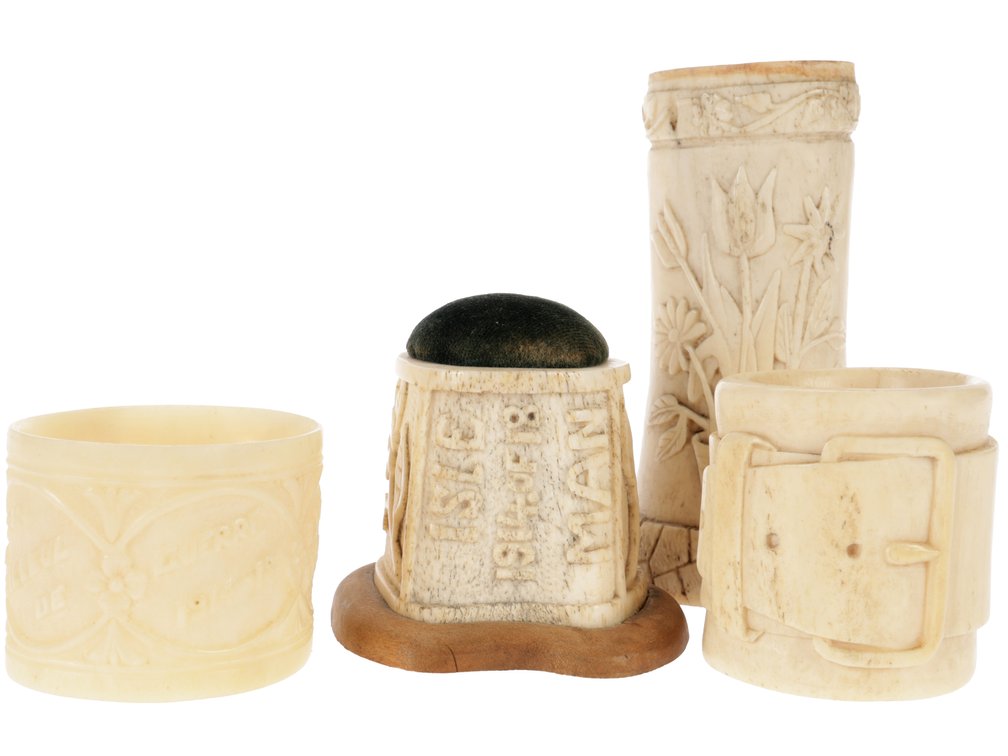
#127 • French & British WWI Bone Art: Lot of Four with Pin Cushion and Napkin Rings
Part of TRENCH ART & WWI Memorabilia (live auction by Bannerman Auctions)
High bid $80.00
Status: SOLD
Category: Britain
French & British WWI Bone Art: Lot of Four with Pin Cushion and Napkin Rings. All of bovine bone - first example is a napkin ring that is 4cm tall, with inscription "En Souvenir de son Filleul de guerre 1914-18" which translates as "A souvenir from his war godson, 1914–1918." During World War I, a filleul de guerre was a soldier who was informally "adopted" and supported through correspondence and gifts by a civilian sponsor. On a piece of trench art, the inscription likely indicates the item was presented as a keepsake from the soldier to his wartime benefactor. The remaining three pieces are artifacts of the the UK's enemy alien detention camps. First is another napkin ring, 5cm tall, very nicely carved to appear as a belt and buckle, with Isle of Man Triskelion insignia on the reverse. Next, a pin cushion that stands 6.5cm tall on a fitted wood base, with a green velvet top; sides have floral motifs and inscription "ISLE OF MAN 1914-18". The last was also very likely intended as a pin cushion as it is stopped part way down and shows residue where the cushion part was previously attached; this one measures 10cm tall and features an inked musician's lyre with "A Present to J.H.", with relief carved potted floral arrangement on the reverse. During the First World War, the British government detained an estimated 30,000 to 35,000 “enemy aliens,” primarily German and Austrian nationals, as a precaution against espionage and internal unrest. These civilians were held in a network of internment camps across Britain and the Isle of Man, including major sites such as Knockaloe Camp, one of the largest internment complexes in Europe, and Stobs Camp in the Scottish Borders. Although they were not prisoners of war, many detainees experienced long periods of confinement, which led to the development of organized activities intended to maintain morale and provide structure to daily life. One notable result of this environment was the creation of what is now referred to as “bone art.” Internees collected discarded animal bones from camp kitchens and transformed them into finely carved objects such as miniature sculptures, jewelry, and decorative items. These pieces were sometimes sold at camp exhibitions or fairs attended by local British civilians, offering a rare opportunity for interaction with the outside world. The income generated allowed detainees to purchase small comforts such as tobacco and sweets, while the creative process itself helped relieve boredom and sustain a sense of purpose under restrictive conditions. The main First World War enemy alien internment camps on the Isle of Man were the Douglas camp (sometimes called Cunningham’s Camp) and the very large Knockaloe Camp near Peel. Cunningham’s Camp in Douglas, a former holiday camp, received the first internees in September 1914, but overcrowding and poor conditions soon prompted the British government to establish a purpose-built complex at Knockaloe Moar farm on the island’s west coast. Knockaloe developed into the central civilian internment camp in the British Isles during the war, ultimately holding nearly 24,000 men in multiple compounds and remaining in operation until 1919. Estimate $150 - $250