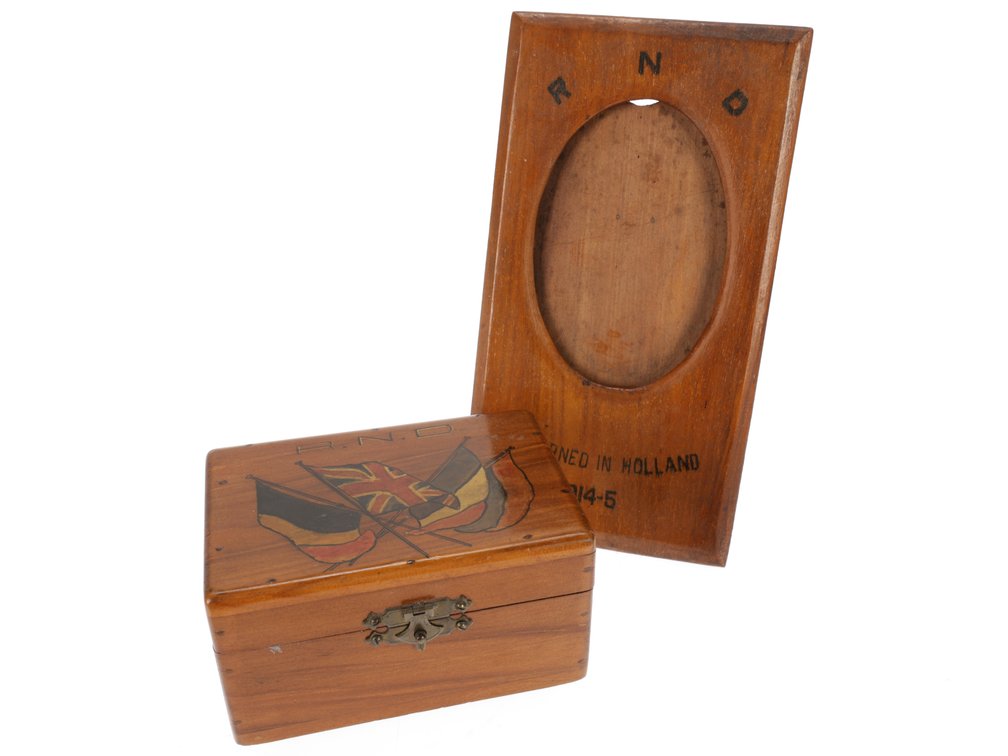
#107 • WWI Royal Naval Division Internee Jewelry Box and Picture Frame
Part of TRENCH ART & WWI Memorabilia (live auction by Bannerman Auctions)
High bid $55.00
Status: SOLD
Category: Trench Art
WWI Royal Naval Division Internee Jewelry Box and Picture Frame 10.2 x 19.7 cm rectangular picture frame has beveled edges and with an oval display opening. Black initials RND (Royal Naval Division) are painted above the opening and INTERNED IN HOLLAND 1914-15 below. Reverse has a 10 x 14 cm wooden pocket to hold a photo and a hinged stand. 11.2 x 7.4 x 5.9 cm wooden jewelry box has the initial R.N.D. painted on the lid above a panoply of the allied flags of Belgium, Britain, France, and Serbia. The box is constructed with simple but neat butt joints with contrasting wood and rounded corners. It stands on four metal tack feet and retains the original adhesive tag indicating it was made by a member of the First Royal Naval Brigade interned at Groningen - Holland. Space for the name and date to be filled in at the time of completion are filled in. The name is illegible due to some material loss on the tag but the date Aug 5th 1916 is clear. Interior is lined in padded fuchsia silk. When Britain declared war in August 1914, there was a surplus of men in the Royal Navy reserves sufficient to form two Naval Brigades and a Brigade of Marines for operations on land. These were formed in haste, without artillery or support units, khaki uniforms, or even basic field equipment. Yet, in early October, they were engaged in the doomed defense of Antwerp. Approximately 1500 men of the 1st Royal Naval Brigade found their escape route from Antwerp cut off. Rather than surrender to the advancing Germans, Commodore Wilfred Henderson led his men across the border into neutral Holland. In accordance with international law, they were detained for the duration of the war. They were housed in wooden barracks erected behind the prison in Groningen. They received an allowance equivalent to the pay for the lowest rank in the Dutch armed forces. To supplement this, a number of workshops were formed. The most well-known shop was that of the woodworkers who produced picture frames and jewelry boxes. These were sent to England for sale in the famed department store Selfridges. Estimate $50 - $100