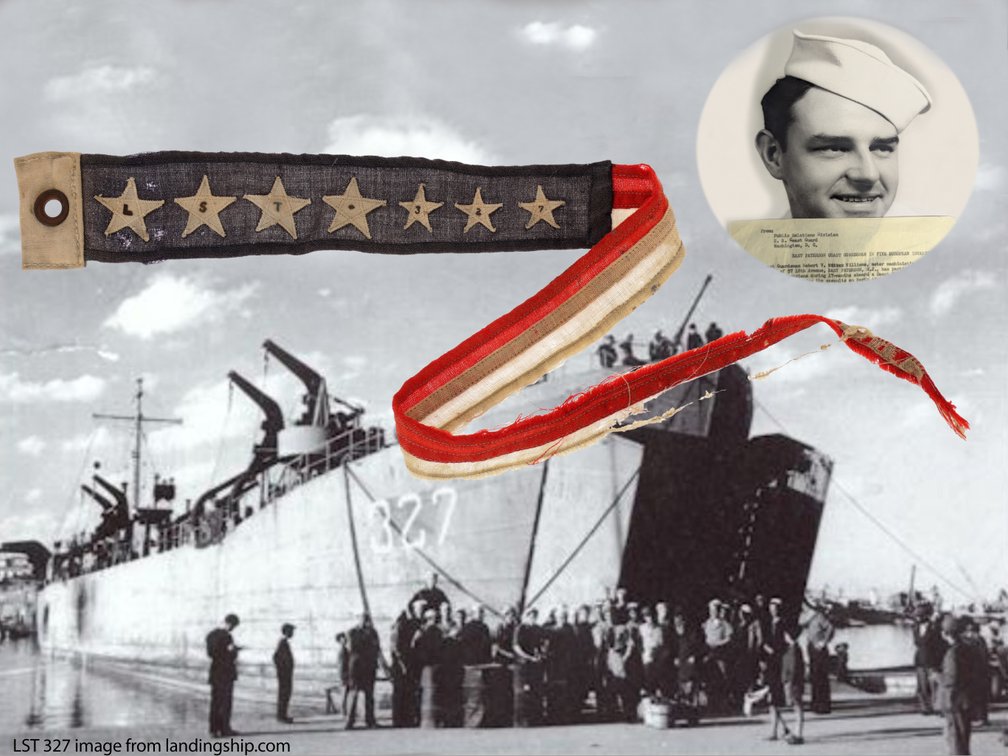
#162 • WWII LST-327 Commissioning Pennant - Sicily, Salerno, Anzio, Normandy - Torpedoed by U-92
Part of Militaria Through The Ages (live auction by Bannerman Auctions)
High bid $600.00
Status: SOLD
Category: United States
WWII LST-327 Commissioning Pennant - Sicily, Salerno, Anzio, Normandy US Navy No.7 commissioning pennant of wool bunting measures 2.5 inches wide at the hoist with approximately 36 inches of the red and white streamer remaining. White canvas hoist is stamped COMM. PENN. with numeral 7 in faded black ink and a single heavily patinaed brass grommet. Faded blue wool field has seven applied white stars with the first four from the hoist measuring 1 3/8 inches and the final three measuring only 1 inch. The stars on the obverse have been inscribed horizontally in black and blue ink LST.327. The first three stars on the reverse are vertically inscribed 327. The blue is fully intact with some fraying on the edges and wear around the star closest to the hoist.The red and white streamer is heavily worn down from its original length. The top red strip is intact for roughly 10 inches with the rest being the remains in place due to the reinforcing seams. Less of the white portion survived with about 5 intact inches that fray away into nothing. These narrow streamers were flown from the mastheads of warships to distinguish them from merchant vessels as far back as the 17th century. They are hoisted during commissioning and one always flies for the duration of the vessel's service until decommissioning. The idea that the same pennant flew during the entire service period is a misunderstanding. They are changed out when required due to wear. Presentation pennants are usually flown for a day and then taken down in order to present a clean, untattered example. This pennant was consigned by the family of Robert "Bob" Verne Williams, MoMM1c, LST 327, US Coast Guard. A newspaper article appearing in several 1944 Paterson, New Jersey area newspapers summarizes Bob's experience at all of the 327's landings - heavy aircraft bombing during the landing at Licata and German 88s "pounding it down from the hills" during Salerno. "The beachhead was completely in flames with the troops pouring in right under the rain of shells." At Anzio (another blazing inferno) "We had a tough time getting started and even had to take the boys off the beach and bring them to another port". Normandy, "was a rather routine affair at some parts of the beach" which Williams credited to "the terrific air coverage. The sky was black with planes - our planes." Williams' press authorized account of the landings barely scratch the surface of the harrowing service record of LST 327 in WWII. It is unclear exactly when Williams came into possession of the pennant, but the muster rolls of the 327 confirm that he certainly earned it. USS LST 327 was active in the Tunisian Campaign, heavily engaged at the Sicily, Salerno, Anzio Landings and a stalwart of the Normandy Landing. She was a Coast Guard manned Navy vessel that earned five battle stars in the European, Africa, Middle Eastern campaign as part of Flotilla 18, Group 52, Division 104. LST 327 was commissioned in March, 1943 and almost immediately joined a convoy to North Africa. They joined operations and began training at Bizerte in May of 43 in preparation for the Invasion of Sicily. During Operation Husky on July 10, 1943, the 327 offloaded combat troops and vehicles under heavy bombardment in the first wave as part of JOSS force (Task Force 86), Licata Beach. The 327 continued resupply and evacuation convoys between North Africa and the Italian port of Palermo until August 28. Preparations began for the Salerno Invasion began on September 3. During Operation Avalanche, September 9, 1943, LST 327 proceeded to Green Beach and anchored a 1/2 mile from the beach where she encountered heavy shell fire from enemy shore batteries and enemy aircraft she was forced to withdraw out of range. After a red alert and heavy anti-aircraft fire she got underway again and successfully stood into Red Beach on September 10. By 0619 all personnel and vehicles were ashore and the 327 retracted and at 0840 joined convoy SBM-2. During the approach and landing the crew had fired on enemy planes without casualties or damage which earned the 327 a commendation. Resupply trips continued until October 8, when she collided with an unidentified vessel. She remained in Palermo for repairs until January of 1944 when she began to prepare for the Anzio landing. She left Palermo for Karouba, Tunisia on January 8, 1944 to prepare for Operation Shingle. Departing on January 21, 1944, she anchored off Peter Beach at 0025 on the 22nd as shelling began. At 0226 the first wave of LCVP's landed troops on the beach. She moved to the unloading anchorage early in the afternoon but enemy shell fire from the beach became so heavy that she was ordered to return to her previous anchorage. Several red alerts followed and at 1627, the 327 departed for X-ray sector and anchored. At 0740 with low doors and ramps opened she unloaded to LCT-212. Unloading to 3 other LCTs followed and at 0934 all LCTs were away. Taking on LCVP crews after moving closer to the beach, five enemy planes were fired upon at 1123. Resupply and duty as a supply mother ship at anchor off Nettuno Beach lasted until May of 1944. She made her way North to Swansea, Great Britain and was attached to a British LST squadron to prepare for the invasion of Normandy. At 00:02, June 7, 1944 she anchored in the eastern Nan Rhino area at the edge of Juno and Sword Beaches. At 1316, she stood into the unloading area close to the beach where she unloaded into LCT-2004. She returned to London on the 9th. A second trip to France was made on the 11th. On the 13th the 327 was rammed by LST-534 causing an 8 foot gash in one of the compartments. She stood into Roger Green Beach on the 13th to unload and received 76 German POWs for transportation to the United Kingdom, returning to Southampton on the 15th. Subsequent round trips to Normandy with vehicles and men took place through June 30, 1944. At the end of June, approximately 35 of the original crew rotated home for rest and reassignment. The LST continued working between English Channel ports and Northern France through July and August. On August 27, 1944, it was reported that she struck an enemy mine and suffered heavy damage and lost 22 men. The mine strike remains part of LST 327's record to this day. However, in October, 2000, a German historian contacted former LST 327 Chief Carl O. Pfannkuch through his Landing Ship website. The historian presented evidence suggesting that, according to German records, LST 327 did not hit a mine that day in August. She was struck by an acoustic torpedo launched by a German U-Boat. The war diary of German U-92 records the exact date, time, and coordinates of a hit by an acoustic torpedo launched at the last ship in an Allied convoy. Though the vessel is not identified there, reports from both navies and research compiled by Pfannkuch - based on discussions with 32 crewmates from the 327, including the Officer of the Deck and Officer of the Day - support the theory that LST 327 was attacked by the U-92. The explosion on August 27, 1944 ripped through the munitions locker in the stern of the ship, directly above the screws (the loudest part of the ship). The crew compartment was right above the munitions locker. 22 men were lost outright and 26 seriously wounded. LST 346 assisted in the rescue effort and towed the 327 to Plymouth. She was repaired and returned to Norfolk, VA in July 1945. She was decommissioned that November. The August published newspaper article featuring Bob Williams mentions he was on short leave in the States before reassignment. Thankfully, he was not onboard the 327 when she she was struck in the Channel. After the war, Robert V. Williams studied undergraduate English at Cornell and earned an MA in English/Creative Writing at Stanford. He even returned to Italy in 1951 to study at the University of Rome on a Fullbright grant. He went on to chair the writing department at California State University, Hayward (currently CSU-East Bay) which still holds the annual Robert V. Williams Memorial Contest for Short Fiction. This is a well earned souvenir of some of the greatest combined military operations in history from Robert Verne "Invader Bob" Williams, MoMM1c of "the Fightingest LST", the 327. Estimate $1000 - $1500