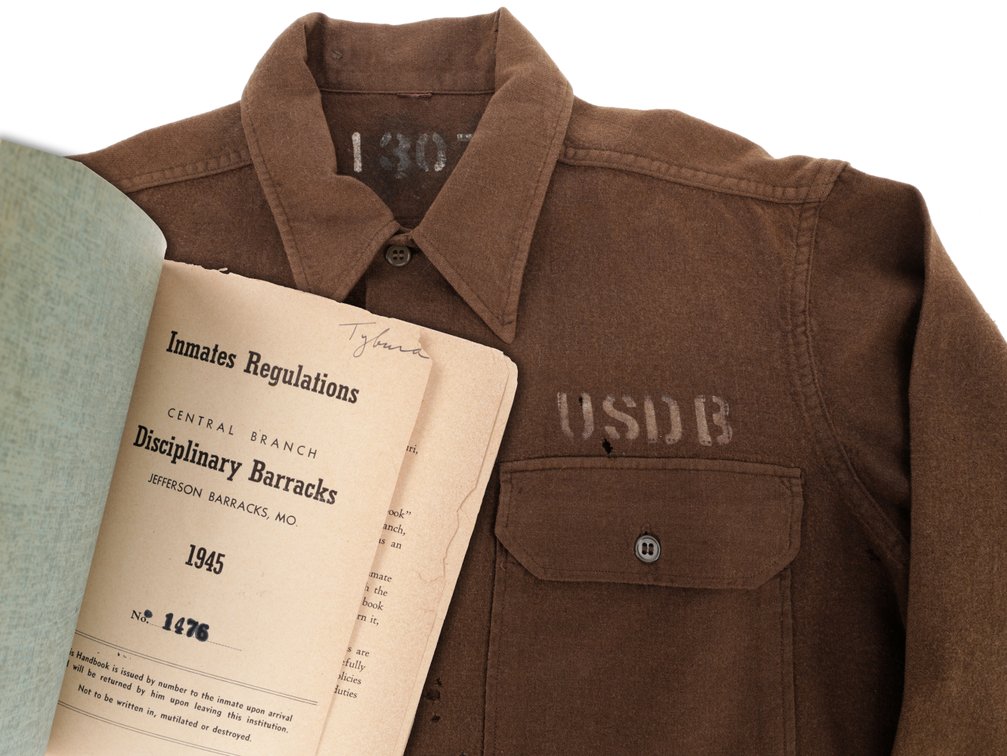
#276 • WWII US Army Disciplinary Barracks Prisoner's Issue Shirt and Inmate Regulations Manual Lot
Part of Militaria Through The Ages (live auction by Bannerman Auctions)
High bid $150.00
Status: SOLD
Category: United States
WWII US Army Disciplinary Barracks Prisoner's Issue Shirt and Inmate Regulations Manual Lot. If you are going to do a US WWII 'Life in the Army' display.. where are you going to find artifacts to tell the story of the ~35,000 soldiers who strayed from Uncle Sam's straight and narrow path and found themselves on the wrong end of a court-martial? Right here! Perhaps not the most glamorous of WWII artifacts, but not commonly encountered and definitely a part of the overall story of the big green machine during the Second World War. Lot includes an enlisted issue shirt which is dyed brown and stenciled "USDB" in white above the left pocket and across the back, with laundry mark "I 3079" on the interior back. A search of WWII enlistment records turns up only four individuals who would have had that laundry number, so this fellow may be researchable. The shirt has light to moderate scattered mothing. Lot further includes a bit of ephemera that honestly should not have survived: the small 28-page paper covered pocket manual "Inmates Regulations / Central Branch / Disciplinary Barracks / Jefferson Barracks, MO" with date "1945" and further notation "This handbook is issued by number to the inmate upon arrival and will be returned by him upon leaving this institution. Not to be written in, mutilated, or destroyed." Not only did the inmate apparently decide to keep his, but he also wrote his name "Tybura". Only one result in Army enlistment records is returned for this: William L. Tybura, a draftsman from St. Louis City, Missouri who was born in 1920 and enlisted on January 8, 1943. During World War II, the United States Army greatly expanded its military prison system to meet the demands of a force that had grown to more than eight million personnel. The United States Disciplinary Barracks at Fort Leavenworth remained the Army's principal prison, but additional disciplinary barracks and rehabilitation centers were established across the country and overseas. By the end of the war, the Army correctional system held nearly 35,000 prisoners worldwide, the largest population in its history. Despite popular perceptions, most inmates were not violent criminals. The most common offenses were being absent without leave, which accounted for nearly half of all prisoners, followed by desertion, with lesser numbers confined for insubordination, violating confinement, theft, or other military offenses. More serious crimes such as murder, rape, mutiny, and espionage represented only a small portion of the prison population. Rather than serving solely as places of punishment, many Army correctional facilities emphasized rehabilitation through military retraining, education, vocational instruction, and strict discipline. More than half of the soldiers sent to rehabilitation centers during the war were eventually restored to active military service. Following Japan's surrender, the rapid demobilization of the armed forces reduced the need to return offenders to duty, and many prisoners convicted of lesser military offenses received reduced sentences or administrative discharges. Those convicted of serious crimes generally remained incarcerated until completing their sentences or receiving parole. As the Army returned to its peacetime strength, most temporary disciplinary barracks and rehabilitation centers were closed, leaving the United States Disciplinary Barracks at Fort Leavenworth once again as the Army's primary long term military prison. Estimate $100 - $200