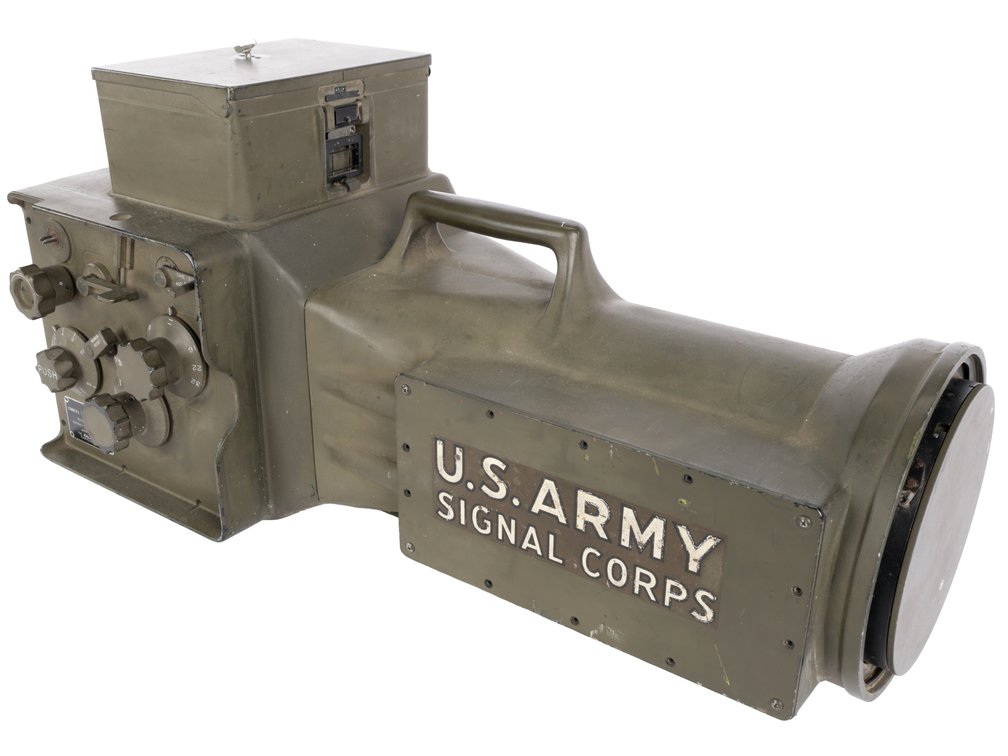
#155 • 1950s-1960s US Army Signal Corps Experimental Reconnaissance Camera PH-631
Part of Militaria Through The Ages (live auction by Bannerman Auctions)
Starting at $400.00
Status: PASS
Category: United States
1950s-1960s Experimental Signal Corps Reconnaissance Camera PH-631 Massive 65.5 pound metal case measures 29" long and almost 12" wide with a cone housing a Bell & Howell Type I, 36 inch, f/8 telephoto lens. This is same lens utilized in the WWII large format aerial reconnaissance cameras. The rubber gasket surrounding the lens is intact, flexible and the lens retains the metal cover. The right side of the body has very accessible range, speed, film advance, mirror, and shutter controls in the form of large knobs and levers. One knob is missing. It has a pop-up, hooded view finder with reticles on the top rear portion of the case and a compartment on the rear to access the film roll. The sides have access panels for servicing the optics control mechanisms - one of the covers is missing 10 of the 14 screws holding it closed. The top has a rigid, integrally molded handle and the bottom has a mounting bracket with a threaded hole in the center. The data plate in the lower left corner of the control panel reads: CAMERA PH-631 (XM-1) / GF. This camera is serial number 5 of contract DA-36-039 SC 64672, manufactured by the KalArt Co. Inc. The case retains most all of its olive drab finish. Both sides have large U.S. ARMY SIGNAL CORPS decals of white lettering outlined in black. This experimental reconnaissance camera was first described in a 1 May, 1953 Project TEOTA (The Eyes Of The Army) report "Problems of Battlefield Surveillance". In it, the Signal Corps outlines various offensive and defensive systems for Company, Regimental Combat Team, and Field Army levels utilizing portable photography, acoustics, radar, television, and infrared devices and programs. The PH-631 is introduced in the report as a vehicle mounted, 40" reconnaissance camera in development, capable of utilizing either Land-Polaroid or conventional film. The system was intended for rapid, front line battlefield surveillance, allowing personnel to quickly capture and develop high-contrast images of tactical targets like machine gun emplacements at ranges of up to 2,000 yards. Estimate $800 - $1200