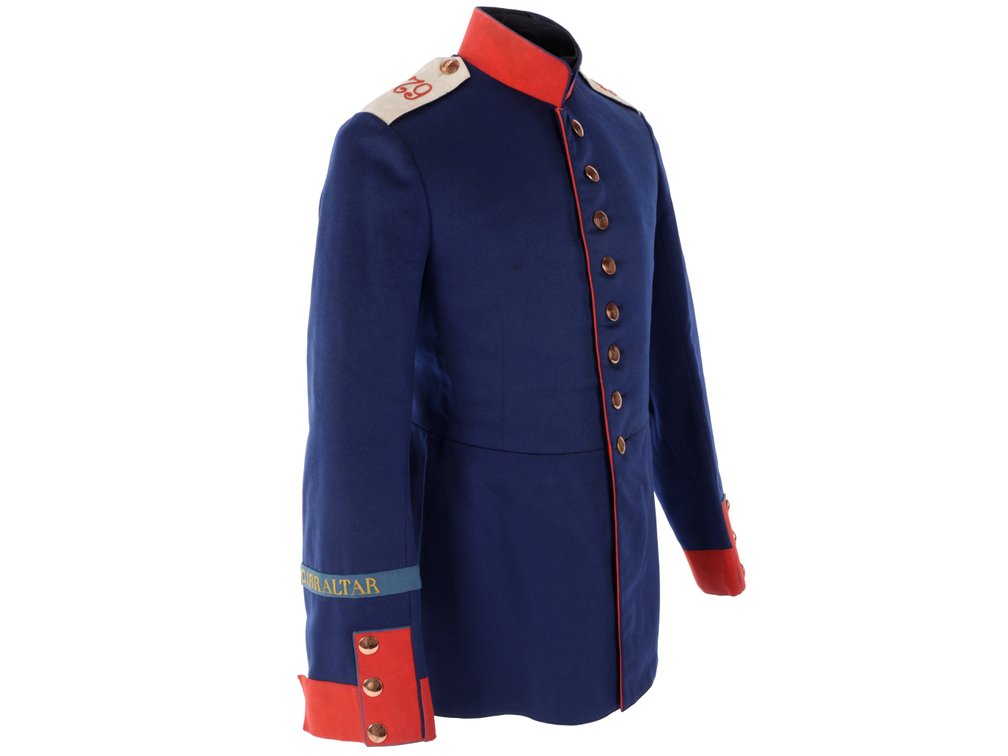
#223 • Hanoverian Infantry Regiment 79 Soldier's Dunkelblau Tunic with GIBRALTAR Cuff Title
Part of Ghosts of the Great War (live auction by Bannerman Auctions)
High bid $300.00
Status: Available
Category: Imperial Germany
Hanoverian Infantry Regiment 79 Soldier's Dunkelblau Tunic with GIBRALTAR Cuff Title. Enlisted private purchase service dress blue wool coat has red standing collar and brandenburg cuffs with light blue corps color piping reflecting service in the X Army Corps. Coat has tombac buttons with "1" company number buttons on the JR 79 shoulder straps. Right sleeve has cuff title with yellow embroidered "GIBRALTAR" on a light blue wool band. Interior has black silk body and skirt lining and white sleeve lining. The light blue cuff title bearing the inscription "GIBRALTAR" was a distinctive hereditary honor authorized for only three Hanoverian formations in the Imperial German Army: Füsilier-Regiment General-Feldmarschall Prinz Albrecht von Preußen (Hannoversches) Nr. 73, Infanterie-Regiment von Voigts-Rhetz (3. Hannoversches) Nr. 79, and Hannoversches Jäger-Bataillon Nr. 10. The distinction commemorated the service of three battalions of the Electoral Hanoverian Army dispatched in 1775 to reinforce the British garrison at Gibraltar. During the American Revolutionary War, the British fortress was subjected to a prolonged siege by Spanish and French forces between 1779 and 1783. The Hanoverian troops, serving under the command of Colonel August de la Motte, played an important role in the successful defense of the strategically vital fortress, remaining in Gibraltar until the siege was finally abandoned. In recognition of their endurance and distinguished service, King George III, who was also Elector of Hanover, originally authorized a commemorative sleeve distinction in 1785. More than a century later, Kaiser Wilhelm II revived this historic honor by an Imperial Cabinet Order dated January 24, 1901. The three designated Hanoverian formations were authorized to wear a light blue band bearing the inscription "GIBRALTAR" in yellow lettering on the right sleeve of their uniforms, immediately above the cuff. The authorization represented an unusual distinction within the Prussian Army, preserving a specific honor of the former Hanoverian military establishment after its incorporation into the Prussian Army following the annexation of Hanover in 1866. The cuff title remained in use through the First World War and is among the more distinctive and historically significant uniform honors encountered on Imperial German infantry uniforms. JR79 mobilized on August 2, 1914, as part of the 39th Infantry Brigade, X Army Corps. The regiment participated in the opening German advance through Belgium, including the operations against Liège and the subsequent fighting around Namur. Following the advance into France, it fought during the opening campaigns of 1914, including the Battle of the Marne, before settling into extended trench warfare along the Aisne. In March 1915, the regiment was transferred to the Eastern Front, where it participated in the major German and Austro-Hungarian offensive at Gorlice-Tarnów and subsequent operations in Galicia, including the fighting around Lemberg. The regiment alternated between the Eastern and Western Fronts during the following years. It returned to the Western Front in 1915, participating in the autumn fighting in Champagne before resuming positional warfare along the Aisne. Further service on the Eastern Front followed in 1916 and again in 1917, including operations in Wolhynia and Galicia. Returning to the Western Front in the summer of 1917, the regiment entered the fighting in Flanders and Artois, where it suffered particularly severe losses during the autumn battles around Zonnebeke on October 4, 1917. The regiment was effectively shattered during this engagement, with much of its surviving personnel taken prisoner. Its remnants were consolidated into a single battalion before the unit was rebuilt with replacement personnel. During the final year of the war, Regiment Nr. 79 participated in the German Spring Offensive of March and April 1918, followed by a succession of costly defensive engagements as Allied offensives progressively forced the German Army into retreat. The regiment suffered further catastrophic losses during the fighting around Havrincourt in September 1918 and again near Prémont in October. Despite repeated reconstruction and the incorporation of replacement formations, it continued in action until the Armistice. The surviving personnel returned to Hildesheim in December 1918, where the regiment was subsequently demobilized and formally dissolved in September 1919. Estimate: $600 - $800 Ex. Chip Minx Collection