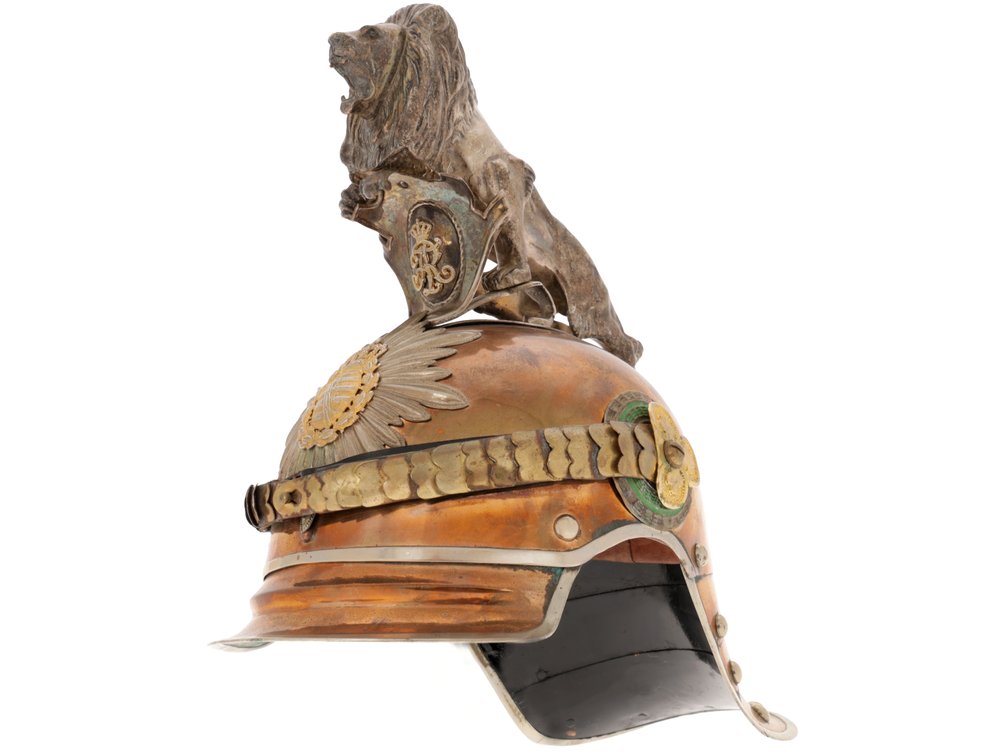
#159 • Imperial German Saxon Garde-Reiter-Regiment Officer's Helmet With M1907 Parade Lion
Part of Ghosts of the Great War (live auction by Bannerman Auctions)
Starting at $7,500.00
Status: Available
Category: Imperial Germany
Imperial German Saxon Garde-Reiter-Regiment Officer's Helmet With M1907 Parade Lion. An impressive Imperial German officer's helmet of the Royal Saxon Garde-Reiter-Regiment, featuring a gilt tombak shell of characteristic cuirassier pattern, with stepped front visor and extended, lobed rear neck guard. The helmet is fitted with a large silvered Saxon Guard star bearing the applied gilt Saxon coat of arms, silvered trim, and gilt convex-pattern chin scales secured by distinctive cloverleaf rosettes. Complete with large-format officer's cockades. Interior has a light green silk lining and brown leather sweatband that is a bit stiff but intact and in good condition. The end of the lion attachment bolt appears to have been trimmed shorter at some point. The underside of the lion's base has small stamped assembly number "13". The helmet is surmounted by the distinctive silvered Parade-Löwe M/1907, a finely detailed representation of a rampant lion, with a separately applied shield bearing the crowned gilt royal cipher of King Friedrich August III of Saxony. The scroll upon which the shield is attached lacks one small fitting from where it is secured to the underside of the lion's mane, but it remains quite attached. Introduced on July 19, 1907, the parade lion replaced the white horsehair plume previously worn by the regiment on ceremonial occasions. Its adoption commemorated the centenary of the elevation of the King's Cuirassier Regiment to the Guards and its renaming as the Leib-Cuirassier-Garde in 1807. The presentation was accompanied by an address from the regiment's commander, Oberst Hans Krug von Nidda, to King Friedrich August III. In acknowledging the distinction, Krug von Nidda invoked the historic Lion of Meissen, declaring that it would serve as a symbol of the regiment's bravery and courage. He further pledged that, should the King's call be heard, the Guards would hurl themselves against the enemy as their predecessors had done a century earlier, and "crush them with mighty lions' paws." The sentiment reflected the regiment's longstanding association with the Saxon royal household and the heraldic traditions of the Kingdom of Saxony. The parade lion also makes this helmet considerably less frequently encountered than the more familiar officer's helmets of the Prussian Garde du Corps. While both regiments maintained approximately five-squadron establishments, with the Saxon regiment having roughly 25 officers at peacetime strength, the distinction lies in the considerably shorter period during which the Saxon lion was worn. The Garde du Corps employed its distinctive parade eagle from the introduction of its characteristic metal helmet in 1842-43 through the end of the Imperial period, providing a production and service history spanning approximately three-quarters of a century. By comparison, the Saxon parade lion was introduced in July 1907 and remained in use only until the dissolution of the monarchy in 1918. The relative scarcity of surviving Saxon military artifacts is further contextualized by the events of the twentieth century. Dresden, the regiment's home garrison, suffered catastrophic destruction during the Allied bombing raids of February 1945, devastating much of the historic city and resulting in the loss of numerous buildings, collections, and other material associated with its military heritage. Following the war, Saxony fell within the Soviet occupation zone and subsequently the German Democratic Republic, where restrictions on the movement and export of privately held cultural property limited the availability of surviving material to Western collectors for decades. These circumstances, together with the regiment's relatively brief use of the distinctive parade lion, provide important context for the comparatively infrequent appearance of these helmets on the international collector market. Although the precise number of surviving examples is unknown, the combination of regimental exclusivity, limited period of use, and the subsequent history of Saxony makes this a particularly desirable and historically significant form of Imperial German ceremonial headgear. Established in 1680, the Garde-Reiter-Regiment was the senior cavalry regiment of the Saxon Army and was permanently garrisoned in Dresden. As a royal Guard formation, its duties included service at the royal palace and participation in court ceremonies and other state occasions. Its distinguished history and close association with the Saxon monarchy were reflected in the elaborate appointments of its officers' uniforms and equipment. This helmet, with its exceptional parade lion and combination of silvered and gilt fittings, represents the distinctive ceremonial headgear of the Imperial Saxon cavalry. Estimate $15,000 - $20,000