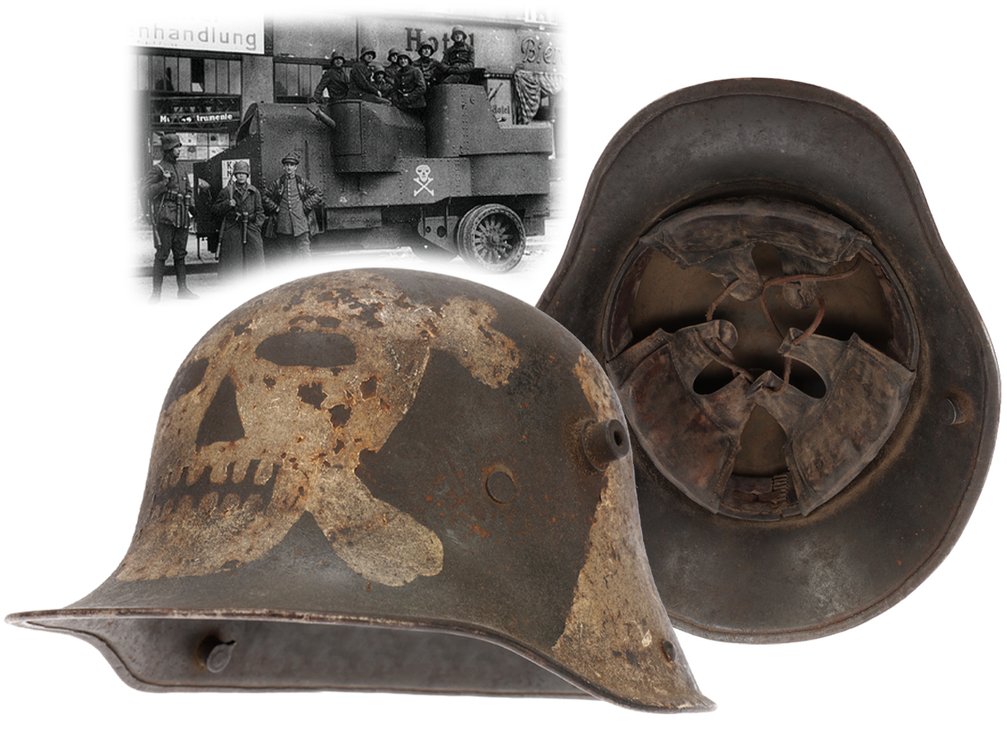
#158 • German Freikorps Painted M.16 Helmet
Part of Ghosts of the Great War (live auction by Bannerman Auctions)
High bid $1,000.00
Status: Available
Category: Imperial Germany
German Freikorps Painted M.16 Helmet. Imperial German Model 16 stalhelm has a few faint traces of dark feldgrau finish blending with an overall dark patina. Sides have two lightning bolts and the obverse has a large totenkopf skull and bones in white, both heavily worn as well with ~60% remaining. Interior has "E.T. 64" maker size stamp of Eisenhüttenwerk Thale, and a dark stained brown leather 1916 pattern liner with all three pads intact. Leather is heavily stained from service but remains in good condition and is Pecard-free. Judging by the patina on the liner pins and their impressions in the liner band, there has been no tinkering with this helmet since its time in service. Of all the 'Freikorps' helmets that we see out there at shows and in collections, this is the first one in a very long time that I believe to be a legitimate example. The Freikorps (literally, "Free Corps") emerged in Germany during the closing months of the First World War and the turbulent period immediately following the Armistice of November 1918. Their rise was closely connected to the collapse of Imperial Germany, the abdication of Kaiser Wilhelm II, and the subsequent disintegration of the Imperial Army. As Germany's regular military forces were demobilized and the newly established republican government struggled to maintain order, numerous volunteer paramilitary formations arose, composed largely of former Imperial Army officers, veterans, and soldiers who were unwilling to return to civilian life. Their objectives varied, but most were strongly nationalist, anti-communist, and opposed to the revolutionary socialist movements seeking to reshape Germany. Many regarded themselves as defenders of German national interests and sought to prevent a communist revolution, preserve traditional military and social institutions, and suppress domestic uprisings. Beginning in late 1918 and remaining active throughout much of the early 1920s, the Freikorps became an important instrument of the provisional government, particularly in suppressing the Spartacist uprising in Berlin in January 1919 and revolutionary movements elsewhere in Germany. They also participated in the violent political struggles surrounding the establishment of the Weimar Republic, with some formations subsequently turning against the very republican government they had initially helped defend. The movement reached its height between 1919 and 1921, although Freikorps veterans and successor organizations remained active in German political violence for years afterward. Their existence reflected the profound instability created by Germany's defeat in the First World War: the sudden end of four years of military conflict, the collapse of the monarchy, the revolutionary upheaval at home, and the restrictions imposed on Germany's armed forces by the Treaty of Versailles. Although initially sanctioned and employed by the republican government, the Freikorps represented a significant threat to the young democracy, and some of their members participated in the attempted Kapp Putsch of March 1920, which sought to overthrow the Weimar government. Many former members subsequently gravitated toward nationalist and radical right-wing organizations, including the emerging Nazi movement. Estimate $2000 - $3000