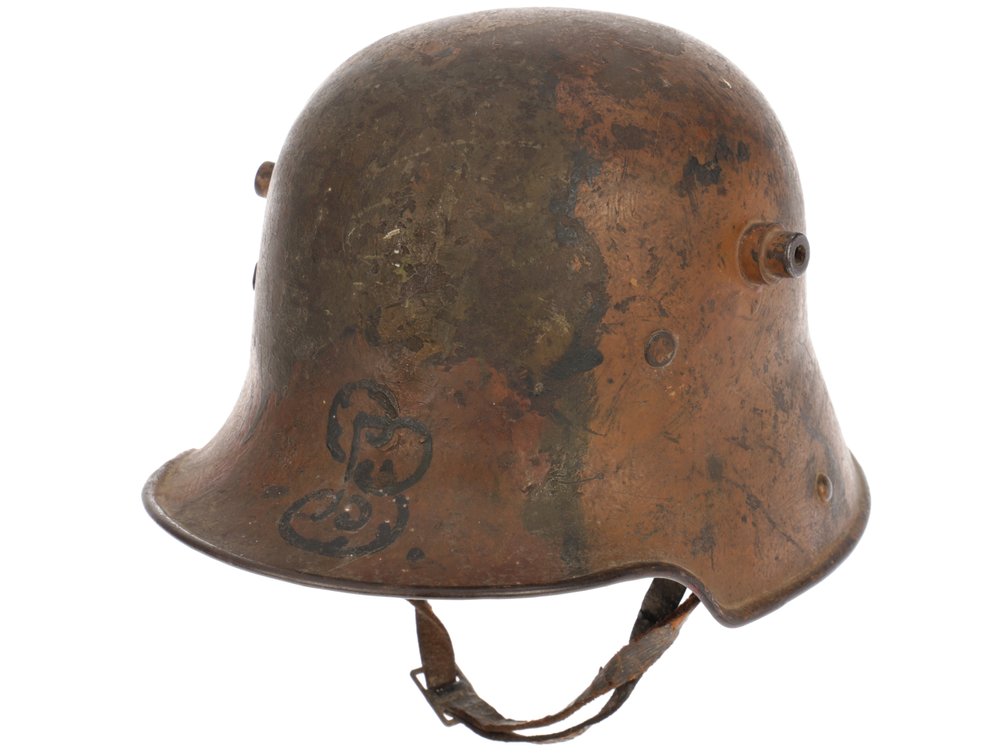
#157 • Camouflaged First Production Square-Dip M1916 Stalhelm With Cypher
Part of Ghosts of the Great War (live auction by Bannerman Auctions)
High bid $1,100.00
Status: Available
Category: Imperial Germany
Camouflaged First Production Square-Dip M1916 Stalhelm With Cypher. One of my absolute favorite helmets that I have ever owned! AGM sold this many years ago to a dear friend who has recently consigned his Imperial collection to Bannerman, and it is truly a pleasure to have it back in the building. M.16 steel helmet retains ~50% camouflage painted finish blending with dark steel patina where worn. The camouflage is worked in dark ocher and light military brown, utilizing the original feldgrau as well, with irregular flowing black separating lines. Obverse has "SB" cypher on the brim and lower crown. Interior has "E.T. 60" maker's size stamp, 1916 pattern leather band with all three cushions intact, and the helmet is complete with a heavily worn and delicate but intact black leather chinstrap. The distinctive "Square-Dip" configuration, as it is known to collectors, represents the earliest production form of the M1916 Stahlhelm, distinguished by the sharply angled transition from the rear neck guard toward the front visor. Eisenhüttenwerke Thale (E.T.) was the sole manufacturer involved in producing this initial run. An order for approximately 30,000 helmets was placed with the intention of having them available by the end of January 1916. The first batch was delivered to Sturmbataillon Rohr for field trials in mid-December 1915, and a substantial number were reportedly ready for the opening German assault at Verdun in February 1916. The steep, narrow transition between the visor and neck guard proved to be a significant manufacturing flaw, creating excessive stress during the stamping process and resulting in frequent cracking. Consequently, large numbers of shells had to be rejected and scrapped, preventing Thale from fulfilling the original production requirement. The design was subsequently modified to eliminate this problem, and the more familiar rounded transition became standard. Although the actual number of square-dip helmets successfully manufactured remains undocumented, their relatively brief production makes surviving examples considerably scarcer than conventional M1916 helmets. Though the "SB" cypher is not an exact match for the "StB" cypher reproduced on Sturmbataillon Rohr unit-specific postcards of the period or the 1939 unit history, but the very close association with 'square-dip' helmets with Sturm-Bataillon Nr. 5 makes this quite plausible. It could just as easily be the owner's initials... but that would be quite a coincidence. Formed in March 1915 as the German Army's first experimental assault formation, Sturm-Bataillon Nr. 5 (Rohr) became one of the most influential tactical organizations of the First World War. Under the leadership of Hauptmann Willy Rohr, who assumed command in August 1915, the unit pioneered a fundamentally different approach to trench warfare, abandoning traditional massed infantry assaults in favor of small, highly mobile assault groups (Stoßtrupps) operating with considerable tactical independence. Combining hand grenades, flamethrowers, machine guns, trench mortars and specialized infantry weapons, these teams infiltrated weak points in enemy defenses, bypassed strongpoints where possible, and attacked trenches from the flanks and rear. The battalion successfully tested its developing methods in the Vosges in October 1915 and subsequently distinguished itself at Verdun in February 1916. Renamed Sturm-Bataillon Nr. 5 (Rohr) in February 1917, it also became an important center for training and instruction, with officers and experienced noncommissioned officers from formations throughout the German Army sent to study its methods and carry the new tactics back to their own units. Rohr's innovations in assault-squad organization, decentralized command, combined-arms cooperation and infiltration warfare profoundly influenced German infantry doctrine, culminating in the official 1918 manual The Attack in Position Warfare and the storm-troop tactics employed during the German Spring Offensives. The battalion's significance thus extended well beyond its own battlefield service: it helped reshape the methods by which modern infantry conducted offensive operations. Ex. Bob Evans Collection Estimate $2000 - $3000