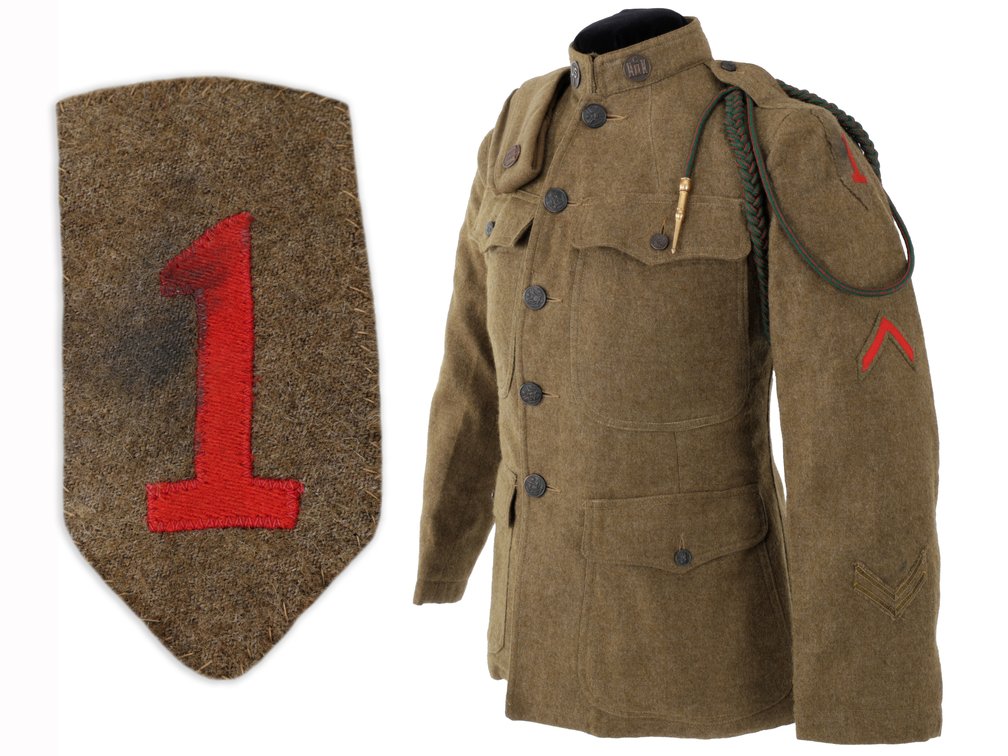
#284 • AEF 1st Division 1st Engineers Soldier's Coat with Croix-de-Guerre Fourragere
Part of Ghosts of the Great War (live auction by Bannerman Auctions)
Starting at $50.00
Status: Available
Category: United States
AEF 1st Division 1st Engineers Soldier's Coat with Croix-de-Guerre Fourragere. Enlisted issue olive drab wool 1917 pattern coat has "US / 1" and "C / Engineers" discs, Engineer PFC sleeve insignia, two overseas service chevrons, honorable discharge chevron, and 1st Division shoulder insignia. Left shoulder has a French Croix-de-Guerre Fourragere cord. No name or initials. No readily apparent mothing; one of the small epaulette buttons has detached and is now stowed in a pocket for safekeeping. Includes issue overseas cap with Engineer disc. The 1st Engineers, 1st Division, A.E.F., received two French Croix de Guerre citations with palm for its service during the First World War, qualifying the regiment for the French Croix de Guerre fourragère. The regiment's distinction was earned through its participation in major combat operations, rather than simply its general engineering support of the division. The first citation is particularly associated with the regiment's service in the Picardy sector, especially the fighting at Cantigny, May 28–30, 1918. The 1st Engineers had been constructing trenches, dugouts, defensive wire entanglements, and roads in the Montdidier area. During the attack on Cantigny, Company D advanced alongside the 28th Infantry and, after the town was captured, constructed defensive strongpoints under intense German artillery fire. The company worked for approximately five hours under bombardment and subsequently returned to the line as infantry reinforcements. Its losses were substantial: two officers were killed and another wounded at the beginning of the action, and the company suffered further casualties over the three days of fighting. The regiment's second major period of distinction was the Aisne-Marne offensive near Soissons, July 18–22, 1918. Here, the 1st Engineers demonstrated that they were capable of functioning as combat infantry as well as military engineers. During the opening two days of the advance, they served as infantry reserves, constructed and repaired roads, and assisted in moving tanks forward. As the fighting intensified, the regiment was committed almost entirely as infantry, with its companies assigned important offensive objectives and difficult defensive positions against German counterattacks. The regiment suffered 157 casualties during this operation. Its performance at Soissons was an especially significant demonstration of the regiment's combat effectiveness. Estimate $100 - $150