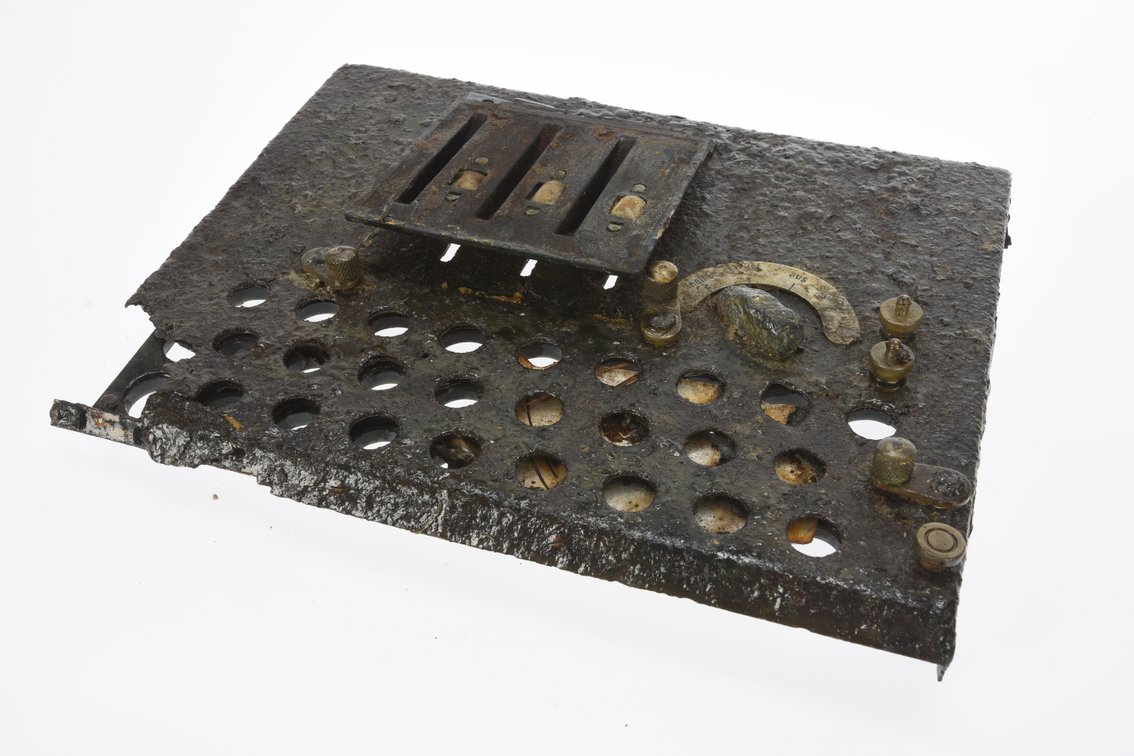
#240 • Relic Battlefield German M1 Enigma Machine Lampboard and Rotor Cover
Part of Spoils of Victory: Historical Memorabilia from a World at War (live auction by Bannerman Auctions)
High bid $1,800.00
Status: PASS
Relic Battlefield German M1 Enigma Machine Lampboard and Rotor Cover This artifact is the inner metal cover plate, specifically the rotor and lampboard (Lampenbrett) cover, from a three-rotor German Enigma I or M3 model encryption machine. Used extensively by the Wehrmacht and Kriegsmarine during World War II, the Enigma was an electromechanical cipher device that bedeviled Allied intelligence until its codes were famously broken at Bletchley Park. The upper portion of the plate features a hinged flap with three vertical slots, which originally allowed the operator to view the alphabet rings and adjust the thumbwheels of the machine's three cipher rotors. Directly below the rotor flap is the lampboard (Glühlampenfeld) cover, characterized by a staggered grid of twenty-six circular apertures arranged in the standard German "QWERTZ" typewriter layout (nine holes in the top row, eight in the middle, and nine in the bottom). When a key was pressed on the keyboard below, the electrical current would travel through the rotors and illuminate one of the corresponding light bulbs under this plate, revealing the enciphered or deciphered letter. Several of the original translucent lamp lenses remain within their respective sockets. To the right of the rotor flap, the power selector switch assembly is visible. It features a rotating knob, a curved metal escutcheon partially reading "aus" (off), and two adjacent metal posts. These posts served as screw terminals for attaching an external 4-volt power source (Sammler), while the dial allowed the operator to switch the internal battery power between "Hell" (bright), "Dkl" (dark), and "Aus" (off) to conserve the life of the delicate bulbs. During World War II, Enigma cipher machines were manufactured under strict military secrecy by a consortium of authorized German contractors. The most notable manufacturers included Chiffriermaschinen AG (the original patent holder), Heimsoeth & Rinke in Berlin, Konski & Krüger, and Ertel-Werk in Munich. Production was tightly controlled, and as the war turned against Germany, operators were ordered to destroy the devices rather than let them fall into Allied hands. The artifact is in excavated, relic condition, exhibiting profound oxidative deterioration, blistering, and heavy rust characteristic of long-term exposure to damp soil or a marine environment. The original black enameled finish is mostly lost, replaced by a thick crust of corrosion. Approximately fifteen of the twenty-six lamp covers are missing, exposing the cylindrical sockets below. The hinged rotor flap is frozen due to rust, and the brass and alloy components (such as the power switch and external terminals) show heavy patina and mineral encrustation. Consignor notes this was discovered near Stalingrad. In 1961, Nikita Khrushchev's administration changed the name of the city to Volgograd ("Volga City") as part of his program of de-Stalinization. We are pleased to offer this surviving piece of incredible historical importance to collectors for the first time. Estimate: $3,000 - 5,000