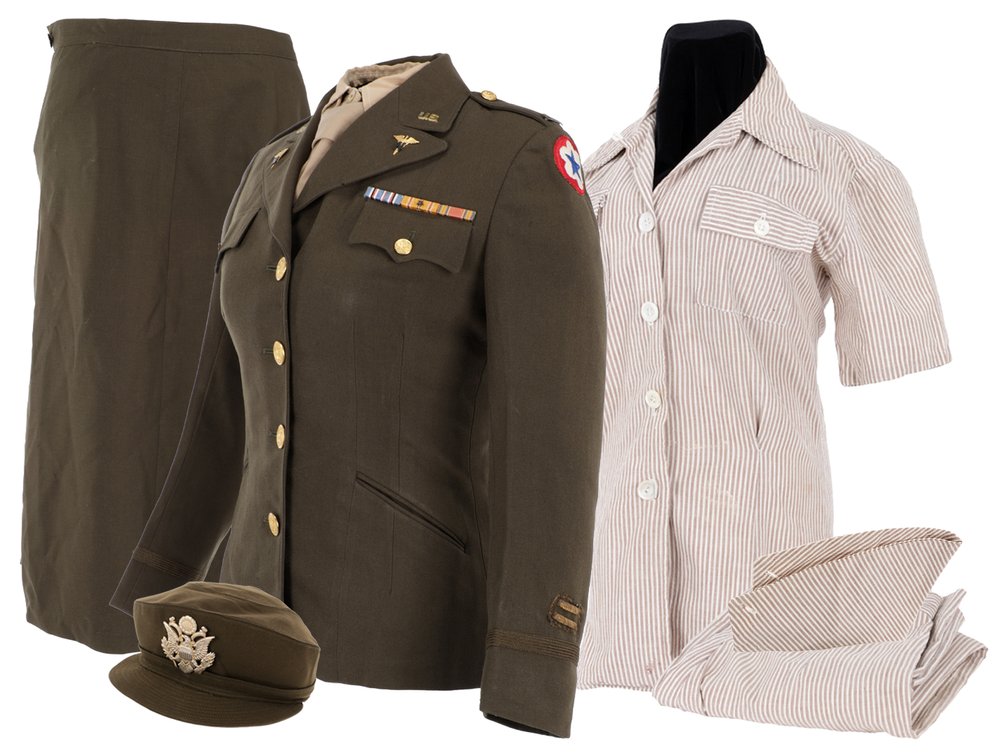
#83 • WWII US Army Nurse Service Dress & Seersucker Uniform Set: Attributed To A Pacific Theater Nurse
Part of Spoils of Victory: Historical Memorabilia from a World at War (live auction by Bannerman Auctions)
High bid $650.00
Status: PASS
Category: United States
WWII US Army Nurse Service Dress & Seersucker Uniform Set: Attributed To A Pacific Theater Nurse. Brown and white cotton seersucker US Army Nurse uniform shirt, pants and cap, as standardized in August 1943. Shirt and cap remain in very nice condition, pants have some white paint (or possibly cast plaster) residue in spots. Service dress uniform includes olive drab wool service coat with Pacific Ocean Areas and Army Service Forces shoulder sleeve insignias, First Lieutenant rank insignias, "U.S." and Army Nurse officer collar devices, and three medal ribbon bar with American Campaign, Pacific Campaign, and WWII Victory medal ribbon bars. Cuffs have Meritorious unit citation insignia and two overseas service bars. Insignia is secured by a mix of original WWII fasteners and post-war dimpled clutch replacements. There is a small repaired hole under the left epaulette, otherwise the coat remains in very good overall condition; includes matching skirt which has a few pinhead size holes, tan issue shirt and tie, and the olive drab wool Hobby hat with officer's eagle device. Ex. Don Dixon collection, with a notation in his records that this set was worn on duty by Phyllis J. Thompson (originally Phyllis J. Bunker) who served as a nurse in the 232nd General Hospital on Iwo Jima and Saipan in 1945. The 232nd General Hospital served extensively in the Pacific Theater, providing critical care to combat casualties during some of the war’s most intense campaigns. Deployed to the Mariana Islands, the unit established operations on Saipan in 1944, where it treated large numbers of wounded from the island’s brutal invasion and subsequent operations. In early 1945, elements of the 232nd moved forward to support the assault on Iwo Jima, where they operated under austere and hazardous conditions to receive and stabilize casualties evacuated from the front lines. Staffed by surgeons, nurses, and enlisted technicians, the hospital played a vital role in reducing mortality through rapid surgical intervention and postoperative care. Estimate $300 - $500