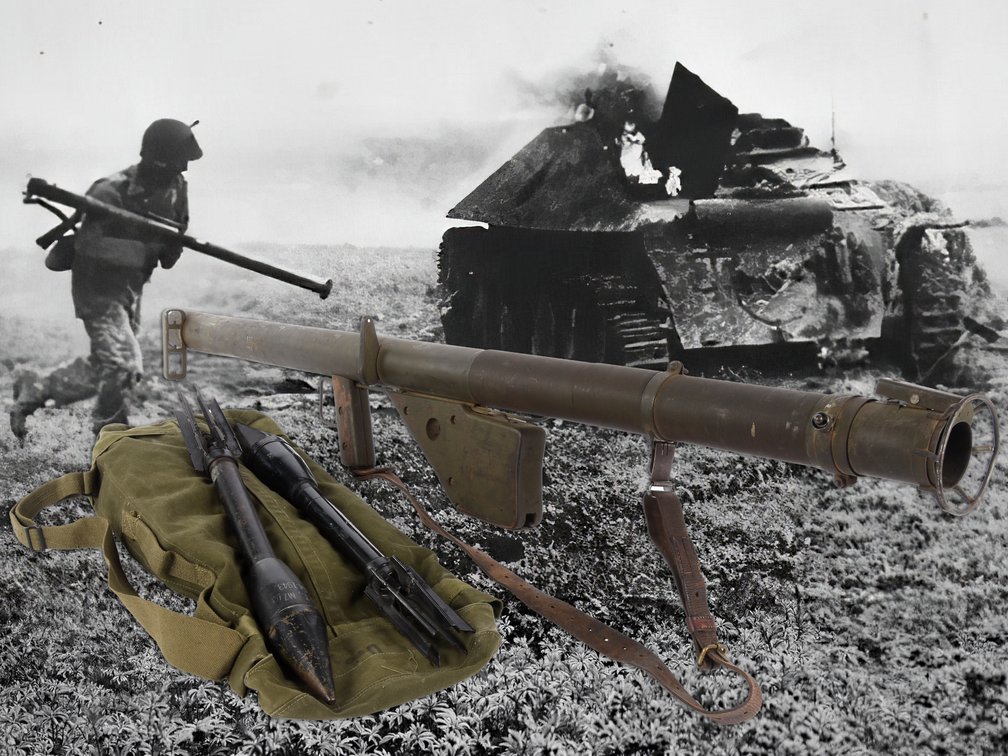
#56 • U.S. WWII M1A1 Rocket Launcher (Deactivated)
Part of Spoils of Victory: Historical Memorabilia from a World at War (live auction by Bannerman Auctions)
High bid $4,600.00
Status: SOLD
Category: United States
U.S. WWII M1A1 “Bazooka” Rocket Launcher (Deactivated) U.S. M1A1 2.36-inch Rocket Launcher (“Bazooka”), an improved early-war production variant introduced in 1942 as a refinement of the original M1. The launcher features the characteristic smooth steel tube retaining original olive drab finish, fitted with forward grip, shoulder rest, and sighting apparatus. The exterior lacks the exposed wiring and separate battery box associated with the earlier M1, reflecting the M1A1’s redesigned internal electrical system. A period leather sling is present. Also includes two inert practice rockets and a 1945 dated olive drab web rocket bag. This example retains much of its original wartime finish with scattered abrasions, finish loss, and light oxidation consistent with age and service use. The overall configuration is consistent with M1A1 production, representing the first major improvement in the series. The launcher has been deactivated in accordance with modern requirements, with a circular hole cut into the tube wall near the muzzle and a welded obstruction in the barrel, rendering it functionally and legally inert. The development of the Bazooka marked a pivotal advance in infantry anti-tank capability and emerged from pre-war American experimentation with shaped-charge munitions and rocket propulsion. Central to its creation were Dr. Robert H. Goddard, whose pioneering work in rocketry laid the technical foundation, and the U.S. Army Ordnance Department team led by Col. Leslie A. Skinner and Lt. Edward G. Uhl, who adapted rocket propulsion to deliver a high-explosive anti-tank (HEAT) warhead. The resulting 2.36-inch rocket projectile employed the Monroe effect, focusing explosive energy into a concentrated jet capable of penetrating armor independent of velocity—an innovation that allowed a relatively slow-moving projectile to defeat contemporary tank protection. The original M1 launcher, standardized in 1942, proved immediately effective but suffered from reliability issues stemming from its exposed wiring and separate battery box ignition system, which was vulnerable to damage and environmental conditions. The improved M1A1 variant quickly followed, incorporating internalized wiring, better insulation, and a simplified, more robust electrical system. These refinements greatly enhanced durability and field reliability, making the M1A1 a far more practical weapon in combat conditions. The nickname “Bazooka” is widely attributed to its resemblance to a whimsical, tubular musical instrument popularized by radio comedian Bob Burns in the 1930s. Soldiers noted the similarity between the launcher’s long tube and Burns’ improvised instrument, and the name quickly became the informal (and ultimately enduring) designation for the weapon. In combat, the Bazooka proved highly effective against early- and mid-war Axis armored vehicles and fortified positions, particularly in North Africa and the Pacific. As enemy armor improved, its effectiveness against heavily armored German tanks diminished, prompting continued development. The M1A1 was soon superseded by the improved M9 series beginning in 1943, which introduced a collapsible two-piece tube, improved sighting systems, and further refinements to the ignition system. Despite its relatively brief production life, the M1A1 represents a critical evolutionary step in the development of portable anti-tank weapons and remains one of the most iconic infantry arms of the Second World War. Estimate $3,000 - $4,000