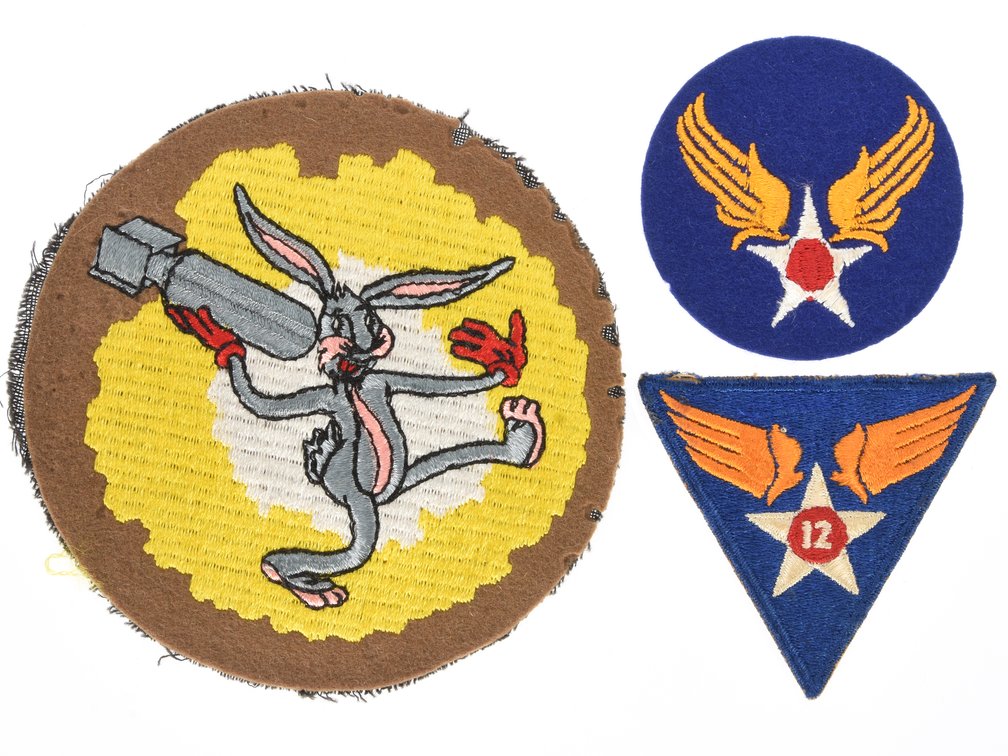
#20 • WWII AAF 486th Bombardment Squadron Insignia
Part of Spoils of Victory: Historical Memorabilia from a World at War (live auction by Bannerman Auctions)
Starting at $100.00
Status: PASS
Category: United States
WWII AAF 486th Bombardment Squadron Insignia. Obtained from the estate of a gentleman who served in this squadron. The 486th is a Warner Brothers insignia, 12.5cm diameter, depicts Bugs Bunny with red gloves, tossing a bomb. Insignia is embroidered on khaki-olive wool felt, with a black cotton backing cloth. Has several moth nips around the edges of the felt field. Includes an AAF winged star embroidered on felt shoulder insignia, and a 12th Air Force cut edge issue shoulder insignia, both of which are original, but were added to the set to complete the display. The insignia used by the 486th Bombardment Squadron was one of those created courtesy of Warner Brothers. The studio was among several film studios accused in early 1941 of actively promoting US intervention in the European war with the release of the films Confessions of a Nazi Spy (1939) and Sergeant York (1941). During a senate hearing in September of that year, Harry M. Warner proudly declared: "I abhor and detest every principle and practice of the Nazi movement... I am ready to give myself and all of my personal resources to aid in the defeat of the Nazi menace to the American people." One way that studios like Warner Brothers and Disney supported the US military was donating the skills of their artists in the design of unit insignia, a service used extensively by Army, Navy, and Marine Corps aviation units in particular. The 486th was a B-25 Mitchell medium bomber squadron, deployed to IX Bomber Command in Egypt in March 1943, then reassigned to Mediterranean Theater of Operations, and to XII Bomber Command in Tunisia. They supported Allied ground forces in Tunisian Campaign; participated in Invasions of Sicily and Italy during 1943, supporting Allied ground forces with tactical bombing of enemy targets. Participated in liberation of Corsica during the spring of 1944, then returned to Italy engaging in attacks on enemy ground forces and targets in the Po Valley during the spring of 1945. Personnel demobilized in Italy during summer of 1945; squadron returned to the United States, being prepared for deployment to Pacific Theater for use as a tactical bomb squadron in the planned Invasion of Japan. Japanese capitulation led to squadron's inactivation in November 1945. Estimate $200 - $300