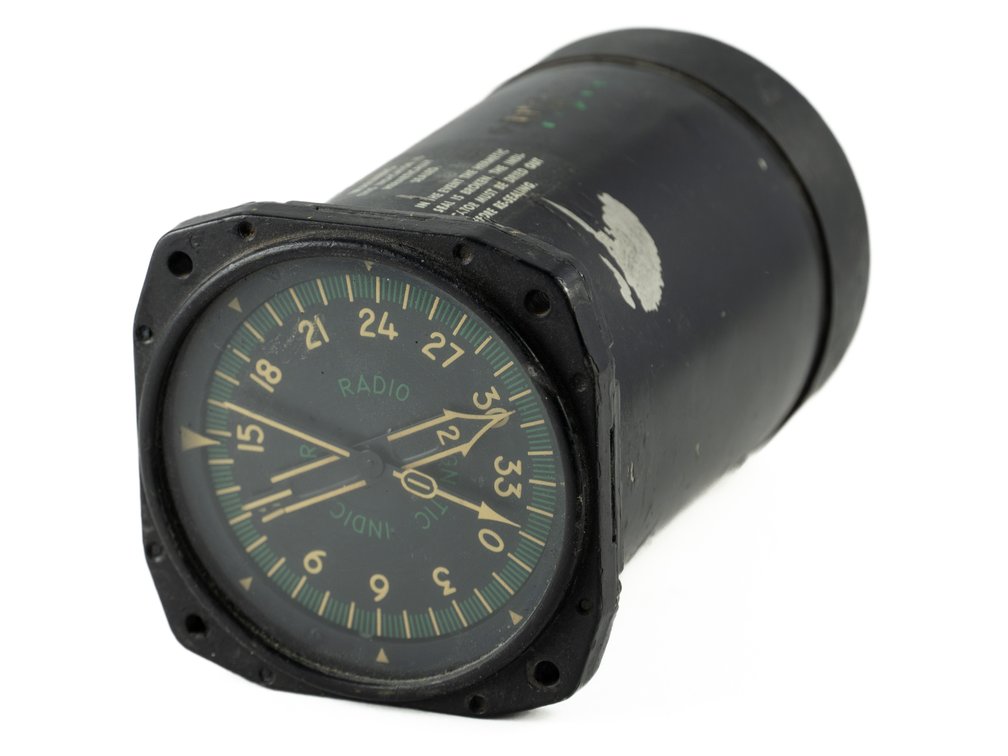
#110 • Cold War Era Bendix ID-250/ARN Radio Magnetic Indicator (RMI)
Part of Decoding Doomsday: Cold War Military Tech (live auction by Bannerman Auctions)
Starting at $75.00
Status: PASS
Cold War Era Bendix ID-250/ARN Radio Magnetic Indicator (RMI) A Cold War-era ID-250/ARN Radio Magnetic Indicator (RMI), a sophisticated flight instrument developed by the Bendix Radio Division. Designed to provide pilots with a unified navigational display, the RMI integrates a remotely-slaved magnetic compass with bearing information from two separate radio sources, typically an Automatic Direction Finder (ADF) and a Very High Frequency Omnidirectional Range (VOR) receiver. The dual-needle design allows for simultaneous tracking of two navigation beacons, facilitating triangulation and position-fixing without the need for manual mental arithmetic. The compass card automatically rotates to show the aircraft's current magnetic heading at the top index, while the needles point directly toward the selected ground stations. Historically, the ID-250 series was a cornerstone of military aviation cockpits during the 1950s and 1960s. It was a standard-issue component in iconic aircraft such as the Boeing B-52 Stratofortress, the North American F-100 Super Sabre, and the Lockheed C-130 Hercules. Perhaps most famously, it served as a primary navigation tool in the Bell UH-1 'Huey' and AH-1 'Cobra' helicopters during the Vietnam War. The instrument's 'hermetically sealed' construction was essential for maintaining calibration and preventing moisture ingress during the high-altitude and tropical humidity cycles typical of global military operations. Crafted with the precision required for aeronautical navigation, the unit features a black-finished aluminum housing and a glass-shielded dial. The dial markings use a high-visibility cream and pale green palette, designed to be legible under varied cockpit lighting conditions, including red-lit night operations. Estimate: $150 - 250