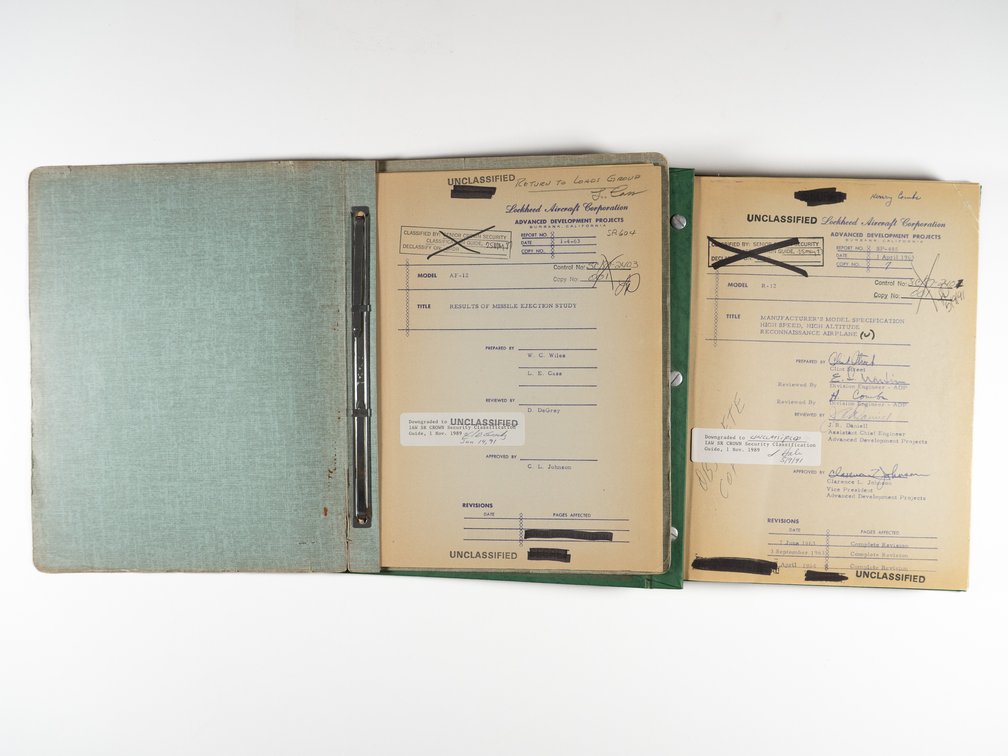
#54 • Lockheed "Skunk Works" SR-71 Technical Development Reports: Models AF-12 and R-12
Part of Decoding Doomsday: Cold War Military Tech (live auction by Bannerman Auctions)
High bid $750.00
Status: Sold
Lockheed "Skunk Works" Technical Development Reports: Model AF-12 (SP-604) and Model R-12 (SP-485) The Lockheed SR-71 Blackbird remains, more than sixty years after its first flight, the pinnacle of aviation achievement, a machine that flew faster and higher than any air-breathing aircraft in history. Offered here is a rare opportunity to acquire the foundational engineering "DNA" of this program: two original technical reports from Lockheed’s "Skunk Works". These documents capture the Blackbird family at its most critical evolutionary juncture (1962–1963), as the CIA’s "Project Oxcart" (the A-12) was being adapted into specialized variants for the United States Air Force. The first report, "SP-604 (January 1963)", concerns the "Model AF-12", the prototype designation for what would become the YF-12A interceptor. This study tackles one of the most harrowing engineering challenges of the era: the ejection of an AIM-47 Falcon missile at Mach 3. At such extreme speeds, the shockwaves and aerodynamic pressures are immense. The document contains raw oscillograph traces, the "heartbeat" of the test, capturing the mechanical stresses and ballistic trajectories that allowed Lockheed to master weapon delivery in the stratosphere. The second report, "SP-485 (April 1963)", is arguably the more historically significant of the pair. It outlines the "Model R-12", the internal Lockheed designation for the aircraft that would be immortalized as the "SR-71 Blackbird". This is the "Manufacturer's Model Specification," the master blueprint for the aircraft's mission. It details the intended flight envelope (Mach 3.2+ at 80,000+ feet) and contains extraordinary blue-ink fold-out schematics. These blueprints reveal the "Inboard Profile," showing the internal arrangement of the sensor bays and mission equipment that would allow the Blackbird to overfly denied territory with impunity. Both documents bear the bold, facsimile signature of Kelly Johnson. As the leader of the Skunk Works and perhaps the greatest aircraft designer of the 20th century, Johnson’s personal approval on these specific reports marks them as vital artifacts of the Cold War. While declassified versions of these reports may exist in government archives, original physical copies with high-fidelity blueprints are almost never seen in the private market. They represent the intersection of high-stakes espionage, pioneering physics, and the mid-century "Space Age" aesthetic. Estimate: $2,000 - 3,000