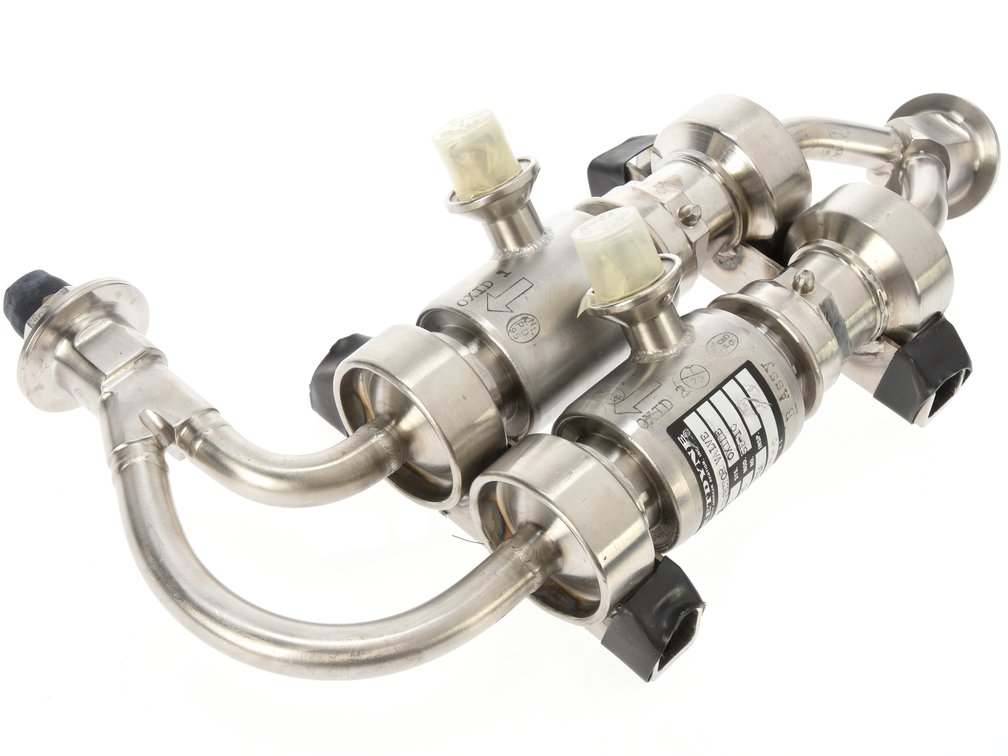
#86 • Prototype Lunar Module Descent Engine (LMDE) by Rocketdyne c. 1964
Part of Decoding Doomsday: Cold War Military Tech (live auction by Bannerman Auctions)
High bid $750.00
Status: Sold
Prototype Lunar Module Descent Engine (LMDE) by Rocketdyne c. 1964 Helium Injector Valve assembly, manufactured by the Rocketdyne Division of North American Aviation. The assembly is designated by part number 557700, serial number 9393610, and model SE-10. Historically, the SE-10 engine was a developmental rocket engine concept evaluated by Rocketdyne as a potential lunar module descent engine during the Apollo program, competing with designs from other aerospace entities. The use of helium injection was a specialized technique explored to enable deep throttling of rocket engines by modifying propellant density within the lines, a critical requirement for controlled lunar landings. The component displays exceptional mid-century aerospace craftsmanship, featuring high-quality stainless steel piping, TIG-welded joints, and precise machined fittings. The assembly is marked with various inspection stamps, including 'ANA 287' and date codes (11-7-64), indicating rigorous quality control standards typical of the Cold War-era space race. The integration of complex fluid manifolds and valve structures highlights the sophisticated engineering challenges involved in managing cryogenic propellants and high-pressure gas systems for space flight applications. Rocketdyne was a major American rocket engine manufacturer, originally a division of North American Aviation. It was instrumental in the United States' space program, developing iconic engines such as the F-1 and J-2 for the Saturn V launch vehicle. Known for its rigorous engineering standards and innovation in liquid propulsion, Rocketdyne remains synonymous with the development of the high-thrust technology, and conversely, its beautifully engineered attempt see here to get man safely to the lunar surface. The artifact is in very fine, preserved, test-stand condition. All identification labels are intact, legible, and firmly attached. The critical interface ports are protected by "CaPlugs"-branded plastic caps and the internal mechanisms have been protected from contaminants since its production in 1964. Some very light superficial scuffing is present on the exterior housing, consistent with standard shop handling during assembly. The item comes with its original packaging which was removed for presentation and identification purposes for the first time in April, 2026. Estimate: $1,500 - 2,500