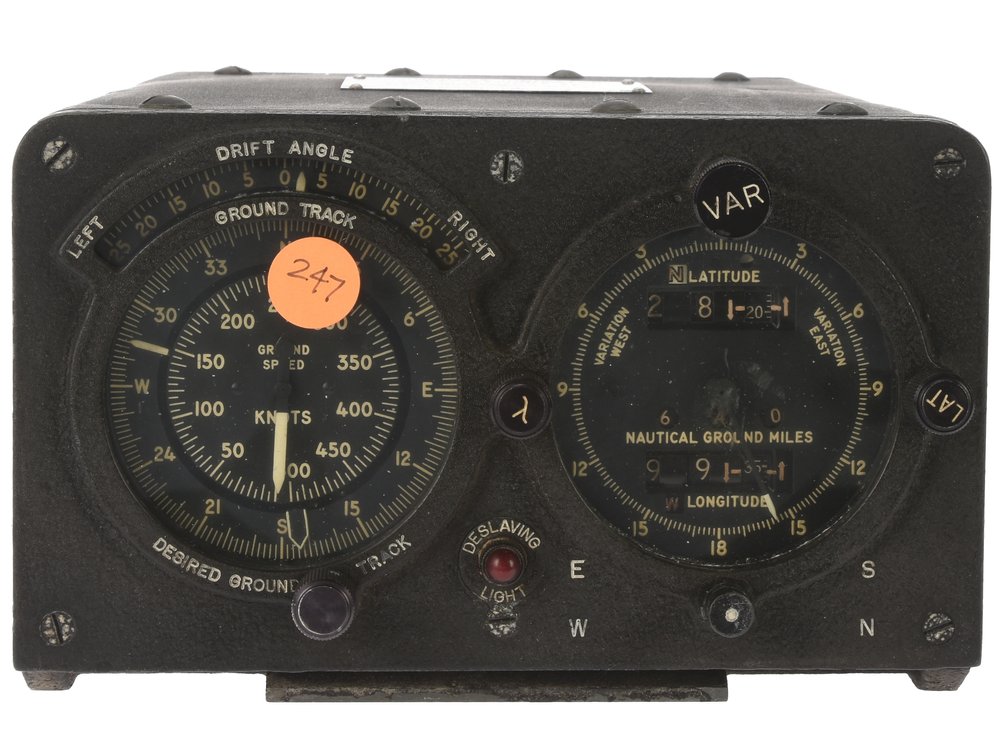
#11 • Experimental Prototype XN-1 Navigational Computer
Part of Decoding Doomsday: Cold War Military Tech (live auction by Bannerman Auctions)
High bid $200.00
Status: Sold
Experimental Prototype XN-1 Navigational Computer Exceedingly rare, experimental XN-1/APN-67 Navigational Computer-Indicator, representing a pivotal moment in the early Cold War evolution of autonomous airborne navigation. Designed by Ryan Aeronautical and manufactured by Kollsman Instrument Corporation, the APN-67 was a continuous-wave Doppler radar navigation system that freed naval aviators from relying on ground reference points or external aerological data. The "XN-1" designation is critically important; according to the Joint Army-Navy Nomenclature System, "XN" stands for "Experimental, Navy-designed," and "1" indicates the first developmental series. This proves the unit was an early prototype rather than a mass-production model. The front panel features two primary electromechanical dials: the left integrates ground track, drift angle, and ground speed, while the right provides real-time latitude, longitude, and nautical ground miles traveled. Prototypes of the APN-67 were vigorously tested aboard the P-2 Neptune and ultimately found significant historical use during "Project Magnet," an intensive Navy operation utilizing R5D Skymasters to globally map the Earth's magnetic field. Circa 1952. The instrument survives in very good, authentic condition commensurate with its age and experimental military service. The black crinkle-finish aluminum casing exhibits moderate edge wear, scuffing, and minor paint loss along the top edges and corners, consistent with rack-mounting. The primary instrument dials and glass faces remain intact and highly legible, with a small orange adhesive inventory sticker (bearing handwritten text) affixed to the left dial's glass. The original luminescent markings are preserved with an appropriate aged patina. The rear panel retains eight aluminum multi-pin electrical connectors (J-1201 through J-1208) showing heavy surface oxidation on the threads, with a single red plastic dust cap remaining. The manufacturer's data plate is securely riveted and clearly legible. Founded in 1928 by Paul Kollsman, the Kollsman Instrument Corporation became a dominant manufacturer of precision aircraft instruments. The company is historically significant for inventing the 'Kollsman Window' for altimeters, which revolutionized flight safety and navigation by allowing pilots to calibrate their altitude based on local barometric pressure, becoming a standard feature in all modern aviation. Estimate: $400 - 600