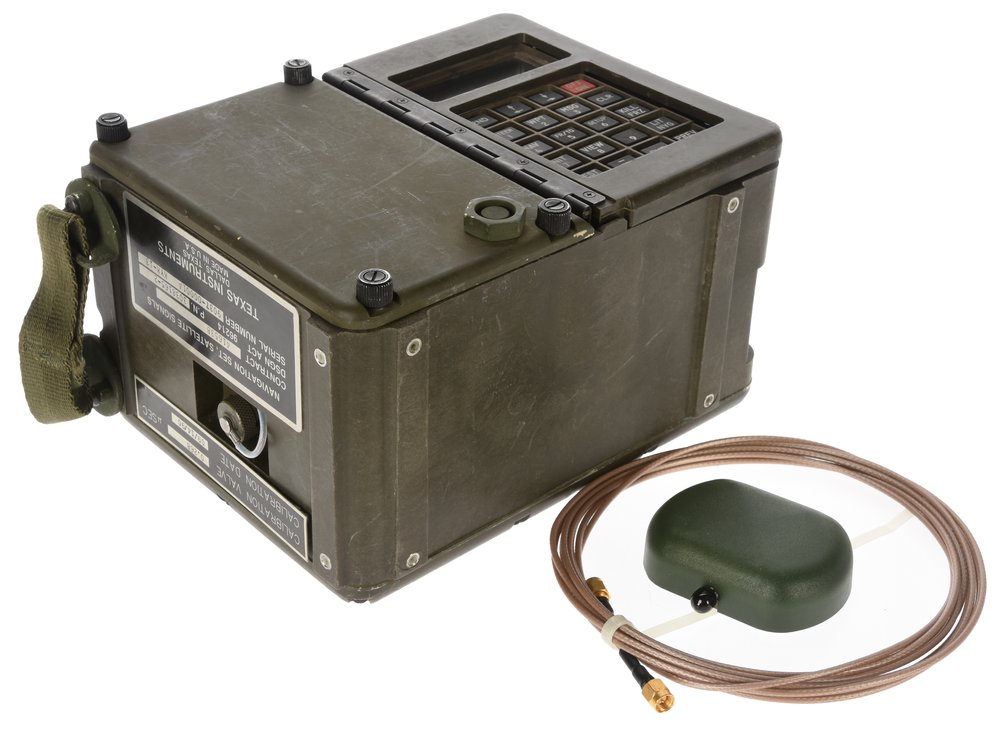
#8 • Early Navstar GPS Receiver Set
Part of Decoding Doomsday: Cold War Military Tech (live auction by Bannerman Auctions)
High bid $100.00
Status: Sold
Early Navstar GPS Receiver Set The Navstar GPS Receiver Set was a military-grade navigation receiver component manufactured by Texas Instruments, likely part of a manpack GPS system developed during the early operational phases of the Navstar Global Positioning System. The unit, labeled as a 'Navigation Set, Satellite Signals,' reflects the pioneering era of satellite navigation technology when Texas Instruments was at the forefront of developing portable receivers for both geodetic and military applications. Its robust, olive-drab casing and industrial-style keypad interface were designed for harsh field environments, representing the transition from massive, rack-mounted equipment to the earliest deployable man-portable systems. Also included is a specialized low-profile GPS signal antenna, intended to be used in conjunction with the primary receiver unit. The antenna is connected via a coaxial cable, a configuration typical for military radio and navigation sets where the antenna needed to be placed for optimal line-of-sight to orbiting satellites while the main receiver unit remained with the operator. This combination of components highlights the modular nature of 1980s military communications and navigation technology. The main unit shows signs of active service life, with expected wear on the external olive-drab finish, including minor scuffs and patina consistent with field use. The nomenclature plate remains legible, though some light oxidation may be present on metallic fittings. The keypad appears intact, with no obvious signs of catastrophic damage. The antenna component appears well-preserved, with the casing surface showing light superficial wear. The associated coaxial cable and connectors appear complete, though the internal state of the wiring cannot be verified without technical testing. Throughout the 1970s and 1980s, Texas Instruments was instrumental in developing early microprocessors and pioneering commercial and military GPS receiver technology, transitioning from experimental analog navigation to advanced digital signal processing. Estimate: $200 - 400