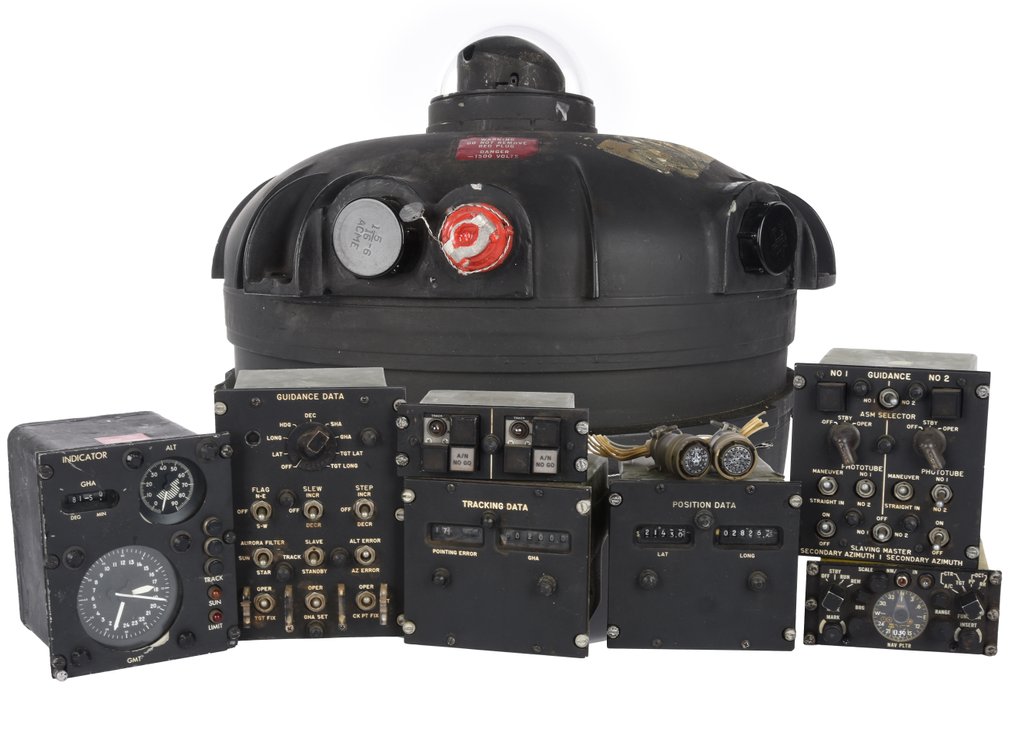
#17 • B-52 MD-1 Astro Tracker
Part of Decoding Doomsday: Cold War Military Tech (live auction by Bannerman Auctions)
Starting at $750.00
Status: No sale
B-52 MD-1 Astro Tracker The MD-1 Automatic Astro Compass was a critical piece of Cold War-era avionics, designed for long-range navigation in aircraft such as the Boeing B-52 Stratofortress. Acting as an electronic, automated sextant, this star tracker allowed navigators to determine precise geographical positioning by automatically sighting celestial bodies, a necessary capability before the advent of reliable GPS. The tracker unit features a high-precision optical system housed within a pressurized, hermetically sealed shell, topped with a distinctive glass dome through which it tracked stars even during daylight hours. The accompanying array of control and display panels—including 'Guidance Data', 'Tracking Data', 'Position Data', and 'Secondary Azimuth' units—formed the interface for the navigator. These electromechanical components worked in tandem with the astro tracker to process celestial observations and output critical flight path information, such as true heading and ground position. The panels reflect the rugged, specialized design language of mid-century military aerospace hardware, utilizing tactile knobs, analog dials, and labeled instrumentation designed for high-stress operational environments. Visible on the primary unit are several maintenance tags from 'OCAMA' (Oklahoma City Air Materiel Area), confirming that this specific hardware underwent overhaul and acceptance testing as late as August 1973. The warning labels explicitly caution against the removal of the 'Red Plug', which shielded high-voltage components (-1500 Volts) within the tracker assembly. The set shows significant signs of flight/military use, including scuffing, chipped paint on the control panel faces, and atmospheric wear consistent with service in an aeronautical environment in addition to long-term storage. The main tracker housing has several adhesive labels and maintenance records from the 1970s that are partially degraded though mostly legible. The electrical connectors exhibit minor oxidation and dust accumulation, and there are visible remnants of sealant or tape around the optical assembly and casing interfaces. Despite this the physical integrity of the instruments are intact. The instrument incorporates a star tracker that follows a predetermined star, planet, or the sun; it will even work down to third magnitude stars at night. Its robust industrial design coupled with such delicate instrumentation is an interesting combination that makes for a wonderful display piece. A star simulator that had 3 "stars" in known locations that could be used for testing and calibrating the MD-1 system. When testing at night, brighter "magnitude 1" starlights were used in the testing collimator since they were easier to lock onto. Estimate: $1,500 - 2,500