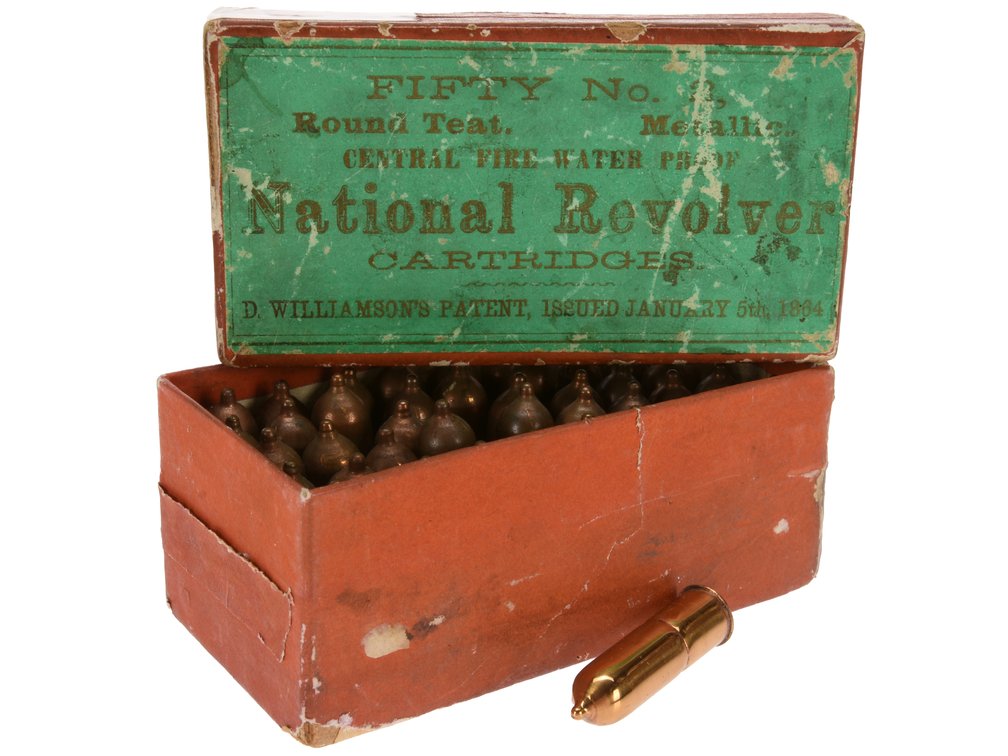
#54 • .32 Teat-Fire National Arms Co. Revolver Cartridge Box With Partial Contents
Part of To Arms! Relics of the American Civil War (live auction by Bannerman Auctions)
High bid $600.00
Status: SOLD
Category: United States
.32 Teat-Fire National Arms Co. Revolver Cartridge Box With Partial Contents. Lot consisting of an original pasteboard box for National Arms Co. .32 caliber teat-fire revolver cartridges, retaining its green top label reading “Fifty No. 1 Round Teat Metallic Central Fire-Water Proof National Revolver Cartridges,” with reference to D. Williamson’s patent. The box is open and shows moderate wear consistent with age, including edge chipping, surface abrasions, and minor losses at the corners of the label, but remains structurally sound and largely legible. Interior contains 46 cartridges arranged in the original configuration, most exhibiting a uniform darkened patina from age, with one example showing heavier oxidation. Accompanied by an additional example cartridge for display next to the box that has had its patina polished away. Teat-fire cartridges represent a distinctive and short-lived American approach to early metallic cartridge development, produced primarily during the early 1860s through the later years of the Civil War. Covered under the Williamson patent and closely associated with Moore’s Patent Firearms Co. and the National Arms Co. of Brooklyn, this system employed a copper case with a small projecting hollow nipple or “teat” at the base containing the priming compound. In use, cartridges were inserted into a fully bored-through cylinder from the rear, with the projecting teat exposed at the back of the cylinder and struck directly by the hammer to ignite the charge. This design differed fundamentally from both rimfire and emerging centerfire systems, and, while mechanically simple, left the priming element vulnerable to damage and made cartridges somewhat delicate in handling. The development of this system was closely tied to patent restrictions of the period, particularly the Rollin White patent controlled by Smith & Wesson, which limited the manufacture of conventional bored-through cylinder revolvers using rimfire ammunition. Teat-fire cartridges provided a practical, if temporary, workaround, allowing other American makers to produce self-contained cartridge revolvers during a period of high demand. National Arms was among the principal producers of both revolvers and ammunition of this type, manufacturing primarily .30, .32, and .38 caliber pocket revolvers; the firm was acquired by Colt in 1865, which briefly continued production of teat-fire arms as an interim measure. Unlike the contemporaneous pinfire system, which saw widespread adoption in Europe, teat-fire cartridges remained largely confined to the United States and were produced for only a limited period. With the expiration of key patents in the late 1860s and the rapid improvement of rimfire and centerfire designs, the system was quickly rendered obsolete. As a result, surviving original boxes with contents, even when partial, are increasingly scarce and represent an important and illustrative stage in the evolution of metallic ammunition. Estimate: $240 - $350