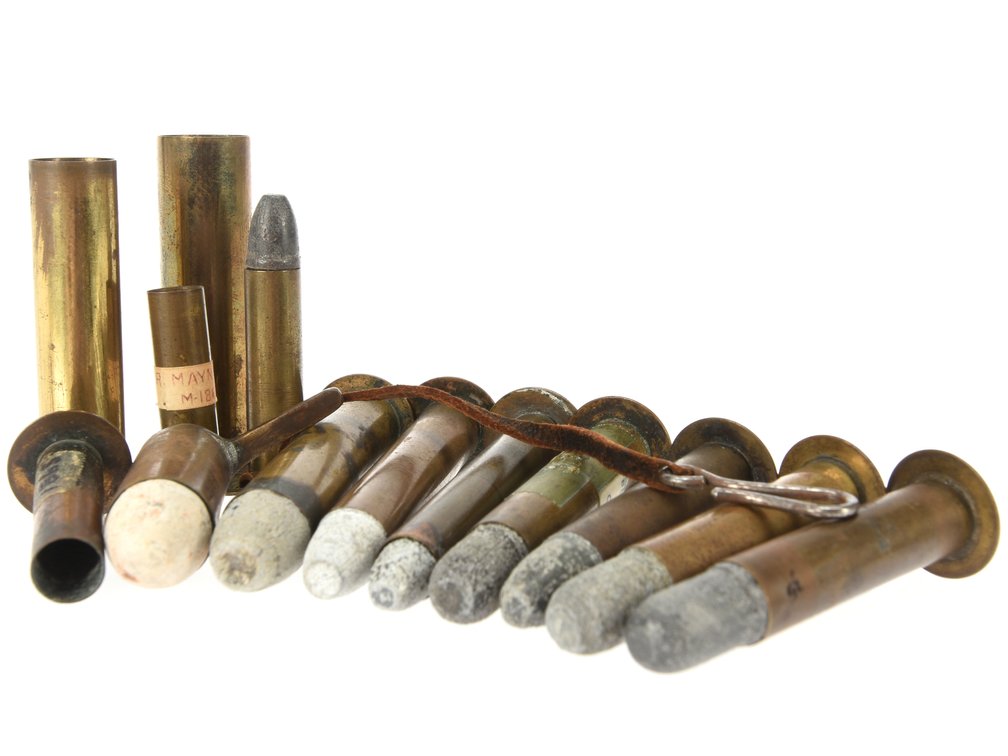
#97 • Maynard Rifle And Carbine Cartridge Lot Including Experimental Types
Part of To Arms! Relics of the American Civil War (live auction by Bannerman Auctions)
High bid $800.00
Status: SOLD
Category: United States
Maynard Rifle And Carbine Cartridge Lot Including Experimental Types. A representative and technically interesting group of metallic cartridges and related cases for the Maynard system, spanning multiple calibers and configurations associated with both early experimentation and later commercial development. The Maynard system, designed by Dr. Edward Maynard and adopted in limited quantities before and during the Civil War, is notable for its reusable brass cases with external priming via tape primer or percussion cap, and its continued postwar evolution into a wide range of sporting and target calibers. The lot includes examples labeled as .35/30, .35/70, .40/40, .40/60, .40/70, .50/100, .55, .58 musket, and .64 shot, representing both rifle and carbine applications. Several cartridges exhibit the characteristic wide, thin rim and straight-walled brass construction typical of Maynard production. Bullet types vary, including round nose and sharp nose forms, with both copper base riveted and non-riveted variants noted. Particularly noteworthy is the inclusion of a .58 Maynard musket cartridge identified as the “mule ear” type associated with the 1857 U.S. trials, an early experimental configuration seldom encountered. Also present is a scarce .35/30 “stopper case,” retaining its lanyard, indicative of specialized or experimental use. Condition varies, with most pieces showing expected age patina, oxidation, and handling marks. Some cases are empty, while others retain projectiles; several exhibit staining or surface corrosion consistent with long-term storage. The group is mounted in a modern foam display with typed identification labels, likely assembled for study or exhibition purposes. Overall, a diverse and educational assemblage illustrating the breadth of Maynard cartridge development from antebellum experimentation through later 19th-century sporting use. Estimate: $300 – $500