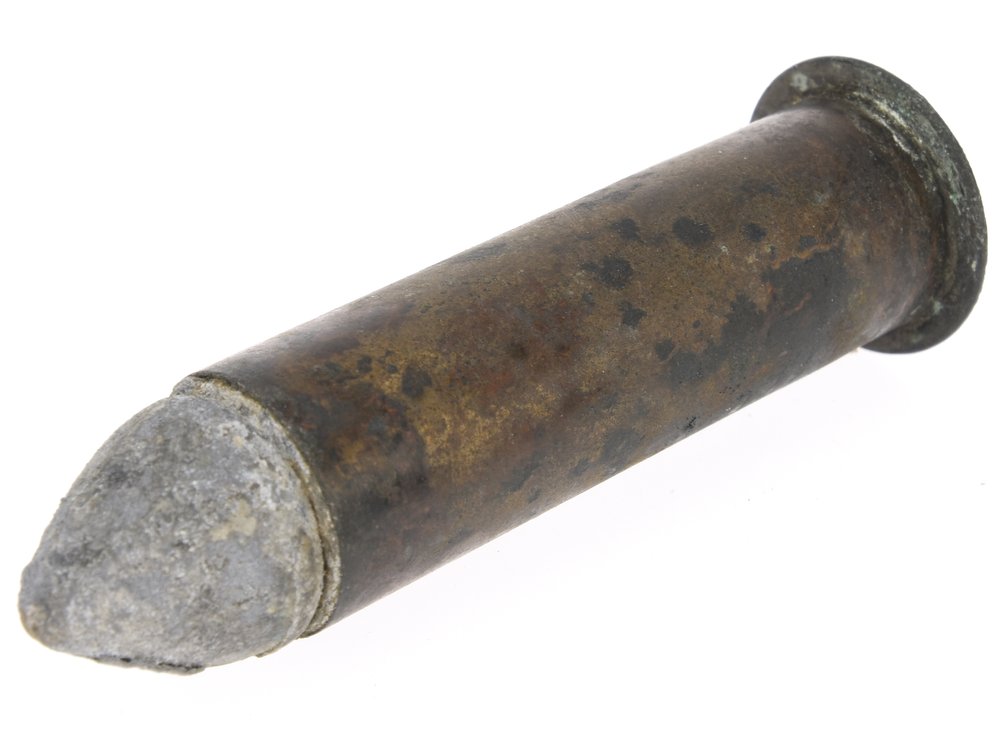
#275 • .56 Cal Billinghurst-Requa Battery Gun Cartridge
Part of To Arms! Relics of the American Civil War (live auction by Bannerman Auctions)
High bid $65.00
Status: SOLD
Category: United States
.56 Cal Billinghurst-Requa Battery Gun Cartridge 56 caliber metallic round for the Billinghurst-Requa Battery Gun. The cartridge features a straight-walled brass case with pronounced rim and seated conical bullet, exhibiting scattered oxidation, surface patina, and areas of age-related discoloration. The Billinghurst-Requa Battery Gun, patented just prior to the American Civil War, was an early volley-fire weapon designed by Josephus Requa and William Billinghurst as a means of delivering rapid, concentrated fire from a multi-barrel arrangement. The weapon was operated by means of a manually actuated sliding breech mechanism into which a full complement of cartridges was inserted simultaneously, each round corresponding to an individual barrel. Once in battery, a single motion of the firing bar or lock plate discharged the entire row of cartridges at once, functioning in effect as a controlled volley. Although trials demonstrated its mechanical effectiveness, the U.S. Ordnance Department declined to adopt the system, citing concerns over the design’s reliance on specialized ammunition and its high rate of consumption as well as limited tactical flexibility relative to conventional artillery and infantry arms. Despite this official rejection, approximately fifty guns were produced through private funding and saw limited but documented service with Union forces. Their use is best attested in siege and defensive operations, including actions at Port Hudson, Charleston (notably Fort Wagner and Fort Sumter), Cold Harbor, and during the Petersburg Campaign, where they were employed primarily to suppress sharpshooters and support trench warfare activities. While never widely issued, the Billinghurst-Requa gun represents an important transitional development in rapid-fire weaponry, bridging the gap between traditional artillery practices and later machine gun systems. Estimate $80 - $150