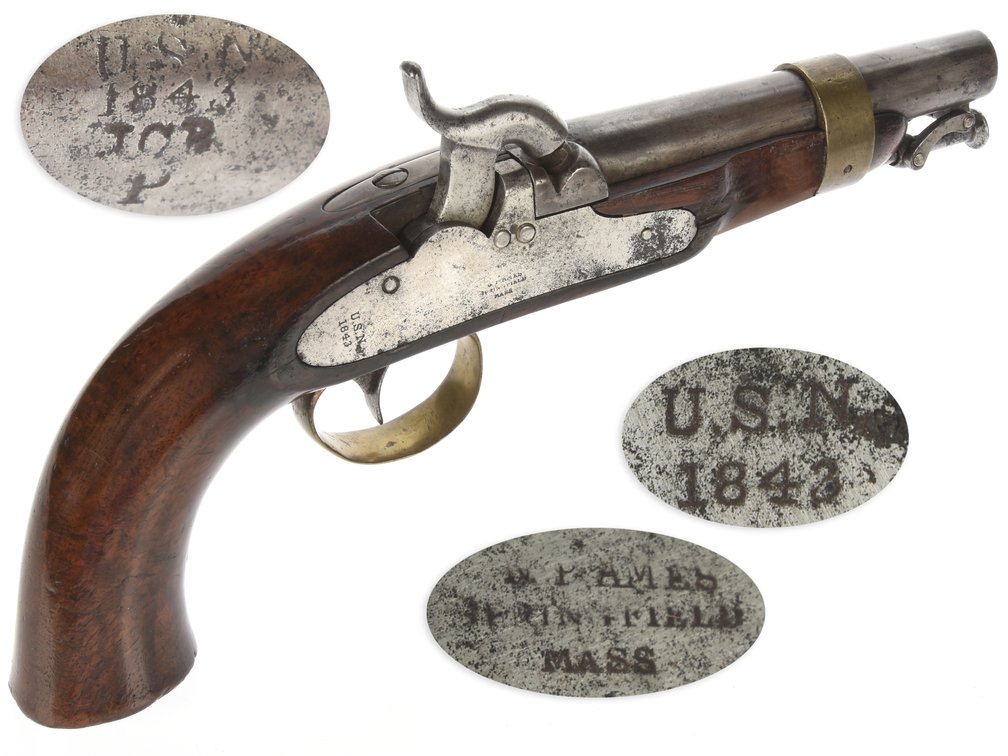
#143 • Mexican War US Navy Model 1842 'Box Lock' Percussion Pistol
Part of To Arms! Relics of the American Civil War (live auction by Bannerman Auctions)
High bid $750.00
Status: SOLD
Category: United States
Mexican War US Navy Model 1842 'Box Lock' Percussion Pistol. .54 caliber smoothbore pistol has a single brass barrel band and a captive swivel ramrod; lock is distinctive for its use of a hammer mounted on the interior of the lock plate hence the term 'inside lock' or 'box lock'. The lock is marked in three lines under the hammer "N.P. AMES / SPRINGFIELD / MASS" and at the heel "U.S.N. / 1843". Barrel is marked "U.S.N. / 1843 / J.C.B. / P". The inspector is Joseph C. Bragg, who was one of four civilian sub-inspectors assigned to assist Navy Lieutenant Joseph Lanman in the inspection of these pistols during the period of 1843 to 1845. Bragg inspected the order for 144 of the pistols for the U.S. Revenue Cutter Service with his initials on the barrel and in a cartouche on the stock; on the Navy pistols his mark appears on the barrel only. In the case of this pistol a cartouche is no longer visible on the stock flat. There is damage on the stock with a small chip forward of the lock that is connected to a fracture visible along the bottom nearer the lock than the trigger guard, and another starting at the bolster screw and moving back along the flat; both of these look to have been very well repaired at some point as there is but a very thin dark line on both. There are only slight traces of the original lacquer browned finish on the barrel; ramrod has some dark 'salt-and-pepper' pitting, as does the lock in several places. Action is not what I would describe as 'crisp', but it is functional. The stock appears to have been lightly sanded and lacquered, likely when the small repairs were made. II These were the first general issue US military pistol to make use of the percussion ignition system. The design draws heavily from the British Model 1842 Naval Pistol, to include the box lock feature and the flat butt, which was a very distinct departure from the 'club butt' utilized by most previous designs. This is no coincidence - Nathan P. Ames, Jr. was commissioned by the US government to visit the arsenals and arms manufacturers of Europe during this key time when most were transitioning from flint to percussion technologies. He was clearly impressed by the design of the British pistol. Arms scholars suggest that this created a more streamlined profile, allowing a sailor to tuck one (or more) of these into his waistband or a belt for use in boarding a hostile vessel, or repelling an enemy attempting the same, without need for the clunky belt hook that had previously characterized sea service pistols. Ames delivered 300 of these to the US Navy in 1842, and an additional 1,700 over the next three years, with a small number of those going to the US Revenue Cutter Service. A second contract for 1,200 pistols of this pattern was awarded to Henry Derringer in 1845. Estimate $900 - $1200