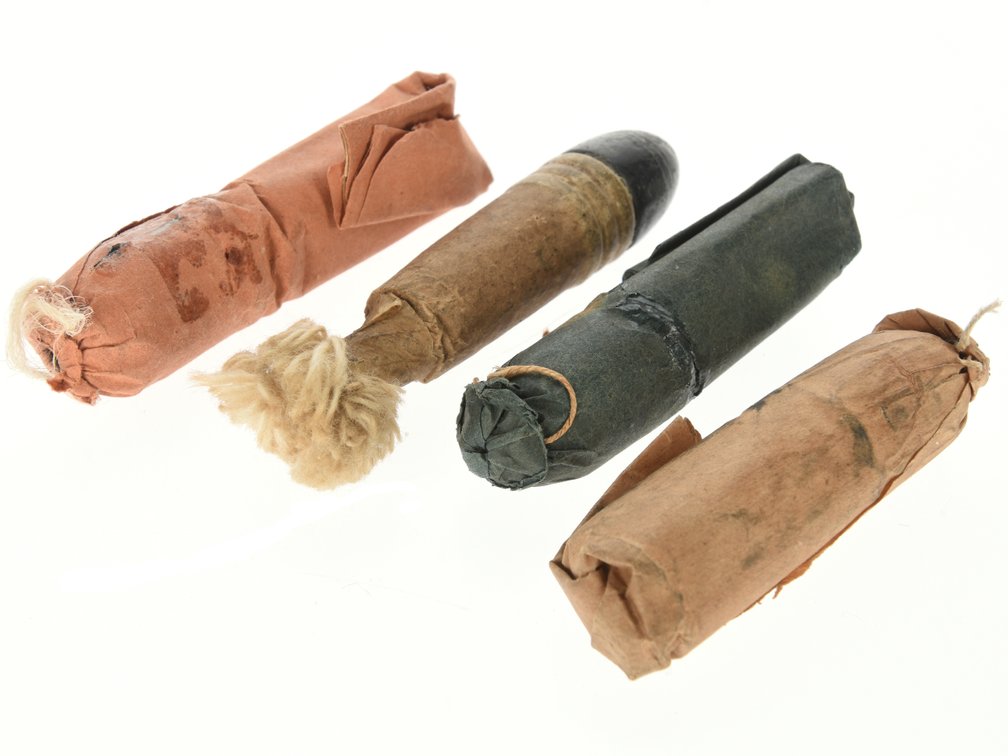
#125 • .58 Caliber Rifle-Musket Cartridge Lot: One Cartridge Two Williams Cleaner Rounds, and One Experimental(?)
Part of To Arms! Relics of the American Civil War (live auction by Bannerman Auctions)
High bid $350.00
Status: SOLD
Category: United States
.58 Caliber Rifle-Musket Cartridge Lot: One Cartridge Two Williams Cleaner Rounds, and One Experimental(?) Four original paper cartridges for the US .58 M1855 / M1861 / M1863 rifle-muskets; one a standard .58 Burton (aka 'Minié') conical ball in tan paper, two Williams 'cleaner' rounds including an example in both blue and red paper. Both of the Williams rounds have a small fractures showing evidence of old collector adhesive repairs. The fourth example is quite interesting; a .58 conical ball which protrudes from the treated paper tube in the manner of many carbine rounds, and includes a short tow lead on the tail rather than a fold. This was labeled by the collector who had it displayed suggesting an association with the 1855 Army Trials, though I have not been able to verify that. In the mid‑1850s the U.S. Army conducted a series of formal experiments at Harpers Ferry and Springfield Armory to determine a standard elongated, or conical, ball for its rifled small arms. Trials compared various hollow‑base “expanding ball” patterns—both plugged and cup‑based Minié types and newer plug‑less forms—across different calibers, using altered .69 smoothbores, .54 rifles, and experimental .58 barrels. Plugged bullets were ultimately rejected as unreliable and hazardous, tending either to shed the plug in flight or blow it through the bullet, while systems that relied on deformation during ramming proved inconsistent and difficult to keep clean in service. The final design that we collectors still refer to as 'Minié balls' was refined by Harpers Ferry Master Armorer James Burton. Alongside bullet trials, the Ordnance Department also experimented with how the new expanding ball would be packaged and handled in the field. The resulting 1855 U.S. expanding ball cartridge enclosed bullet and powder in a relatively sophisticated three‑piece paper construction: a stiff inner “powder cylinder” of heavy “rocket paper” holding the charge, wrapped in thinner paper that also formed the outer cartridge, with the bullet seated ahead of the cylinder. Unlike the British Enfield system—where the bullet was reversed in the cartridge and the paper wrapper served as a paper patch to be rammed down with the projectile—the U.S. design was intended purely as a container; in service the soldier tore the tail, poured the loose powder, then withdrew and thumb‑started the bare, lubricated Burton ball. Trials and early service experience showed that the stiff inner tube protected the powder, made cartridges more rigid in packing and handling, and created a predictable “break point” to free the bullet, though the complexity of the three‑piece construction later led to simplified, wartime cartridge patterns after 1862. The unusual cartridge included in this lot may or may not have had anything to do with the 1855 trials as its previous custodian suggested, but it is a very interesting piece and remains in nice condition with no fractures or leaks. Estimate $200 - $300