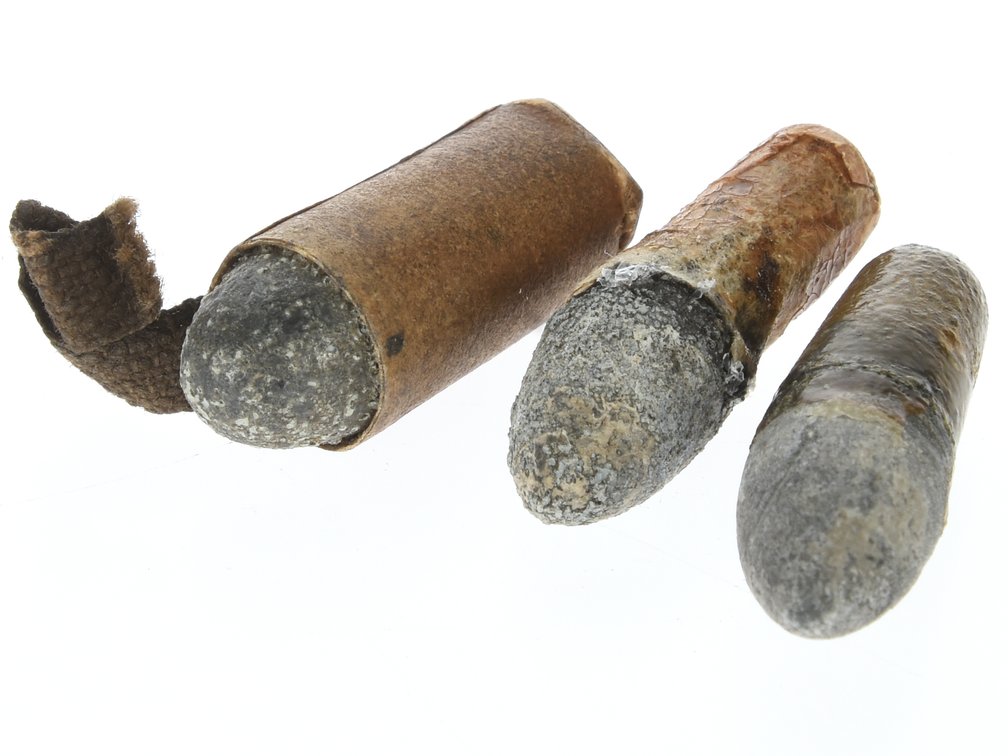
#50 • Civil War-Era .31 Revolver Skin and Combustible Cartridges, English and American
Part of To Arms! Relics of the American Civil War (live auction by Bannerman Auctions)
High bid $130.00
Status: SOLD
Category: United States
Civil War-Era .31 Revolver Skin and Combustible Cartridges, English and American This lot consists of three original mid-19th century .31 caliber revolver cartridges representing both British “skin” construction and American combustible types commonly encountered with small pocket revolvers of the antebellum and U.S. Civil War eras. The group illustrates the evolution from loose powder and ball to factory-prepared, quick-loading ammunition for pocket revolvers, a development that paralleled the widespread adoption of small percussion revolvers in civilian and military contexts. The first cartridge is a .31 caliber Adams-pattern revolver skin cartridge in its original protective outer paper envelope with intact pull-cloth, of the type marketed by Eley Brothers of London for small-bore Adams and similar pocket revolvers. Eley produced these thread-bound mutton-intestine “skin” cartridges in several bore sizes, including the approximate .31 caliber “110 bore,” and they saw import and use in both British and American revolvers during the Civil War period. The second cartridge is a separate .31 caliber pocket revolver skin cartridge, lacking the external paper wrapper and preserving only the translucent skin case and bullet. This example was attributed by a previous owner to Johnston & Dow, but that firm is best documented for its combustible envelope cartridges for larger .36 and .44 caliber U.S. service revolvers, and attribution of this small, unwrapped skin example should be regarded as tentative without a packet label or distinct maker’s mark. The third specimen is a .31 caliber combustible cartridge for the Colt Model 1849 or similar pocket percussion revolver, identified by the former owner as a Hazard Powder Company product made under the Doremus & Budd patent for pressed-powder cartridges. In this Civil War–era American system, the powder charge was hydraulically compressed into a solid, self-supporting “cake” behind the bullet, eliminating the need for a separate paper tube and producing a robust combustible unit cartridge. Collectively, these cartridges document British Eley production and American Hazard and Johnston & Dow output, all of which had documented sale and use in the United States from the 1850s through the Civil War. Individually, .31 caliber pocket cartridges are less frequently encountered than their .36 and .44 counterparts due to lower wartime demand, and intact skin cartridges retaining their fragile outer envelopes, as in the first example here, are appreciably scarcer than loose or damaged specimens. Eley Brothers of London was among the leading British ammunition manufacturers of the period, supplying percussion caps and pre-packaged cartridges for both military and commercial markets worldwide. In the United States, the Hazard Powder Company of Hazardville, Connecticut, along with firms such as Johnston & Dow in New York City, became key suppliers of combustible revolver cartridges to the Northern market during the early and middle years of the Civil War. Estimate $160 - $300