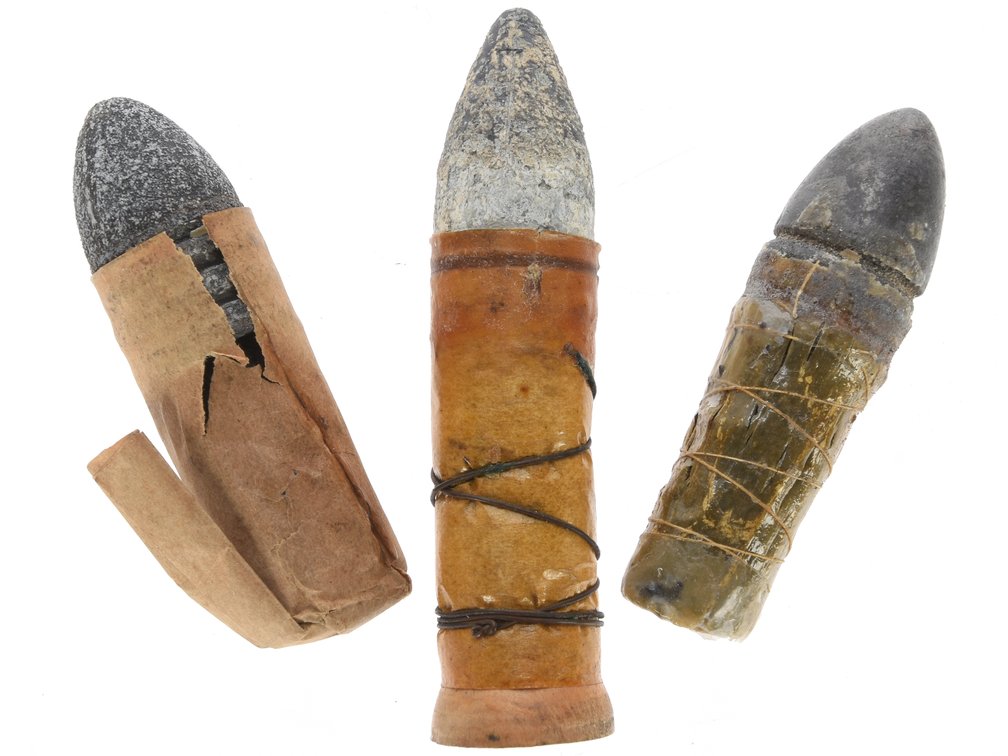
#122 • British 1850's-1860's Ammunition Lot including Sharps Wire‑Wound Combustible Cartridge
Part of To Arms! Relics of the American Civil War (live auction by Bannerman Auctions)
High bid $500.00
Status: SOLD
Category: Britain
British 1850's-1860's Ammunition Lot including Sharps Wire‑Wound Combustible Cartridge. Lot of three cartridges; includes Sharps wire‑wound combustible cartridge for the British contract Sharps Model 1855 Carbine, ca. 1856–1865, .577 caliber skin cartridge for the Mont Storm rifle, and a musket cartridge, the latter being fractured on one side. The wire-wound example is a combustible cartridge was produced for use with the British‑contract Sharps Model 1855 slant‑breech carbine, a breech‑loading arm acquired in limited numbers during mid‑nineteenth‑century trials of cavalry carbines. The cartridge incorporates a paper or linen case containing the powder charge and an expanding lead bullet, the exterior of the case reinforced by a fine wire wound spirally around the body. The wire winding was intended to help the cartridge retain its shape during transport and handling and to support reliable positioning in the chamber, while still allowing the Sharps breech block to shear the base of the cartridge and expose the powder for ignition when the arm was fired. The associated Sharps Model 1855 carbine is itself a scarce firearm: only 6,796 were produced between 1856 and 1857, of which 6,000 were supplied to the British government and issued primarily to cavalry units serving in India. Although this figure represents a significant contract for the period, surviving British‑marked Sharps carbines are now regarded as “one of the real rarities of Sharps long arms collecting” and are infrequently encountered, particularly in North America. Ammunition for these arms was manufactured in far greater quantities than the carbines, but was designed to be entirely consumed upon firing. As a result, original Sharps cartridges of any type, and especially specialized British patterns such as wire‑wound examples are seldom found on the collector market. Surviving specimens provide material evidence for a transitional phase in British and transatlantic ammunition development, between traditional paper cartridges for muzzle‑loaders and the later, widespread adoption of metallic cartridges for military breech‑loading firearms. The Mont Storm rifle is historically significant as one of the British Army’s first serious attempts to convert the Pattern 1853 Enfield into a capping breech‑loader, briefly selected in 1865 as the army’s standard breechloading system before being superseded by the Snider. Its design depended on a .577 “skin” or combustible cartridge made from treated animal gut, which allowed rapid loading and clean burning but proved too fragile and unreliable for hard field service, ultimately dooming the system despite otherwise promising performance. Estimate $200 - $300