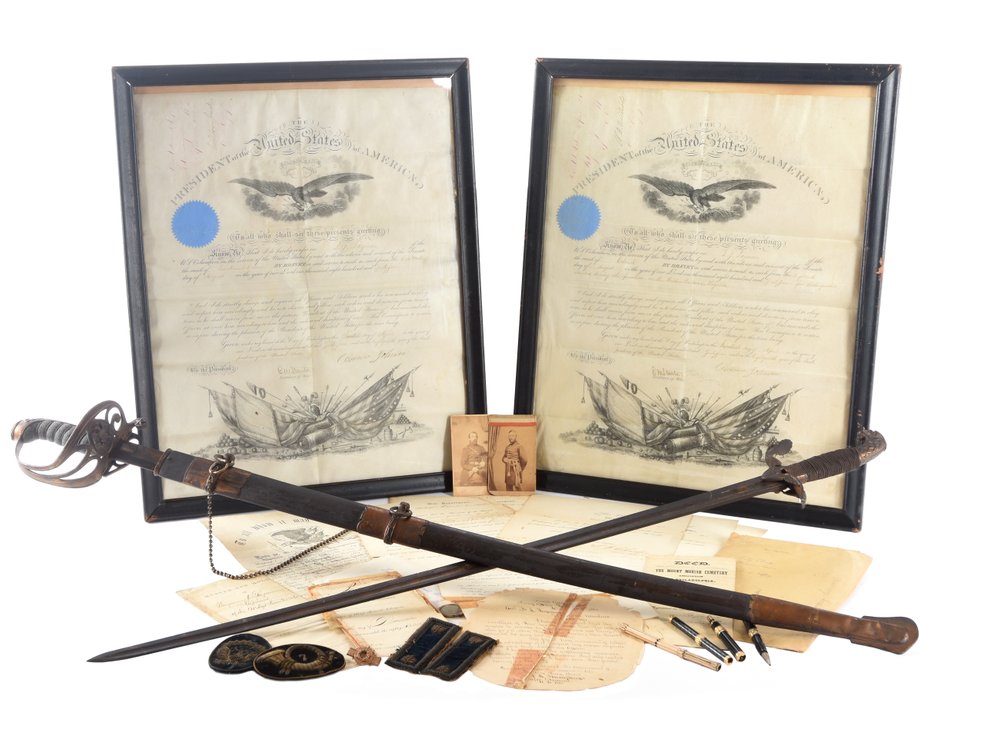
#29 • 91st Pennsylvania Volunteer Infantry Signed Documents, Insignia, and Swords Group - 1st Lieutenant / Adjutant Benjamin J. Tayman
Part of To Arms! Relics of the American Civil War (live auction by Bannerman Auctions)
High bid $0.00
Status: SOLD
Category: United States
91st Pennsylvania Volunteer Infantry Swords and Signed Documents Group - 1st Lieutenant / Adjutant Benjamin J. Tayman A group of items from 1st Lieutenant Benjamin J. Tayman, Adjutant of the 91st Pennsylvania Infantry Regiment documenting some of Tayman's lasting achievements during the war. It contains a number of wartime documents, insignia, two swords, and three images. The official documents and insignia trace Tayman's progress as an officer through the war and are listed in rough chronological order. First is the remains of Tayman's Commission Certificate as Adjutant in the 91st Pennsylvania. It is folded and shattering on all the creases. Failing tape repairs make it impossible to examine without causing further damage. It is uncertain if it is complete and remains folded. Tayman joined the 91st Pennsylvania December 4, 1861. Second is a series of four promotion letters dated December 2, 1864. On August 18, 1864, Tayman was successively appointed Captain, Major, Lt. Colonel and Colonel by Brevet for his actions at Petersburg. The letter for Brevet Captain cites Tayman's "meritorious conduct during action at the Norfolk and Petersburg Railroad in June, 1864." The letter for Brevet Colonel cites "distinguished services during operations on the Weldon Railroad." All four letters are signed by EM Stanton, Secretary of War with creases that are now weak and tearing. One is heavily stained with adhesive tape. All have material loss and are age stained, mostly on the backs. Third are Lt. Tayman's discharge papers dated December 3, 1864, when his three years as Adjutant with the 91st PA expired. His 10.5" x 7.75" discharge certificate was processed "at camp near Petersburg, VA" and is signed by 91st Pennsylvania Lt. Colonel Eli G. Sellers. A second signature is illegible. The reverse bears a US Pension Office date stamp of May 8, 1888. His Muster-Out Roll is folded due to its long format of 31" x 10.5". It was also filled out in "camp near Petersburg, VA" and signed by Lt. Colonel Sellers. Next are Tayman's four commission certificates dated , one for each rank of Brevet Captain through Brevet Colonel. Four 19" x 11.5" commission certificates are printed on vellum and embossed with the seal of the Board of War and Ordnance. They are all dated April 20, 1865 and signed by EM Stanton, Secretary of War and Andrew Johnson, President of the United States. The Johnson signatures are handwritten and not stamped. Johnson injured his right arm in a train derailment in 1857 and resulting in lifelong complications that prompted the use of a signature stamp in many cases. All of them have registrar notations in red ink in the upper corner signed by Assistant Adjutants General E.D. Townsend and W.A. Nichols. They again cite Tayman's actions at Petersburg. Two of the certificates are framed, two are not. One of the frames is backed with a piece of pasteboard covered in mid-20th century travel postcards dated March 1962 and first names of two possible descendants. All certificates are creased from being folded. Three of the cover letters that accompanied these certificates remain. They are signed by Samuel F. Chalfin, Assistant Adjutant General and are in similar condition to the promotion letters mentioned above (minus the tape). There is a partial letter of appointment as Major in "First Corps (Hancock's)". The top third of the letter is missing and the remains are separated and stained with tape. This is from Tayman's brief stint with the 7th US Infantry starting in June of 1865 that only lasted until December of that year. He was discharged, likely due to his health. This explains the few pieces of Insignia with the group: a pair of Major's shoulder straps on blue velvet with scant traces of the apparently delicious black wool edging. The pasteboard core of the straps is exposed. The paper backed reverse is unmarked and each has a loop of tape applied from display. There are two pieces of headgear insignia related to this appointment: a 7th US Infantry cap badge with bullion embroidered Infantry horn and applied numeral 7. The end of one of the wire loops on the back is poking through the black velvet face of the badge just below the mouthpiece of the horn. Also, an officer's Hardee hat badge with bullion embroidered eagle on black velvet. There is some wear to the background where the loops on the back has created high spots in the velvet. Some personal records include an 1860 dated deed for burial lots at Mount Moriah Cemetery in Philadelphia. Tayman's family members likely rest there but Tayman himself is buried in the Hampton National Cemetery, Hampton, VA. Next appears to be personal handwritten letter from Major General Andrew A. Humphreys, Chief of Staff, Army of the Potomac. It was sent to Tayman while he was on sick leave in late 1864, about a month before he mustered out: "Head Quarters Army of the Potomac November 8th, 1864 Lieut. B.J. Tayman, 91st Penna Volunteers Dear Sir, I learn with regret that the condition of your health is such that you will be unable to remain in the service and will therefore retire from it when your term of service (three years) expires in the early part of the winter. The present being a moment of leisure I take advantage of it to express my warm regards for you as a man and as an officer. I have witnessed the unflinching manner in which you performed whatever your duty required however painful and I have seen your gallant bearing on the field. With my best wishes for the improvement of your health and for your success in life. I am very truly yours A A Humphreys Major General U.S Vols" I have no doubt that the content of this letter is genuine, however, it does not appear to be in Humphreys' handwriting and it does not look to have ever been folded for mailing. It is torn completely in half and was repaired with tape. The odd format of the letter and the oval shape in which the paper is trimmed suggests this is a copy meant for display in a frame. This seems disappointing on the surface - the original letter is in the winds. Fortunately, Humphreys himself acknowledges sending a letter (the original of the letter above) to Tayman, starting on page 265 of Henry H. Humphreys' 1924 book Andrew Atkinson Humphreys: A Biography. He also acknowledges receipt of Tayman's reply and then gives a brief description of his relationship with Tayman. " ... I send (another letter) together with one from Lieutenant Tayman, Adjutant of the Ninety-first Pennsylvania Volunteers, Colonel Gregory's regiment, one of my old Fifth Corps division. Learning that he was about leaving the service I wrote him a very brief note expressing my opinion of his faithful performance of duty under every circumstance. It is that note he replies to. Knowing the good opinion I had of him and his great regard for me, General Tyler endeavored to damage him by preferring false accusations against him in connection with the battle of Chancellorsville, of which the Court honorably acquitted him." Tayman's reply is transcribed on pages 266 and 267. He confirms he is replying to Humphrey's letter dated the November 8th. It explains the importance of the letter from Humphreys, even a copy of the letter found in this group: "Major General Humphreys. Headquarters, Second Brigade, First Division, Fifth Army Corps. My dear General: Pardon my liberty in thus familiarly addressing you, for the cold, formal "I have the honor" will in no degree express the profound feeling of personal respect and esteem I have ever entertained toward you. A desire to answer your kind and valued favor of the 8th inst.(instante mense) so flatteringly complimentary to myself I now offer as my excuse for thus trespassing upon your valuable time. I beg of you to believe me, General, your friendly letter and honorary testimonial will be treasured and cherished by me during my entire life; and will be transmitted to my children with a history of its origin that the name of its author may have a place in their memories along with the name of their father and as one who held no second place in the galaxy of patriots during the Great Rebellion. Regretting that the pressing nature of my duties has compelled me so long to defer my acknowledgement of your highly prized communication, I most respectfully beg leave to subscribe myself, Truly your obedient servant and friend, Signed, B. F. Tayman, First Lieutenant and Adjutant, Ninety-first Regiment P.V., A.A.A.G. & A.B.I.; Second Brigade, First Division, Fifth Army Corps." Tayman died in 1889, long before Humphreys' biography was published in 1924. In his own words from 1864, the sentiments in this letter are Benjamin J. Tayman's prized memento from the war. Somewhere, the original is hopefully in safe keeping but this could potentially be the only copy of this correspondence. Tayman's deep appreciation of these words is explained further below. It involves Generals, egos, insults and courts martial. Two presentation swords: a non-regulation US officer's sword based on the British Pattern1845 officer's sword made by the German company Clauberg. The brass gothic hilt has a folding counterguard with a droop winged eagle and shield above US inside a cartouche on the guard. The quillon tip is decorated with a raised star. The wire wrapped fish skin grip is in fair shape with minor loss to the leather and minimal loose wires. The stacked teardrop pommel has no finial. The blade was formerly fantastic with a gold washed, acid etched finish that is now mostly gone. The blade is so dark that any personalization or vendor markings are indiscernible. The ricasso is clearly stamped W / Caluberg / standing knight / Solingen. The metal scabbard has a very worn brown finish and gilded mounts. The second sword is an 1830s-1840s era militia officer's sword with spread winged Federal eagle and shield on a recurving guard that terminates in two scalloped shells. The guard is loose. The wire wrapped grip is complete and is not "sprung" but it does move. The eagle head pommel has a crack along the back and the chain guard is missing. The gold washed, etched finish is dark and mostly obliterated. No maker's marks are visible and there is no scabbard. Though Tayman was enrolled in Philadelphia's sixth ward Home Guard in early 1861, he is listed as a Sergeant. Tayman's father was in the 17th Regiment of the Maryland militia but he entered and discharged as a private. The one wartime photo of Lt. Tayman found online shows him with a US regulation M1850 officer's sword. It is unconfirmed if either of these swords were Tayman's or if they are simply family embellishments. There are two CDV's of Federal officers, both with Philadelphia photographer's markings on the back and loops of cellophane tape from a previous display. A jewel sized tintype inside a broken locket depicts a heavily bearded man. None are identified and based on a known photo of him, none of them are Tayman. Benjamin J. Tayman entered the service in Philadelphia on December 4, 1861 with the 91st Pennsylvania Volunteers as an Adjutant. The 91st was assigned to duty in the Washington DC area where Tayman trained the non-commissioned officers. In a "Letter from the Ninety -First" printed in the Philadelphia Inquirer on February 5, 1862, the officers, including Tayman, are described: "'The Adjutant (Tayman) appears to be a general favorite. Being a strict military man, he expects and is bound to have everything transacted in military style. Any one who wishes to be convinced of this fact need only be in his tent about half an hour." The regiment remained in the DC area until September 15 when it moved to Monocacy Creek as part of the Maryland Campaign. It reached Antietam, MD on September 18, the day after the battle, and remained camped near Sharpsburg, MD until October 30. During that time, the 91st engaged retreating Confederates in skirmishes at Kearneysville and Shepherdstown and conducted reconnaissance to Leesburg. A medical certificate from October 24 reported Tayman had been suffering from typhoid fever for a week and he was put on medical leave from October 31 through November 16, 1862. From December 12 through15 the 91st Pennsylvania was part of the final, furthest assault on the stone wall at Marye's Heights during the Battle of Fredericksburg. 91st Colonel Edgar M. Gregory described that action in his report, "We were ordered into position on the left of the One hundred and twenty-sixth Regiment Pennsylvania Volunteers, Colonel Elder, and in the rear of the One hundred and twenty-ninth Regiment Pennsylvania Volunteers, Colonel Frick. The regiment started on the charge in this position about sunset, and marched up the hill and over the plains above. We steadily advanced, notwithstanding the fact that our path was almost completely blocked up by regiments of men lying in line of battle on the hill, and were while in this position constantly exposed to a terrific fire from the rebels, who were posted behind stone walls and formidable earthworks, while their batteries on the hill shelled us unceasingly. The advance continued beyond the brick house, about 30 or 40 yards, when we retired." Under Brigadier General Andrew A. Humphreys, 3rd Division, V Corps, the division suffered over 1000 casualties with over 400 killed at Fredericksburg. It was this devastating loss that exacerbated conflict between General Humphreys and Erastus Tyler, Brigadier General of 1st Brigade, 3rd Division, V Corps. A very public letter campaign between the two resulted in the arrest and court martial of General Tyler in March of 1863. The worst charges were dropped but the feud between the men endured and Tayman got tangled up in the tit for tat. On May 3, 1863 at the Battle of Chancellorsville, Humphreys’ Division was in position near the center of the Federal lines along the Orange Plank Road, right next to the fork at Ely's Ford Road. As ammunition dwindled, Humphreys decided it would be "impracticable to distribute had it been with the brigade" and directed General Tyler withdraw. According to Humphreys "General Tyler states that the conduct of the officers and men was admirable." During the fight, Colonel Gregory was wounded in the leg and Lt. Tayman assisted him to the rear for treatment. On May 12, General Tyler had words directly with Lt. Tayman resulting in Tayman's arrest the next day. General Tyler accused Lt. Tayman of Neglect of Duty for an incident in April over the loss of a wagon full knapsacks and of Misbehavior Before the Enemy for allegedly deserting his post and hiding behind a tree during the fighting at Chancellorsville. Lt. Tayman was court martialed on May 25, 1863, was found not guilty and was honorably acquitted. Tayman had the support of General Humphreys who is quoted in his biography, "Knowing the good opinion I had of (Tayman) and his great regard for me, General Tyler endeavored to damage him by preferring false accusations against him in connection with the battle of Chancellorsville". Lt. Tayman went on to Gettysburg where the 91st Pennsylvania served as part of V Corps under General Sykes. The regiment arrived on the battlefield on July 2 as part of Weed's Third Brigade, II Division. When General Sickles of III Corps advanced prematurely into the Peach Orchard, Sykes ordered Vincent's Brigade and Weed's Brigade to cover the exposed southern end of the Federal line at Little Round Top. Sickles intercepted Weed and ordered Weed's four regiments, including the 91st PA, into the Peach Orchard. Sykes and General Gouvenour K. Warren managed to redirect Weed back to the original assignment on Little Round Top, where they physically assisted Hazlett's Battery up to the summit and then played a vital defensive role on the slope, strengthening the line and supporting neighboring units under intense fire. An individual monument to the 91st Pennsylvania stands atop Little Round Top and a roster is displayed on the East face of the Pennsylvania State Monument on Hancock Avenue. Tayman is listed on the bronze tablet as Adjutant. Tayman suffered bouts of acute rheumatism in the Fall and Winter of 1863 and was absent for much of that time. He was detached as a recruiting officer for the first half of 1864 but returned to the 91st in June and was at the Siege of Petersburg. He received a series of promotions for his meritorious conduct in the action at the Norfolk and Petersburg Railroad and distinguished services during the operations on the Weldon Springs Railroad, earning him the rank of Brevet Colonel. He was mustered out on December 3, 1864 when his three years as a 1st Lieutenant and Adjutant expired. Tayman was appointed Major in the 7th US Volunteers on June 26, 1865, but was discharged by special order on December 20, 1865, likely due to his health. After the war, Tayman continued his work as a wood turner and machinist. He registered patents in 1872 and 1873 (in addition to one from 1852) for improved wood carving machines. He was still living in Philadelphia at the time of the 1880 census and still listed as a machinist. He entered the Southern Branch of the National Home for Disabled Volunteer Soldiers in Hampton, VA on June 5, 1888 and died there on June 29, 1889. Estimate $4000 - $6000