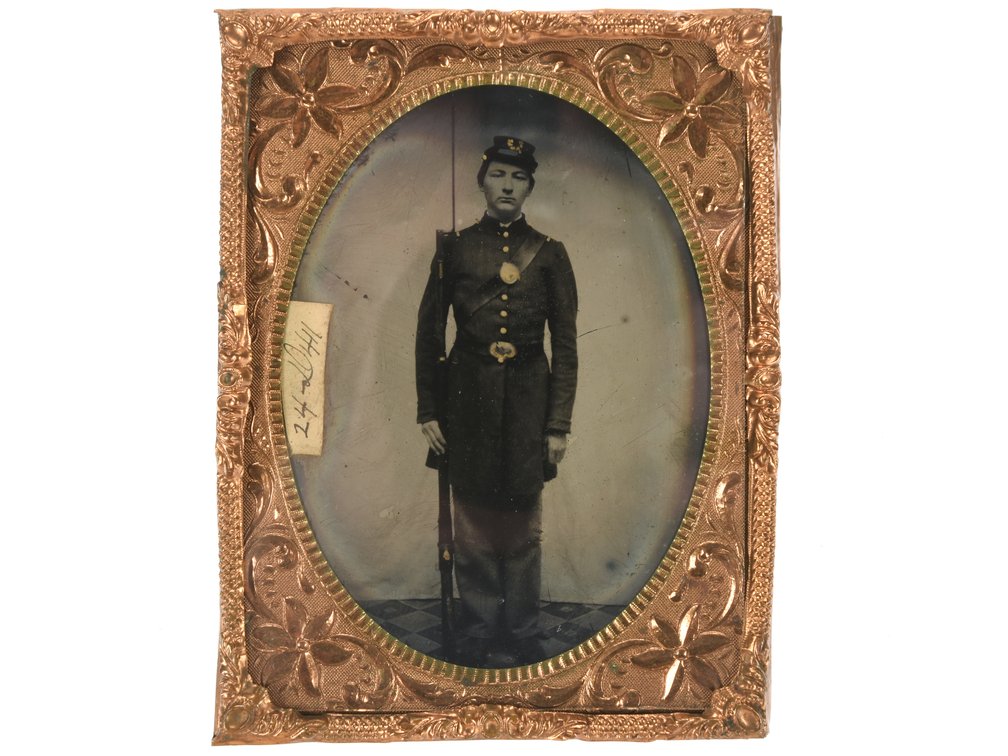
#19 • 35th Indiana '1st Irish' Infantryman's Quarter Plate Tintype
Part of To Arms! Relics of the American Civil War (live auction by Bannerman Auctions)
Starting at $700.00
Status: PASS
Category: United States
35th Indiana '1st Irish' Infantryman's Quarter Plate Tintype. Uncased quarter plate image of a standing Federal infantryman, holding what appears to be an Enfield rifle-musket with fixed bayonet, wearing his leather accoutrements over a frock coat, and a forage cap displaying the cloverleaf wreath associated with the 35th Indiana. There is an old identification number on cloth tape on one side of the image. His accoutrement plates, buttons, cap insignia, and the brass fittings on his rifle have a touch of gilt tinting. The 35th Indiana Infantry was one of the classic Western-theater ethnic regiments, raised at Indianapolis in December 1861 and known throughout the war as the “1st Irish” because it was recruited heavily from the state’s Irish-American community. To emphasize that identity the men were issued emerald‑green kepis, chasseur-style coats, and dark trousers, and they continued to wear distinctive green caps in service, a visible ethnic badge in otherwise regulation Federal ranks. Contemporary and later descriptions note a gold wreath of shamrocks on the cap surrounding the numeral “1,” along with trousers trimmed on the outer seam with green, and a striking green regimental color decorated with Irish devices, including a harp and shamrock, and the motto “Be Just and Fear Not.” Those visual cues, combined with their long record as a veteran Western regiment, gave the 35th Indiana a reputation not only as an Indiana unit but as a self-consciously Irish formation in the Army of the Cumberland. Operationally the 35th Indiana served almost entirely in the Western theater, usually in hard-fighting commands of the Army of the Ohio and then the Army of the Cumberland. Early in its career it served in Matthews’ Brigade, Van Cleve’s Division, Crittenden’s corps, marching into Kentucky in 1862, pursuing Bragg, and fighting its first major battle at Perryville. Through the winter of 1862–63 it remained with Crittenden’s command around Nashville, skirmishing at Dobbins Ford, and then went into the battle of Stones River where it helped hold a critical sector and took heavy casualties. When the Army of the Cumberland advanced into Georgia the regiment was shifted into the 2nd Brigade, 1st Division, IV Corps, a higher-command relationship it retained through much of the Atlanta Campaign and the Franklin–Nashville operations. At Kennesaw Mountain it was in the literal front line of IV Corps, was briefly thrown into confusion by a fierce Confederate assault, then rallied and fought hand-to-hand with bayonets and clubbed muskets, a performance that drew notice within the corps. Later that summer the regiment captured enemy rifle pits and prisoners in front of Marietta, but its losses forced its temporary assignment to train-guard duty until Jonesboro. In the Tennessee campaign of late 1864 the 35th, reinforced by conscripts and substitutes, stood in the front line at Franklin and helped beat back assaults on the works, then took a conspicuous part at Nashville and pursued Hood’s broken army to the Tennessee River before being detached to guard the pontoon train. After duty in Alabama, East Tennessee, and finally Texas, the “1st Irish” was mustered out in the fall of 1865, its record tying a distinct Irish visual and ethnic identity to continuous front‑line service in some of the Western theater’s most demanding campaigns. Estimate $800 - $1000