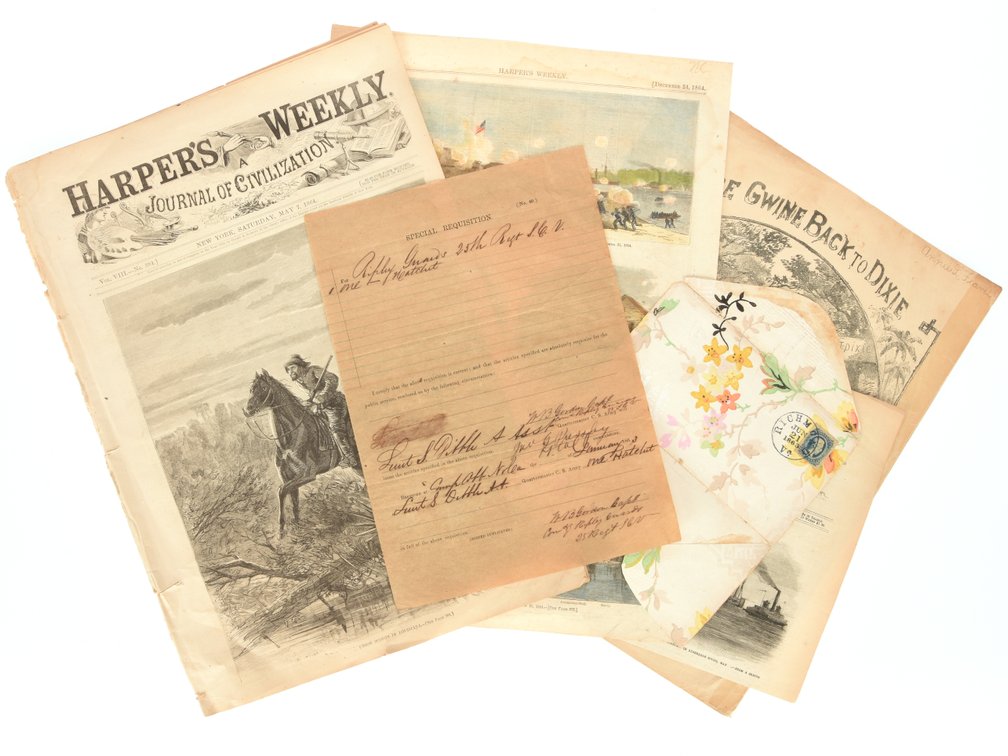
#23 • Civil War Ephemera Lot: Includes a Requisition from the 25th South Carolina Infantry
Part of To Arms! Relics of the American Civil War (live auction by Bannerman Auctions)
Starting at $50.00
Status: PASS
Category: United States
Civil War Ephemera Lot: Includes a Requisition from the 25th South Carolina Infantry. Lot includes a requisition form filled out in detail by Captain W.B. Gordon of the "Ripley Guards" 25th Regiment, South Carolina Volunteers in January 1863 specifically for the purpose of requisitioning... one hatchet. This one just seems to have backstory bursting at the seams - either a passive-aggressive point was being made, it was a part of a paperwork based practical joke.. or the poor fellows of the 25th SCV were indeed subject to that level of paperwork-fueled administrivia by the 1st Military District on James Island where the regiment was serving at that time. The 25th South Carolina Infantry (“Eutaw Regiment”) was formed on 22 July 1862 by expanding the existing 11th South Carolina Infantry Battalion to a full regiment, with Charles H. Simonton as colonel, John G. Pressley as lieutenant colonel, and John V. Glover as major. Its companies were drawn largely from the Charleston, Williamsburg, Marion, Colleton, Orangeburg, and Clarendon districts, incorporating prewar volunteer units such as the Washington Light Infantry and Wee Nee Volunteers. Through late 1862 the regiment served on James Island (Secessionville, Camp Stono, Battery Glover) and briefly went by rail to Wilmington, North Carolina in December before returning to Charleston on 1 January 1863. In 1863 the regiment remained in the Charleston defenses, rotating between James Island, Secessionville, and forward positions on Morris Island and around Charleston Harbor. It saw action at Grimball’s Landing and other small skirmishes in the spring, then endured intense bombardment and heavy losses during the operations around Fort Wagner and the Affair at the Mouth of Vincent’s Creek, losing 16 killed, 124 wounded, and 3 missing between July and September. On 20 September 1863 it was permanently assigned to Brig. Gen. Johnson Hagood’s Brigade, continuing garrison and fatigue duty around Charleston, with its companies rotated into Forts Sumter and Moultrie and suffering further casualties in the October 1863 shell burst in Sumter’s barracks and the December 11 magazine explosion. During early 1864 the 25th remained on James Island and in the harbor forts until Hagood’s Brigade was ordered to Wilmington in late April and then sent on to Virginia in May. In the Bermuda Hundred and Richmond–Petersburg campaigns it fought at Port Walthall Junction and Swift Creek (where Lt. Col. Pressley was severely wounded), at Drewry’s Bluff, and then as part of Lee’s army at Cold Harbor, entering the Richmond lines on 30 May 1864 with about 764 men. The regiment then moved into the Petersburg trenches, taking part in the early siege fighting and later suffering significant losses at Weldon Railroad (2 killed, 29 wounded, 70 missing) and serving under fire in the operations north of the James, including Second Fort Harrison and subsequent actions along the Darbytown - New Market Road line. In late 1864 Hagood’s Brigade was shifted by rail from the Richmond lines to Danville and then to Wilmington, where it moved by steamer to the Cape Fear defenses and helped reinforce Fort Fisher. The 25th South Carolina fought in the Second Battle of Fort Fisher from 13 - 15 January 1865, where most of the regiment was captured when the fort fell and many men subsequently died in Northern prison camps at Point Lookout and Elmira. Remaining remnants joined Hagood’s withdrawal up the Cape Fear, skirmishing at Fort Anderson and Town Creek where more of the 25th were captured, before the survivors were consolidated with other South Carolina units into Rion’s Regiment in March 1865, a composite command that served with Hoke’s Division in the Carolinas Campaign, fought at Bentonville, and surrendered with Johnston’s army at Bennett Place on 26 April 1865. Lot further includes a May 7, 1864 issue of Harper's Weekly, a page from the December 14, 1864 Harper's with illustrations of action in North Carolina, a partial page from Leslie's Illustrated June 11, 1864 edition likely also saved because it features North Carolina content, a copy of sheet music "I'se Gwine Back to Dixie", and a 1932 Confederate reunion souvenir, being a facsimilie of a wartime 'turned' wallpaper envelope with a faux 1863 cancellation. Estimate $100 - $150