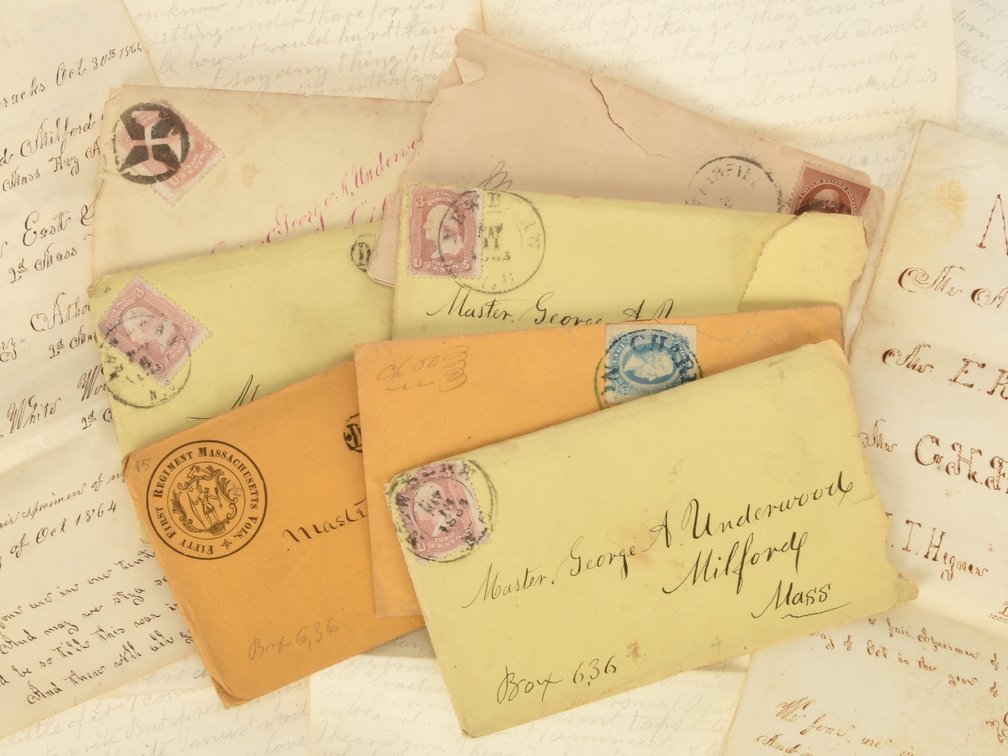
#21 • Civil War 51st Massachusetts Infantry Letter Lot
Part of To Arms! Relics of the American Civil War (live auction by Bannerman Auctions)
High bid $270.00
Status: SOLD
Category: United States
Civil War 51st Massachusetts Infantry Letter Lot. Includes a bundle of seven covers with letters in pencil dating from from May 1863, and one from November. They are all from A.E. Underwood to his son George in Milford, Massachusetts. Most of the May letters talk about early camp life in Newport Barracks, North Carolina. Underwood notes how they were all covered in dust after the march to the camp, but got the best tents in the army upon arriving, sleeping four men to a tent. “We are in plain site of Fort totten one of the finest forts in NC and on our left we have two large gun Boats and on our rite earth works and a masked Battery to. And in our rear we have Brest works and 8 forts Besides so I think the Rebs wont git on to us til we know something about it.” Underwood seems to have done a lot of picket duty and was envious of some of his regiment who were deployed on a gunboat. While on picket duty during the day he examined passes, “But at night I dont allow no man to Pass unless he has the counter sine. if he does down goes his house” Also bragged about making an officer stop and show his pass. Blacks making $25 to $50 a week making tar, turpentine and rosin. Asked for money, tobacco, and cotton socks from home. Several letters repeat instructions to his son to study hard at his lessons at school and to help his mother with planting “I want you to sit your lessons well and attend to studies and dont let any one Beat you in good lessons. I want you to Be the Best Boy in school. You can if you and to and keep w way from Bad Boys. . .” Noted that some of the men were sick with measles and mumps, but many were sick with dysentery. Most are afraid of getting small pox. Not much to do, very hot, men laying in their bunks in their drawers. Only work they do is march. Watched a suspected “old Reb” get hauled out of a river by a bunch of black men. The soldiers then send him on to Newbern. Later letters tell about it being very wet. “I thought a good many times how I should like to have as good a place as my hog had at home.” Had plenty of fish, sweet potatoes and persimmons. Got a coffee mill and used it to grind corn so they could make a pudding. Went to a black man’s house in the country and got supper. The man had a large trap for bears. Lots of sickness from yellow fever. “Bin one man died here from yellow feaver he was only sick a few hours thay opened him and found his liver all Burnt up. it looked like a peace of Burnt leather all crisp he youst to vomit Black as ink.” For a time the train wasn’t running and the mail stopped due to deaths from yellow fever. He gives instructions to his son for keeping the farm clean and neat around the house and preparations for the coming winter weather. Organized at Camp Wool in Worcester from recruits drawn largely from southern Worcester County, the 51st Massachusetts Regiment was mustered into Federal service in late September–November 1862 as a nine‑months militia infantry regiment. Assigned to Major General John G. Foster’s Department of North Carolina (later the XVIII Corps), the unit departed Massachusetts for New Bern, North Carolina, in November 1862 and spent much of its term on garrison, guard, and outpost duty along key rail and coastal supply lines. During Foster’s Goldsboro Expedition in December 1862 the regiment saw its principal combat, participating in the engagements at Kinston on December 14, White Hall on December 16, and the action at Goldsborough Bridge on December 17, supporting the destruction of the Wilmington & Weldon Railroad bridge. In early 1863 the 51st continued service in eastern North Carolina, sending detached companies to posts such as New Bern, Beaufort, Newport, and Morehead City before being shifted north in June and July for brief duty at Fort Monroe, Baltimore, Harper’s Ferry, and in the Army of the Potomac’s pursuit of Lee following Gettysburg, though without further major battle. The regiment returned to Worcester and was mustered out on July 27, 1863, having suffered no combat fatalities but losing forty‑four enlisted men to disease during its nine‑month term. Estimate $80 - $120