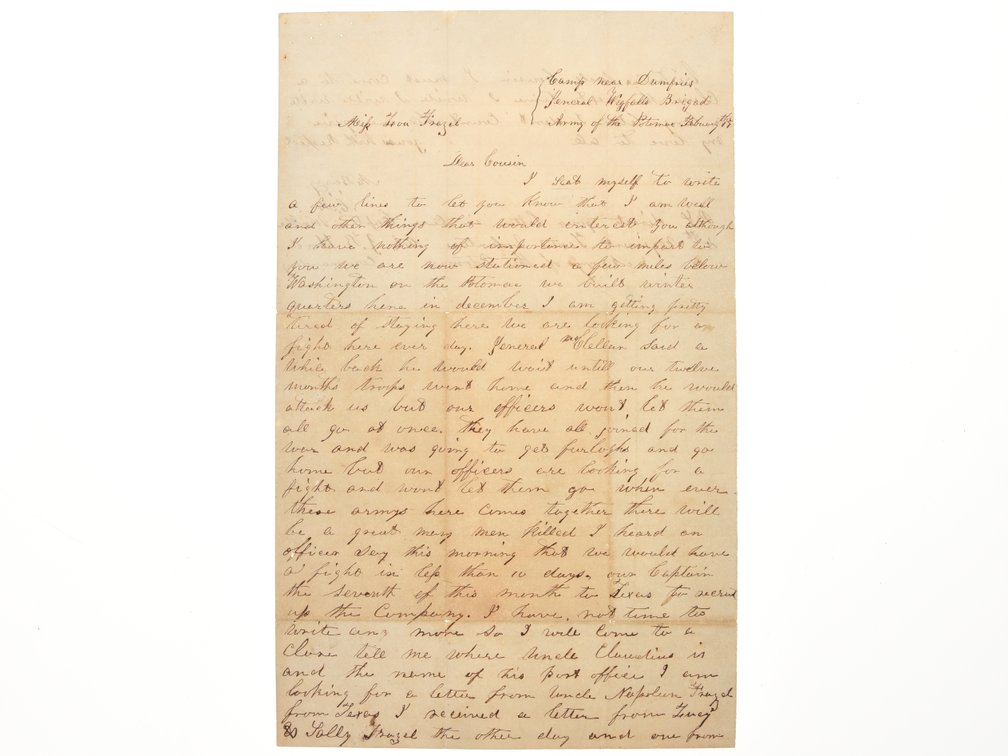
#25 • Civil War Confederate 4th Texas Infantry Soldier's Letter Home - February 1862
Part of To Arms! Relics of the American Civil War (live auction by Bannerman Auctions)
High bid $140.00
Status: SOLD
Category: United States
Civil War Confederate 4th Texas Infantry Soldier's Letter Home - February 1862. Letter from Private M. Barry, 4th Texas Infantry, written home to his cousin on February 17, 1862. Private Barry (or 'Burry' as he is sometimes recorded in the muster rolls) titled this letter "Camp near Dumfries / General Wigfall's Brigade / Army of the Potomac / February the 17". Letter is a single 7-3/8" x 12" page, with content on both sides. In this he communicates to his cousin ".. we are now stationed a few miles below Washington on the Potomac. We built winter quarters here in december. I am getting pretty tired of staying here. We are looking for a fight here ever(sic) day. General McClellan said a while back he would wait untill our twelve months troops went home and then he would attack us, but our officers wont let them all go at once. They have all joined for the war and was going to get furloughs and go home but our officers are looking for a fight and wont let them go. When ever these armys here comes together there will be a great many men killed. I heard an officer say this morning that we would have a fight in less than 10 days, our Captain the seventh of this month to Texas for (illegible) up the Confederacy." He continued to mention correspondence with other friends and relatives, and directed his cousin to address further letters in care of "Captain Winkler, 4th Regiment Texas Volunteers, Col. G.B. Hovel, commanding / Army of the Potomac." The Confederate Army of the Potomac was a short-lived title, being renamed the Army of Northern Virginia in March, 1862. Wigfall's command of his brigade did not last much past the writing of this letter, either. He was not especially well-regarded, reportedly appearing drunk before his men on numerous occasions and calling them to arms at all hours of the night in fear of an imminent Federal attack which never materialized, this environment of tension reflected in the content of Private Barry's letter. He resigned his commission in favor of taking a seat in the Confederate Senate, and was replaced by a far more capable officer - John Bell Hood. The fighting that Barry supposed to be on the near horizon was not as close as he thought when he penned this letter, but I believe it safe to say that he could scarcely have imagined the ferocity, duration, or scope of what lay ahead for himself and the 4th Texas. Organized in 1861 in what became Hood’s famed Texas Brigade after the resignation of General Wigfall, the 4th Texas Infantry saw some of the hardest fighting of the war from early 1862 until Appomattox. From February 1862, the regiment moved onto the Virginia Peninsula, receiving its true baptism of fire at Gaines’ Mill on June 27, 1862, where its charge up Turkey Hill helped break a stubborn Federal line at heavy cost in killed and wounded. At Malvern Hill a few days later, the Texans were again thrown against strong Union artillery and infantry positions in bloody but unsuccessful assaults. Through the Maryland Campaign they fought at South Mountain and then at Antietam, where the regiment suffered its worst single‑day losses of the war in the savage fighting on the Confederate left. In 1863 the 4th Texas marched north with Lee and played a key role in the second day’s assault at Gettysburg, attacking over rocky, broken ground toward Devil’s Den and Little Round Top, losing more than a quarter of its men in the fierce fighting against Strong Vincent's determined defense. Later that year the regiment was shifted west with Longstreet’s Corps, participating in the great Confederate counterattack at Chickamauga and enduring night fighting near Wauhatchie during the Chattanooga campaign. Returned to Virginia in 1864, the 4th Texas helped seal a dangerous gap in the lines at the Battle of the Wilderness, then fought through the brutal trench warfare and repeated assaults at Spotsylvania, Cold Harbor, and the long Petersburg siege. Reduced by years of continuous combat, Barry was among the scarce remnants of the regiment still in the ranks when the Texas Brigade laid down its arms with Lee’s army at Appomattox Court House in April 1865. His muster roll records from September - October 1862 indicate that he was listed as sick since August 12, and was admitted to a Confederate hospital in Culpepper, VA on September 28. It is thus likely that he missed the bloody fight with Wisconsin men of the Iron Brigade in the cornfield at Antietam on the 17th. He was also absent sick in March - April 1864, but is listed as present for May - June, when the 4th played a central role in the “Lee to the rear” episode at the Wilderness, and was paroled with the Regiment at Appomattox. Though not extensive, his letter from February 17, 1862 offers a glimpse into the mindset of a 21-year-old Confederate solider as he stood on the precipice of a journey through some of the hardest fighting in all of American military history. Estimate $200 - $300