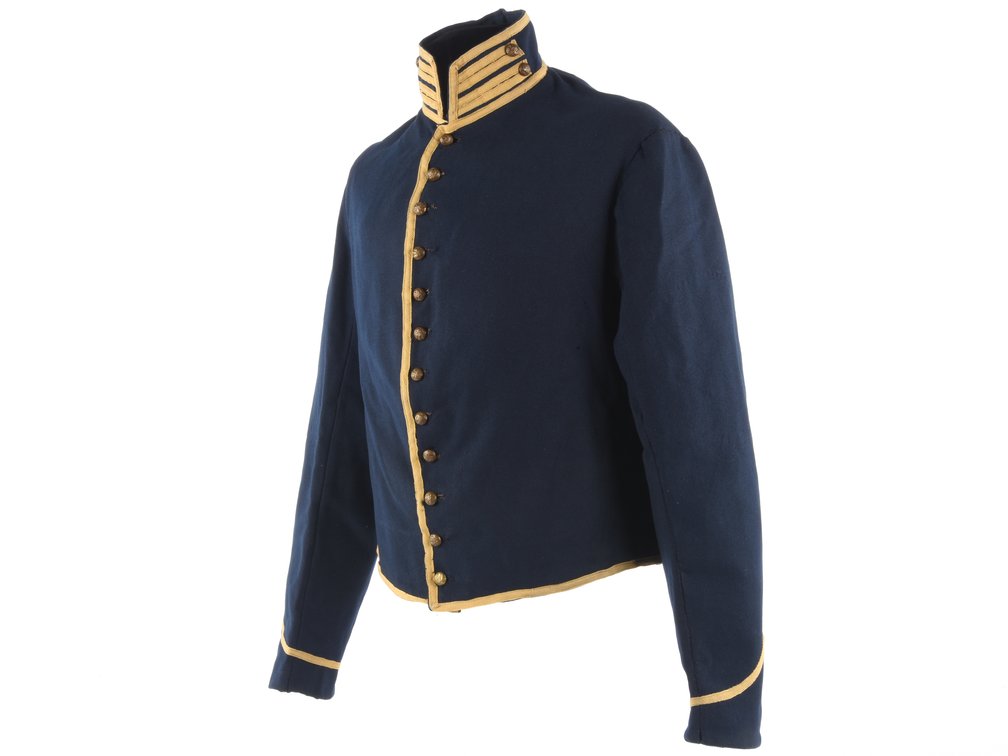
#245 • Civil War US Cavalry Shell Jacket
Part of To Arms! Relics of the American Civil War (live auction by Bannerman Auctions)
High bid $1,100.00
Status: SOLD
Category: United States
Civil War US Cavalry Shell Jacket. M1854 mounted service 'shell' jacket of dark blue wool with faded yellow wool tape trim denoting Cavalry branch of service. It has brass eagle buttons showing a mix of patinas. Construction is a mix of machine and hand stitching. On close inspection the sleeves show evidence of stitches where chevrons were once attached, but this was a collector's addition for display that has since been removed. There is not a discernable difference in the wool on the sleeves, as the chevrons were not in place at the time that the rest of the fading took place during this jacket's active service career. Interior has white cotton lining throughout, with the left shoulder marked with size in the Arabic numeral "4" and an oval contract stamp "I.HABER & CO. / NEW-YORK / 3 NOV.64." Haber, Isaac & Co. of New York City is listed as "a contractor for infantry uniform coats & overcoats, artillery coats, cavalry jackets & trousers. A contract on May 5, 1864 was for 1,000 Duryea Zouave uniforms. Issac Haber was listed from 1860-62 as clothing at 45 Dey. Listed 1862-63 as clothing at 296 B'way. Haber continued in the clothing business at least through 1891." The jacket shows service wear and light fading of the indigo blue wool, with the twill tape trim still obviously Cavalry yellow, but definitely faded in comparison to the unused Civil War surplus examples that we normally see on the market. The jacket has a few small moth bites and a sewn repair of the center seam in the lower back. Lining interior has a faint and partially legible period name stencil marking. These distinctive short, waist-length coat were designed for practicality in the saddle, with a compact cut that reduced interference with equipment and reins, and were used throughout the Civil War by Union Cavalry and Artillery troops. The fact that a great many of them survived the war as surplus to be discovered and sold (primarily by Francis Bannerman's enterprise) means that today they remain relatively affordable and available to collectors compared to other uniform items like trousers and sack coats that continued to be issued (and worn out) into the plains Indian Wars era.