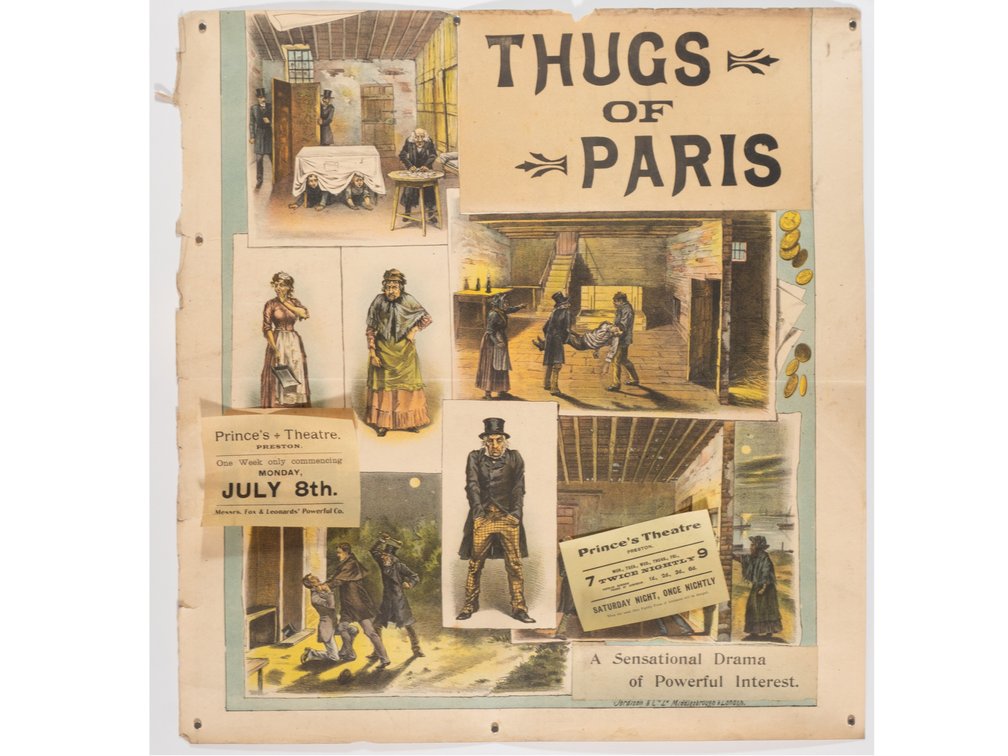
#67 • Victorian Theatrical Poster for 'Thugs of Paris'
Part of The Art of War and Peace - A No Reserve Poster Auction (live auction by Bannerman Auctions)
Starting at $100.00
Status: PASS
Victorian Theatrical Poster for 'Thugs of Paris' Description: A classic 19th-century 'sensational drama' theatrical poster for the play 'Thugs of Paris.' The poster features multiple chromolithographic vignettes depicting dramatic scenes from the melodrama, including a man in a top hat (likely the villain), a confrontation in a tavern, and various characters in period costume. This is a 'stock' poster, a common practice where the central artwork was printed in bulk and specific venue details were added later. In this case, slips for 'Prince's Theatre, Preston' and the performance dates (commencing Monday, July 8th) have been pasted onto the main sheet. The poster was printed by the firm Jordison & Co. of Middlesbrough and London. Condition: There is overall toning (yellowing) of the paper, along with some creasing and minor tears at the margins. Minor paper loss on the top and left edges. The title is pasted over an illustration, and a subtitle is likewise pasted on. The pasted slips for the theater and date remain attached, and while the poster is trimmed from it's original; length, the period paste over title suggests that it was trimmed and reused as a poster during it's working life. Dimensions: Approximately 22 x 23 inches Artist: Unknown Publisher: Jordison & Co. of Middlesbrough and London Date: Circa 1910 Estimate: $200-$500 Historical Background: From the Estate of Actor Bernard Fox These posters come from the collection of the legendary Welsh actor Bernard Fox (1927–2016), who inherited these from his father. A beloved character actor for seven decades, Fox is best known as the flamboyant Dr. Bombay on Bewitched, the bumbling Colonel Crittendon on Hogan’s Heroes, and for his unique dual roles in Titanic history, playing lookout Frederick Fleet in A Night to Remember (1958) and Colonel Archibald Gracie in James Cameron’s Titanic (1997). A fifth-generation performer, Fox descended from a prestigious theatrical lineage including his parents, Queenie and Gerald Lawson, and his uncle, the noted British actor Wilfrid Lawson. This collection offers a rare glimpse into a deep-rooted artistic dynasty; historical records link these circa-1910 posters to the Bradford studio of Fox’s grandfather, the artist John Mitchell Dowling Worsnop. While the "Fox" stage name became synonymous with Bernard’s career, its first appearance with the "B.M. Fox" troupe in 1910 remains a fascinating genealogical mystery currently undergoing further research. Historical Background In the 1890s, the "Golden Age" of the English poster transformed simple broadsides into vibrant works of art, but the economic reality of touring productions necessitated the rise of "stock" posters. Printing giants like David Allen & Sons and Stafford & Co. produced vast catalogs of "blanks"—high-quality chromolithographic illustrations of generic dramatic scenes, from high-kicking dance troupes to suspenseful railway rescues. These posters sometimes featured large empty spaces, which allowed an advance man to visit a local jobbing printer in each new town and "slug" in specific venue names, dates, and ticket prices. A simpler method was the application of "tip-ups" or "snipes", essentially Post-It notes, to the poster advertising the venue and times. When the production wrapped, the tip-up would be torn off, and a new one applied, ready for the next town! This system provided a professional, West End aesthetic to even the smallest traveling "fit-up" companies on a provincial budget. The use of these standardized designs created a visual shorthand for audiences across the industrial North and rural Midlands. A specific stock image of a sinking ship or a floral ballroom immediately signaled the genre of the performance, regardless of the specific acting troupe. For the manager of a touring variety show, these pre-printed sheets were an essential tool for speed and consistency, allowing them to ship posters ahead of the production’s arrival. By bridging the gap between expensive London artistry and the practical needs of the touring circuit, stock posters became the primary medium that fueled the mass appeal of the English stage and dance hall until the rise of modern cinema in the 1920s. Preserved in their authentic, raw condition, this collection features many pieces previously undocumented. Many of these posters are unique to this archive and cannot be found in standard English references, poster catalogs, or online searches.