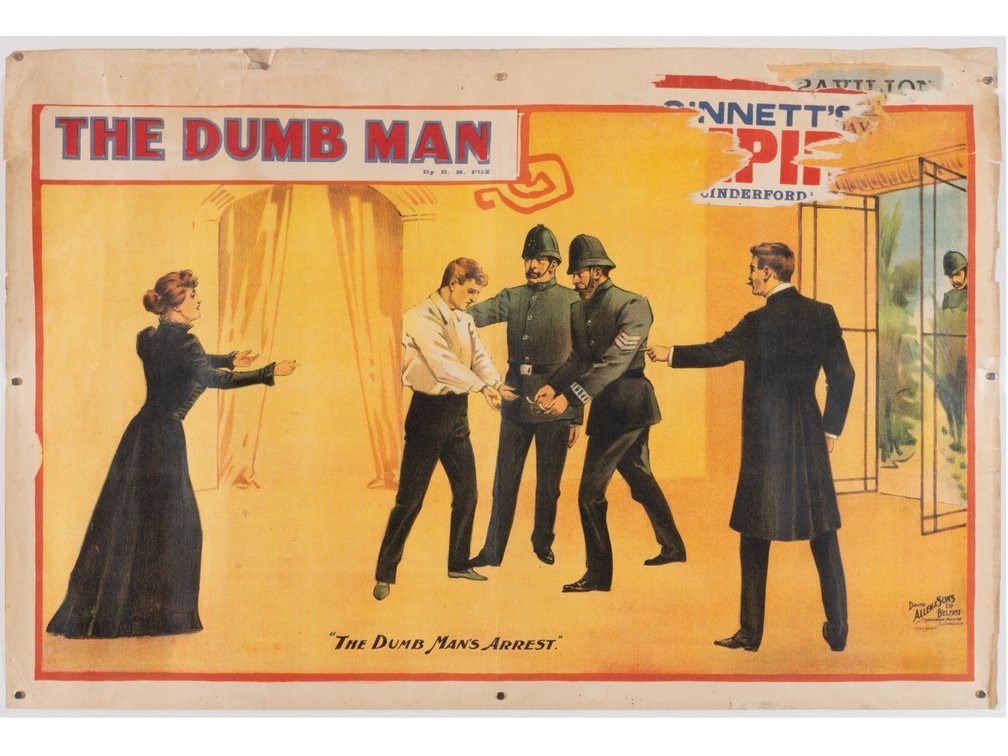
#69 • "The Dumb Man" Edwardian Theatrical Poster
Part of The Art of War and Peace - A No Reserve Poster Auction (live auction by Bannerman Auctions)
Starting at $100.00
Status: PASS
"The Dumb Man" Edwardian Theatrical Poster Description: This is an original chromolithographic theatrical poster for the melodrama "The Dumb Man," written by B. M. Fox. The poster illustrates a dramatic scene titled "The Dumb Man's Arrest," showing the protagonist in a white shirt being apprehended and handcuffed by two Victorian-style police officers. A distressed woman in a black dress reaches toward the man, while an observer in a formal frock coat gestures toward the arrest. The piece was produced by the renowned printing firm David Allen & Sons Ltd, with imprints for their Belfast, London, Harrow, and Manchester locations. A 'snipe' remnant (a printed strip for venue information) at the top mentions "Empire" and "Cinderford," and there is a secondary reference to a "Pavilion" venue, indicating it was used for touring theater performances. Condition: There are small tears and minor paper loss on the margins, and the remnants of two venue snipes in the upper right corner. General age-related toning/yellowing of the paper, and some light creasing and edge wear throughout. Dimensions: Approximately 30 x 20 inches Artist: Unknown Publisher: David Allen & Sons Ltd, London Date: Circa 1897-1910 Estimate: $200-$400 Historical Background: From the Estate of Actor Bernard Fox These posters come from the collection of the legendary Welsh actor Bernard Fox (1927–2016), who inherited these from his father. A beloved character actor for seven decades, Fox is best known as the flamboyant Dr. Bombay on Bewitched, the bumbling Colonel Crittendon on Hogan’s Heroes, and for his unique dual roles in Titanic history, playing lookout Frederick Fleet in A Night to Remember (1958) and Colonel Archibald Gracie in James Cameron’s Titanic (1997). A fifth-generation performer, Fox descended from a prestigious theatrical lineage including his parents, Queenie and Gerald Lawson, and his uncle, the noted British actor Wilfrid Lawson. This collection offers a rare glimpse into a deep-rooted artistic dynasty; historical records link these circa-1910 posters to the Bradford studio of Fox’s grandfather, the artist John Mitchell Dowling Worsnop. While the "Fox" stage name became synonymous with Bernard’s career, its first appearance with the "B.M. Fox" troupe in 1910 remains a fascinating genealogical mystery currently undergoing further research. Historical Background In the 1890s, the "Golden Age" of the English poster transformed simple broadsides into vibrant works of art, but the economic reality of touring productions necessitated the rise of "stock" posters. Printing giants like David Allen & Sons and Stafford & Co. produced vast catalogs of "blanks"—high-quality chromolithographic illustrations of generic dramatic scenes, from high-kicking dance troupes to suspenseful railway rescues. These posters sometimes featured large empty spaces, which allowed an advance man to visit a local jobbing printer in each new town and "slug" in specific venue names, dates, and ticket prices. A simpler method was the application of "tip-ups" or "snipes", essentially Post-It notes, to the poster advertising the venue and times. When the production wrapped, the tip-up would be torn off, and a new one applied, ready for the next town! This system provided a professional, West End aesthetic to even the smallest traveling "fit-up" companies on a provincial budget. The use of these standardized designs created a visual shorthand for audiences across the industrial North and rural Midlands. A specific stock image of a sinking ship or a floral ballroom immediately signaled the genre of the performance, regardless of the specific acting troupe. For the manager of a touring variety show, these pre-printed sheets were an essential tool for speed and consistency, allowing them to ship posters ahead of the production’s arrival. By bridging the gap between expensive London artistry and the practical needs of the touring circuit, stock posters became the primary medium that fueled the mass appeal of the English stage and dance hall until the rise of modern cinema in the 1920s. Preserved in their authentic, raw condition, this collection features many pieces previously undocumented. Many of these posters are unique to this archive and cannot be found in standard English references, poster catalogs, or online searches.