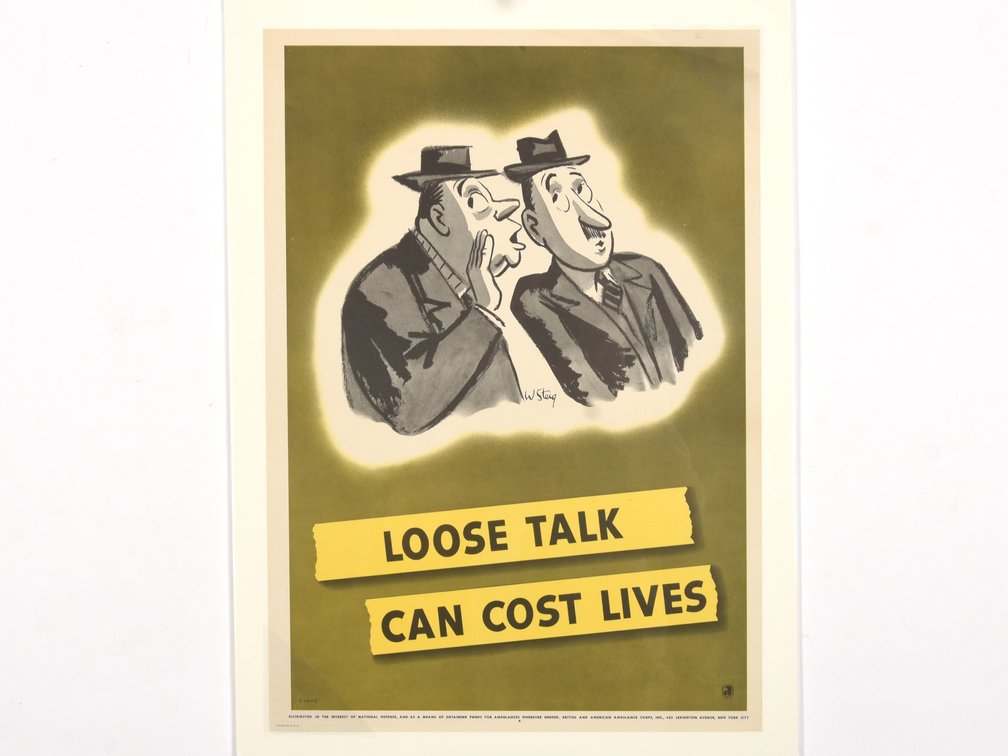
#205 • "Loose Talk Can Cost Lives" WWII Propaganda Poster by William Steig
Part of The Art of War and Peace - A No Reserve Poster Auction (live auction by Bannerman Auctions)
High bid $120.00
Status: SOLD
"Loose Talk Can Cost Lives" WWII Propaganda Poster by William Steig Description: This is an original 1942 World War II propaganda poster from the 'Loose Talk Can Cost Lives' campaign. It was designed by the celebrated American cartoonist William Steig (1907–2003), best known for his work in The New Yorker and as the creator of 'Shrek!', which spawned a successful film franchise. The poster features a whimsical but stern illustration of two men whispering, aimed at warning the public against gossip that could aid enemy espionage. It was published by the British and American Ambulance Corps, Inc. to raise funds for ambulances during the war effort. The printing is a lithograph on paper with bold yellow text boxes and an olive green background. Condition: The poster appears to be in very good to excellent condition. The colors are vibrant with no significant fading. No visible fold lines or significant tears are apparent in the main image area. There is minor creasing in the upper right corner Dimensions: Approximately 14 x 20 inches Artist: William Steig (1907–2003) Publisher: British and American Ambulance Corps, Inc. Date: 1942 (World War II) Estimate: $200-$300 Artist Biography: William Steig was a prolific American cartoonist, illustrator, and award winning author of children's books who lived from 1907 to 2003. He began his career as a freelance artist for The New Yorker in 1930, eventually contributing over 1,600 drawings and 100 covers to the magazine. In his sixties, he transitioned into children's literature, creating beloved works such as Sylvester and the Magic Pebble, which won the Caldecott Medal. He is perhaps most famous for writing the 1990 book Shrek!, which served as the foundation for the successful animated film franchise. Known for his distinctive line work and deep psychological insight, Steig remains a highly influential figure in both American illustration and literature.