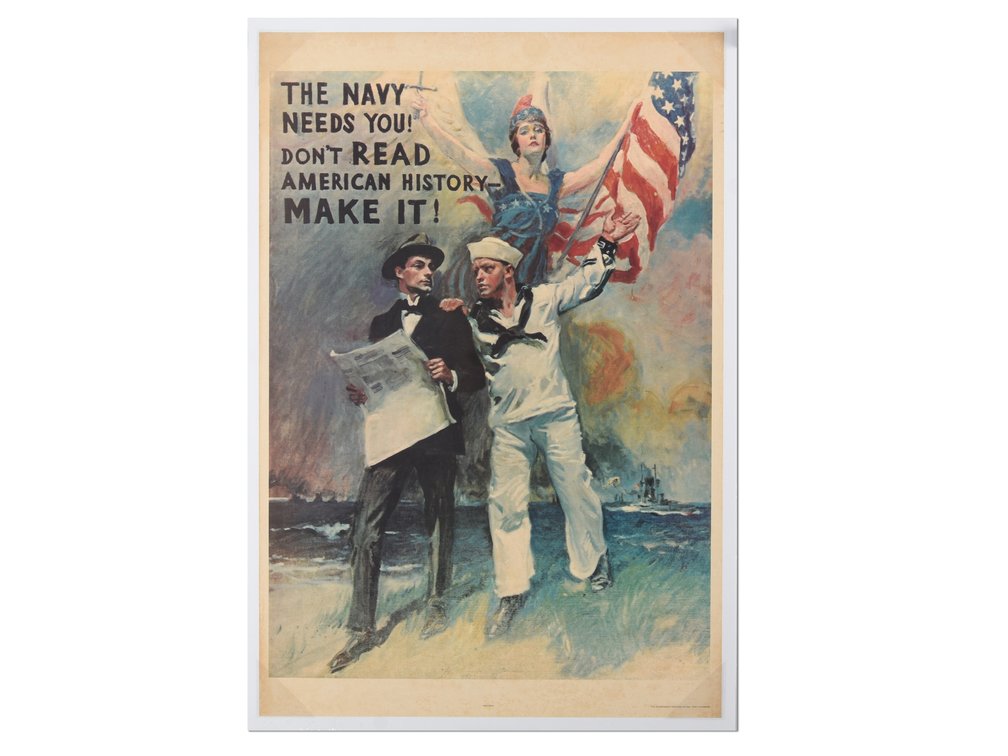
#228 • "The Navy Needs You! Don't Read American History – Make It!" Recruitment Poster (1974 Reprint)
Part of The Art of War and Peace - A No Reserve Poster Auction (live auction by Bannerman Auctions)
High bid $25.00
Status: SOLD
"The Navy Needs You! Don't Read American History – Make It!" Recruitment Poster (1974 Reprint) Description: This is a 1974 reproduction of the iconic 1917 United States Navy recruitment poster designed by famous illustrator James Montgomery Flagg. The artwork depicts a civilian reading a newspaper being encouraged by a sailor to join the service, with a winged personification of Columbia holding the American flag and a sword in the background. This specific version was issued by the U.S. Government Printing Office (GPO) in 1974, as evidenced by the marking in the lower right corner and the dimensions of approximately 25 x 37 inches, which differ from the 1917 original (typically 42 x 28 inches). Condition: There is visible creasing and wear at the corners and along the edges. The paper appears slightly toned, but the colors remain vibrant. Dimensions: Approximately 25 x 37 inches Artist: James Montgomery Flagg (1877-1960) Publisher: U.S. Government Printing Office Date: 1917 (1974 Reproduction) Estimate: $40-$80 Artist Biography: James Montgomery Flagg was a prominent American illustrator and portrait artist born in 1877 in Pelham Manor, New York. A child prodigy, he began selling his work to national magazines at age 12 and became a staff artist for Life and Judge by 15. After studying at the Art Students League and in Europe, Flagg established himself as a versatile creator of book illustrations, comic strips, and advertising art. He is most famous for creating the iconic 1917 World War I recruitment poster featuring Uncle Sam with the caption I Want YOU for U.S. Army, for which he used his own face as a model. Throughout his prolific career, he was one of the highest paid illustrators in America and painted portraits of notable figures such as Mark Twain and Jack Dempsey. Flagg published his autobiography, Roses and Buckshot, in 1946 and continued working until declining eyesight forced his retirement before his death in 1960.