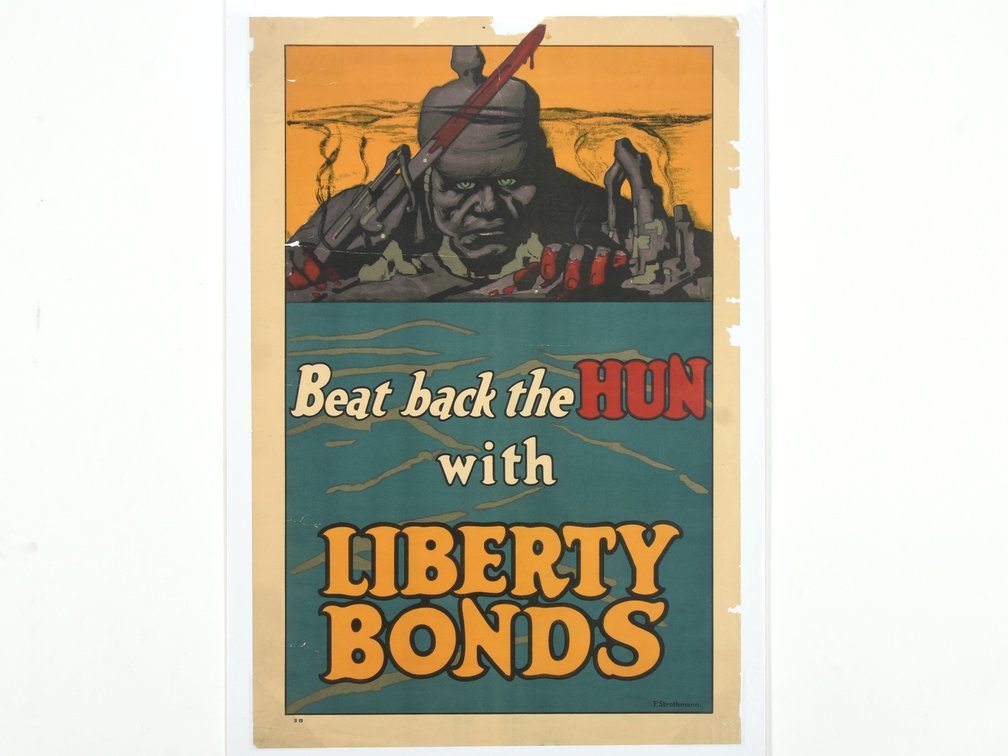
#122 • "Beat back the HUN with LIBERTY BONDS" World War I Poster
Part of The Art of War and Peace - A No Reserve Poster Auction (live auction by Bannerman Auctions)
High bid $160.00
Status: SOLD
"Beat back the HUN with LIBERTY BONDS" World War I Poster Description: This is an iconic original World War I propaganda poster titled "Beat back the HUN with Liberty Bonds," created by American illustrator Frederick Strothmann (1872–1958). The artwork features a menacing, dehumanized representation of a German soldier (referred to by the derogatory term "Hun") with glowing green eyes and blood-stained hands and bayonet, looming over a burning landscape across the Atlantic Ocean. This specific design was issued by the U.S. Treasury Department for the Fourth Liberty Loan drive in 1918. The poster is a color lithograph on paper and features the artist's signature "F. Strothmann" in the lower right and the printer's mark "3 B" in the lower left corner. Condition: There is a significant tear and paper loss at the top center margin, and the right edge shows extensive fraying, small tears, and surface loss that encroaches slightly into the image area. There are visible fold creases and minor surface scuffing throughout. Dimensions: Approximately 20 x 30 inches Artist: Frederick Strothmann (1872–1958) Publisher: Date: 1918 Estimate: $300-$500 Artist Biography: Frederick Strothmann was a prominent American illustrator and political cartoonist who remained active from the late nineteenth century until 1956. Born in the 1870s, he pursued his artistic education at the Carl Hecker School of Art in New York and the Royal Academy in Berlin. By the turn of the century, he had established a successful career contributing illustrations to major publications such as The Saturday Evening Post and Harper's Magazine. He also collaborated with renowned author Mark Twain to provide artwork for several of his books. Strothmann is perhaps best remembered for creating the iconic 1918 World War I propaganda poster titled Beat back the Hun with Liberty Bonds. He spent his later years in New York and passed away in Flushing, Queens, in 1958.