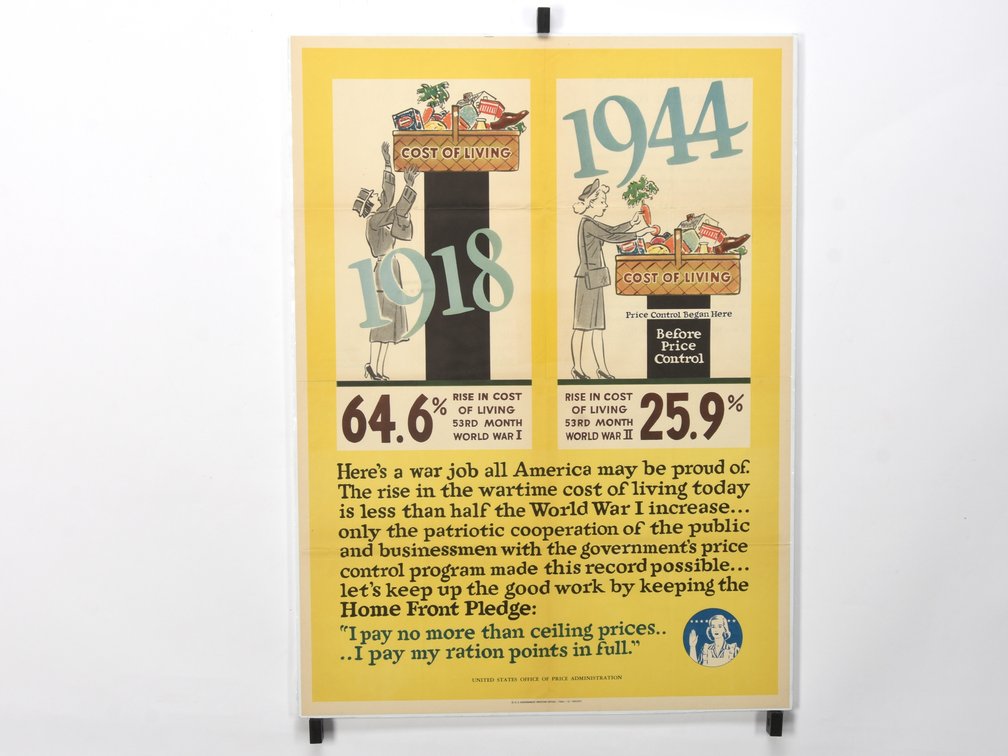
#211 • "Cost of Living 1918-1944" Original WW2 US Propaganda Poster, by Fred Cooper
Part of The Art of War and Peace - A No Reserve Poster Auction (live auction by Bannerman Auctions)
Starting at $50.00
Status: PASS
"Cost of Living 1918-1944" Original WW2 US Propaganda Poster, by Fred Cooper Description: The document titled Cost of Living 1918-1944 explores the United States government's efforts to control its economy during World War I and World War II. During both wars, Congress implemented price controls and rationing requirements through legislation like the Food and Fuel Act of 1917 and the Emergency Price Control Act of 1942. These measures authorized price ceilings and rationing programs to regulate and set fair and equitable prices. This intervention was intended to stabilize the economy, keep rampant inflation at bay, and prevent excessive high prices and gross profiteering, which was viewed as a potent factor in preventing after-war collapse. The impact of wartime price regulation differed significantly between the two periods. The adoption of a national stabilization program during the Second World War was a major factor in preventing wages and prices from rising as much as they did during the First World War. Controls under the Office of Price Administration OPA during World War II were comprehensive, and the cost of living rose less than 9 percent between May 1942 and November 1944. Condition: Notable condition issues include fold lines and uniform toning. No significant tears, stains, or damage. Dimensions: Approximately 20 x 28 inches Artist: Fred G. Cooper (1883-1962) Publisher: US Government Printing Office (printer) US Office of Price Administration (publisher/sponsor) Date: 1944 Estimate: $100-$200 Artist Biography: Fred G. Cooper (1883-1962) was an American writer cartoonist designer and illustrator. Born in McMinnville Oregon he studied art briefly at the Mark Hopkins Art Institute in San Francisco before moving to New York City in 1904 to begin his career as a freelance artist. He was widely known as "the lower case artist" for his distinctive use of all lower case hand lettering in his designs including acclaimed posters for the U.S. War Department. Cooper contributed illustrations and cartoons to Life magazine from 1904 until the 1930s where he eventually served as the art director. His commercial work includes creating the Colonial man corporate icon for the New York Edison Company and designing campaigns for Westinghouse. He was also a member of the Society of Illustrators and a founding member of the American Institute of Graphic Arts.