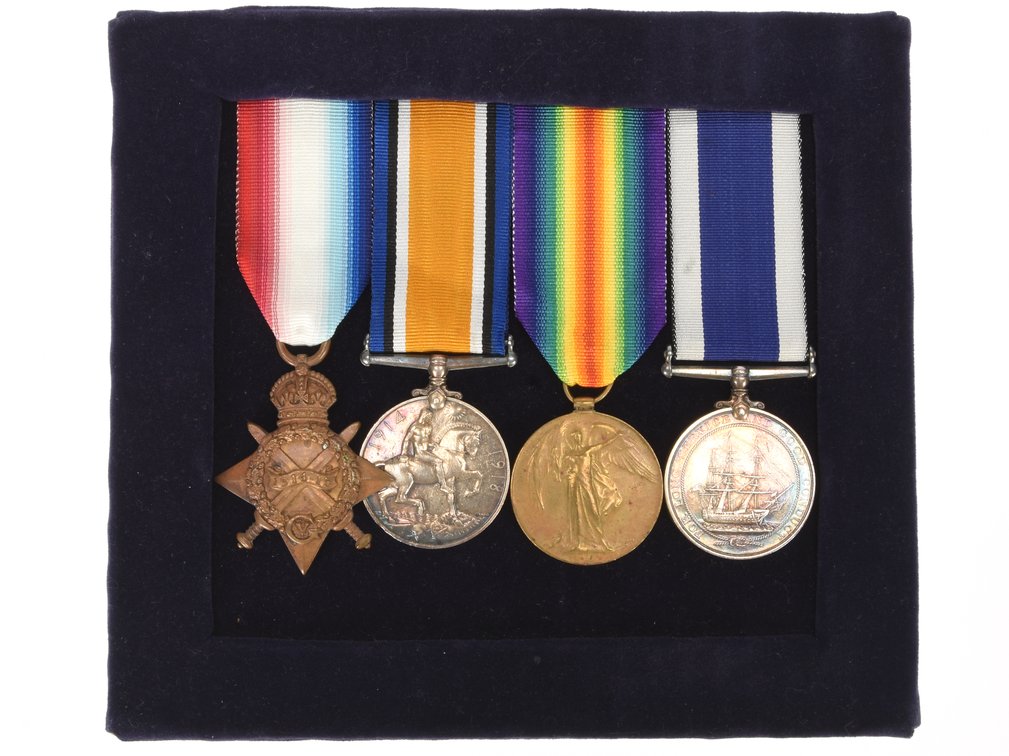
#216 • British WWI Medal Trio & Naval Long Service Medal to Chief Engine Room Artificer W. T. Elliott
Part of British & World Medals (live auction by Bannerman Auctions)
High bid $100.00
Status: SOLD
British WWI Medal Trio & Naval Long Service Medal to Chief Engine Room Artificer W. T. Elliott 1914-15 Star, British War Medal, and Victory Medal plus Naval Long Service and Good Conduct Medal named to Petty Officer Charles Gilbert. Gilbert was born in Stoke Damerel, Devon on 8 November 1887. He joined the Navy on 17 January 1903, and was discharged 30 June 1925. His 1914-1915 Star is marked "270907 W.T. ELLIOTT. E.R.A.2., R.N.", War Medal and Victory Medal are marked "270907 W.T. ELLIOTT. C.E.R.A.2. R.N."; and the Navy Long Service Medal is marked "270907 W.T. ELLIOTT. C.E.R.A.2. R.N. H.M.S. CRESCENT". Navy Long Service medal is the George V version of the award with non-swiveling bar. Medals have replacement ribbons, glued to Velour covered display frame. Elliott's service during WW1 was as follows: HMS St. George - July 1912 to March 1915 HMS Victory II (shore establishment) - April 1915 to July 1917 HMS Pembroke I (shore establishment) - July.1917 to Oct.1917 HMS Acteon (shore establishment)- Oct. 1917 to Feb.1919 HMS Forward - July 1918 to June 1919 Estimate $140 - $250 Historical Backgound: HMS Forward, a Forward‑class scout cruiser completed in 1905, began the First World War with the 9th Destroyer Flotilla on the East Coast of England, performing patrol and local defence duties and being present off Hartlepool during the German battlecruiser bombardment of 16 December 1914. In 1915 she transferred to the Mediterranean and then the Aegean, where she spent the remainder of the war on patrol, escort, and support work in the Dardanelles and Eastern Mediterranean, reflecting the typical secondary employment of the early scout cruisers once newer light cruisers entered service. The 1914-15 Star was authorized in 1918 and was awarded for service in specified theatres of war between 5 August 1914 and 31 December 1915. The British War Medal 1914-20 was instituted by King George V in 1919 to mark the end of the war and recognize the service given. The qualifying period of service between 5 August 1914 and 11 November 1918 was later extended to cover post-war mine clearance and service in Russia during 1919 and 1920. The medal was awarded for service in the Navy, Army, Mercantile Marine and other specified organizations. The Victory Medal was authorized in 1919 to commemorate the victory of the Allied Forces over the Central Powers. The Victory Medal was awarded to prescribed classes of persons who entered a theatre of war on duty between 5 August 1914 and 11 November 1918. The Navy Long Service Medal was awarded for 15 years of exemplary conduct.