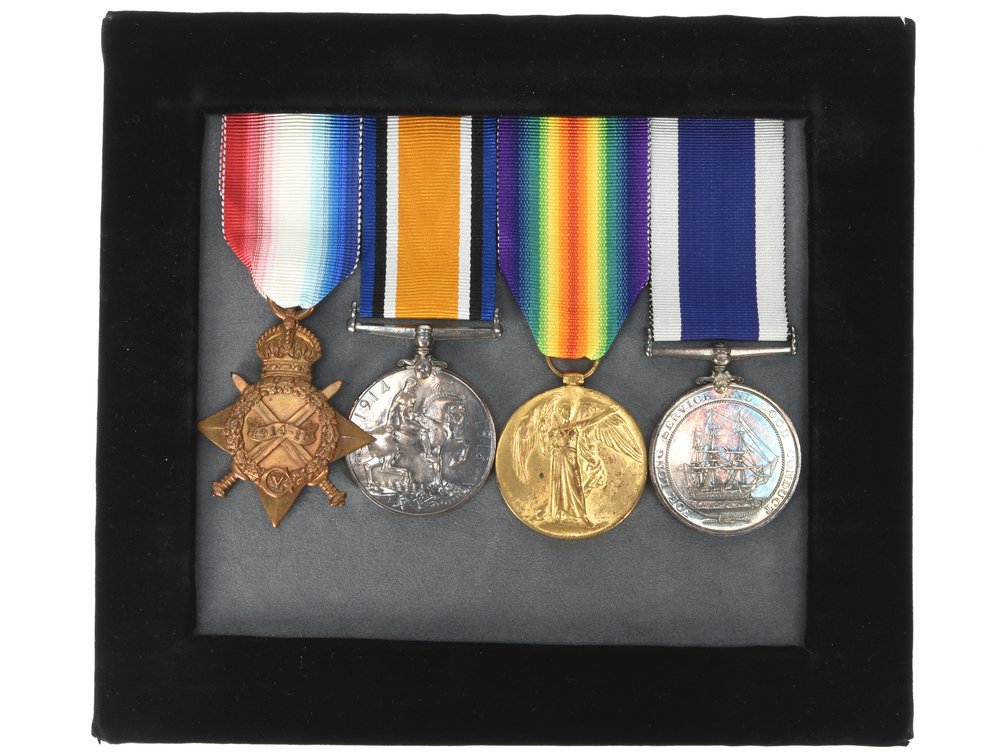
#219 • British WWI Medal Trio & Naval Long Service Medal to Petty Officer C. Gilbert: HMS Russell Survivor
Part of British & World Medals (live auction by Bannerman Auctions)
High bid $120.00
Status: SOLD
British WWI Medal Trio & Naval Long Service Medal to Petty Officer C. Gilbert: HMS Russell Survivor 1914-15 Star, British War Medal, and Victory Medal plus Naval Long Service and Good Conduct Medal named to Petty Officer Charles Gilbert. Gilbert was born in Butley, Suffolk on 18 March 1878. He joined the Navy on 11 June 1897, and was discharged 8 June 1919. His 1914-1915 Star, War Medal, and Victory Medal are marked "285398 C GILBERT. S.P.O., R.N."; and the Navy Long Service Medal is marked "285398 CHARLES GILBERT. S.P.O. H.M.S. FORWARD". Navy Long Service medal is the George V version of the award with swiveling bar. Medals have replacement ribbons, glued to Velour covered display frame. Gilbert's service during WW1 was as follows: HMS Russell - Feb. 1914 to May 1916 (HMS Russell was sank by German mines off Malta, 27 April 1916) HMS Pembroke II (shore establishment) - May 1916 to July 1916 HMS Terror - July 1916 to Jan. 1917 HMS Pembroke II (shore establishment) - Jan.1917 to Mar.1917 HMS Iphigenia - March 1917 to Jan. 1918 HMS Pembroke II - Jan. 1918 to June 1918 HMS Forward - July 1918 to June 1919 Estimate $180 - $300 Historical Background: HMS Russell, a Duncan‑class pre‑dreadnought battleship, began the First World War with the Grand Fleet on Northern Patrol duties and in November 1914 took part in the bombardment of German‑occupied Zeebrugge while serving with the 6th Battle Squadron. After returning to the Grand Fleet and then undergoing refit, she was detached with other pre‑dreadnoughts to reinforce the Dardanelles Squadron, her main wartime action being the final evacuation of Cape Helles in January 1916. Remaining in the eastern Mediterranean after the Gallipoli campaign, Russell was steaming off Malta on 27 April 1916 when she struck two mines laid by U‑73 and capsized with the loss of around 125 officers and men. HMS Terror, an Erebus‑class monitor completed in 1916, spent the First World War with the Dover Patrol, using her twin 15‑inch guns to bombard German positions and coastal installations along the occupied Belgian coast, particularly around Ostend and Zeebrugge. She took part in repeated attempts to neutralise the Bruges–Zeebrugge canal exits, was torpedoed and badly damaged off Dunkirk in October 1917 but repaired, and returned in 1918 to support operations including the Zeebrugge raid and later bombardments during the Fifth Battle of Ypres, ending the war as one of the Royal Navy’s principal heavy shore‑bombardment vessels in the Channel. HMS Iphigenia, an Apollo‑class protected cruiser launched in 1891, was already obsolescent by 1914 and had been converted to a minelayer, serving from the outbreak of war based at Dover and Sheerness with her class in extensive mine‑laying operations in the North Sea and Channel. Later employed as a depot ship in the White Sea with the British North Russia Squadron in 1917, she gained her most notable First World War distinction in 1918 when selected as one of the blockships for the Zeebrugge Raid and was scuttled at the entrance to the Bruges Canal on 23 April in an effort to choke off the U‑boat and destroyer route to the North Sea. HMS Forward, a Forward‑class scout cruiser completed in 1905, spent the early part of the First World War on coastal defence and patrol duties with the 9th Destroyer Flotilla on the East Coast of England, and was present off Hartlepool during the German bombardment of 16 December 1914 without playing a major gunnery role in the action. In mid‑1915 she transferred to the Mediterranean, later operating in the Aegean Sea alongside her sister ship HMS Foresight on patrol, escort, and support duties in the Dardanelles and Eastern Mediterranean theatre, remaining in that area through to the end of the war. The 1914-15 Star was authorized in 1918 and was awarded for service in specified theatres of war between 5 August 1914 and 31 December 1915. The British War Medal 1914-20 was instituted by King George V in 1919 to mark the end of the war and recognize the service given. The qualifying period of service between 5 August 1914 and 11 November 1918 was later extended to cover post-war mine clearance and service in Russia during 1919 and 1920. The medal was awarded for service in the Navy, Army, Mercantile Marine and other specified organizations. The Victory Medal was authorized in 1919 to commemorate the victory of the Allied Forces over the Central Powers. The Victory Medal was awarded to prescribed classes of persons who entered a theatre of war on duty between 5 August 1914 and 11 November 1918. The Navy Long Service Medal was awarded for 15 years of exemplary conduct.