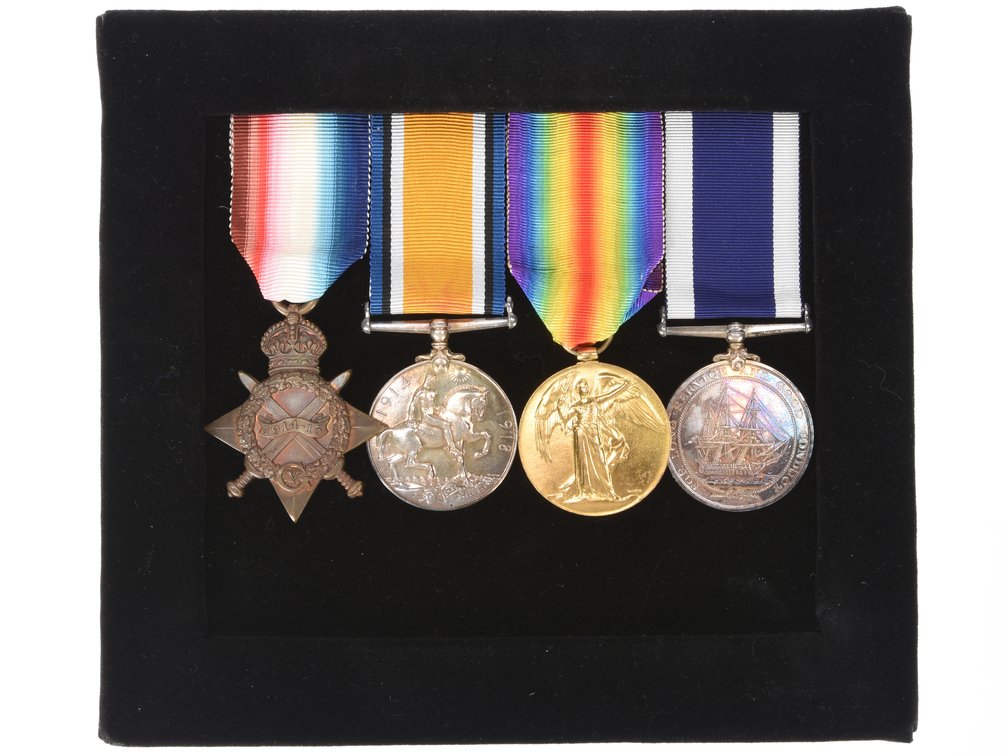
#227 • British WWI Medal Trio & Naval Long Service to CPO Alfred Holness: at Jutland aboard HMS Calliope
Part of British & World Medals (live auction by Bannerman Auctions)
High bid $140.00
Status: SOLD
British WWI Medal Trio & Naval Long Service to CPO Alfred Holness: at Jutland aboard HMS Calliope 1914-15 Star, British War Medal, and Victory Medal plus Naval Long Service and Good Conduct Medal named to Chief Petty Officer Alfred Holness. Holness was born in Chislet, Kent on 23 May 1879. He enlisted in the Navy on 8 June 1895, and was discharged 29 November 1919. His 1914-1915 Star, War Medal, and Victory Medal are marked "A. HOLNESS. C.P.O. R.N."; and the Navy Long Service Medal is marked "184290. A. HOLNESS. C.P.O. R.N. H.M.S. AGAMEMNON". Navy Long Service medal is the George V version of the award with swiveling bar. Medals have replacement ribbons, glued to Velour covered display frame. Holness served on board H.M.S. Calliope (a C-Class Light Cruiser) in WW1 and at Jutland. Estimate $180 - $300 Historical Background: HMS Calliope, a Calliope‑class light cruiser completed in 1915, served in the Grand Fleet’s 4th Light Cruiser Squadron, performing North Sea patrol, screening, and scouting duties in support of the battlefleet. At the Battle of Jutland she acted as the flagship of the 4th Light Cruiser Squadron, and was heavily engaged during the evening fighting, absorbing several hits from German battleships Kaiser and Markgraf that caused 10 fatalities but did not disable her. Many years after the battle (actually in 1932), Jellicoe later wrote that he should have used the 4th LCS more effectively, particularly in the scouting actions when contact had been lost. Calliope remained with the Grand Fleet for the rest of the war, later taking part in North Sea sweeps and in September 1917 helping to destroy four German trawler‑minesweepers off Jutland, before continuing in post‑Armistice service in home waters. HMS Agamemnon, a Lord Nelson‑class pre‑dreadnought battleship, began the First World War in the Channel Fleet, covering the transport of the British Expeditionary Force to France and guarding the English coast and Channel approaches. In early 1915 she transferred to the Dardanelles, taking a prominent role in the campaign by repeatedly bombarding Ottoman coastal forts, supporting the 25 April landings, and later striking targets such as the Kavak bridge, while surviving several heavy hits from Turkish guns. Remaining in the Eastern Mediterranean after Gallipoli, Agamemnon alternated between Mudros and Salonika to deter any breakout by SMS Goeben and Breslau, shot down the Zeppelin LZ‑55 during a 1916 raid on Salonika, and in October 1918 hosted the signing of the Armistice of Mudros, symbolically closing her war as the Allied flagship in the Aegean. The 1914-15 Star was authorized in 1918 and was awarded for service in specified theatres of war between 5 August 1914 and 31 December 1915. The British War Medal 1914-20 was instituted by King George V in 1919 to mark the end of the war and recognize the service given. The qualifying period of service between 5 August 1914 and 11 November 1918 was later extended to cover post-war mine clearance and service in Russia during 1919 and 1920. The medal was awarded for service in the Navy, Army, Mercantile Marine and other specified organizations. The Victory Medal was authorized in 1919 to commemorate the victory of the Allied Forces over the Central Powers. The Victory Medal was awarded to prescribed classes of persons who entered a theatre of war on duty between 5 August 1914 and 11 November 1918. The Navy Long Service Medal was awarded for 15 years of exemplary conduct.