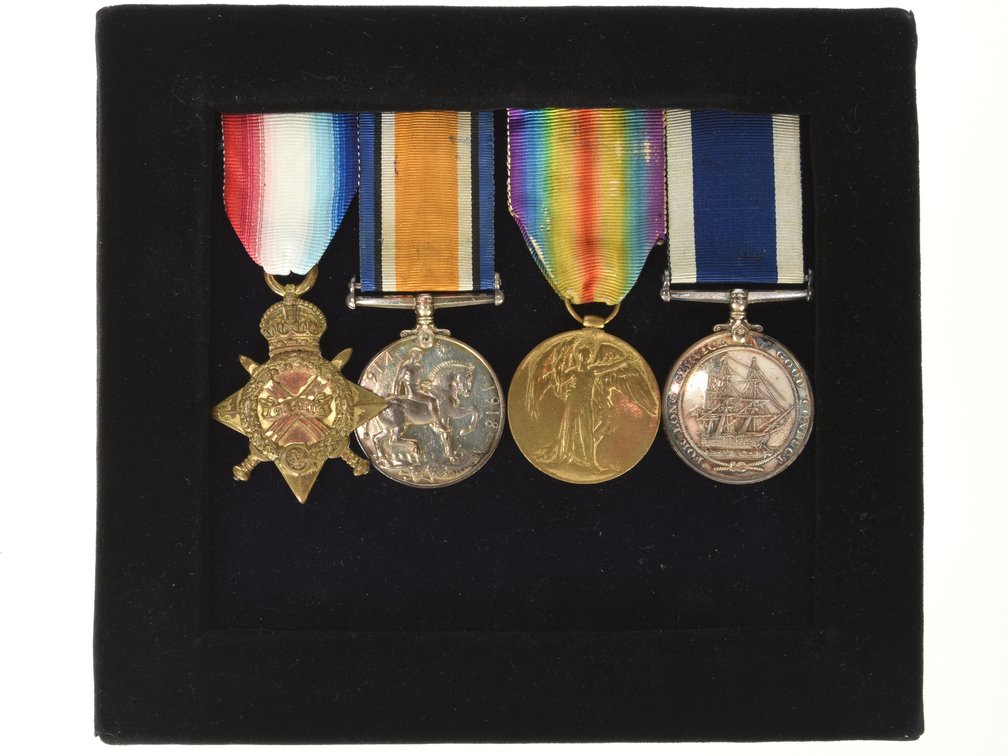
#223 • British WWI Medal Trio & Naval Long Service Medal to Royal Navy Petty Officer W.B. Rufford
Part of British & World Medals (live auction by Bannerman Auctions)
High bid $110.00
Status: SOLD
British WWI Medal Trio & Naval Long Service Medal to Royal Navy Petty Officer W.B. Rufford 1914-15 Star, British War Medal, and Victory Medal plus Naval Long Service and Good Conduct Medal named to Petty Officer Cook William Bartley Rufford, born 15 July 1890 in Birmingham, Warwickshire. Rufford was land based at HMS Pembrooke 1 from March 1914 to May 1917 and served on board several ships until the end of the war. His career in the Royal Navy started in April of 1909 and was discharged in 1928. His 1914-1915 Star, War Medal, and Victory Medal are marked "M.924. W.B. RUFFORD. L.CK.MTE.R.N."; the Navy Long Service Medal is marked "M.924. W.B. RUFFORD. P.O.CK. HMS REPULSE". Naval Long Service medal is the George V version with non-swiveling bar. Slight tarnish on the medals. Wear visible on BWM and Victory ribbons. Ribbons are glued to velour covering on display frame. Estimate $120 - $200 Historical Background: HMS Repulse, a Renown-class battlecruiser completed in August 1916, spent the First World War with the Grand Fleet in the North Sea, largely on patrol, screening, and readiness duties against the German High Seas Fleet. Her sole major fleet action came at the Second Battle of Heligoland Bight in November 1917, where she engaged German light forces, firing her 15-inch guns and scoring at least one hit on the light cruiser SMS Königsberg before helping cover the British withdrawal when German battleships appeared. Repulse also present at the surrender of the German High Seas Fleet in November 1918, she ended the war as flagship of the 1st Battlecruiser Squadron, emblematic of Britain’s emphasis on fast capital ships for North Sea dominance in the conflict’s final years. The 1914-15 Star was authorized in 1918 and was awarded for service in specified theatres of war between 5 August 1914 and 31 December 1915. The British War Medal 1914-20 was instituted by King George V in 1919 to mark the end of the war and recognize the service given. The qualifying period of service between 5 August 1914 and 11 November 1918 was later extended to cover post-war mine clearance and service in Russia during 1919 and 1920. The medal was awarded for service in the Navy, Army, Mercantile Marine and other specified organizations. The Victory Medal was authorized in 1919 to commemorate the victory of the Allied Forces over the Central Powers. The Victory Medal was awarded to prescribed classes of persons who entered a theatre of war on duty between 5 August 1914 and 11 November 1918. The Navy Long Service Medal was awarded for 15 years of exemplary conduct.