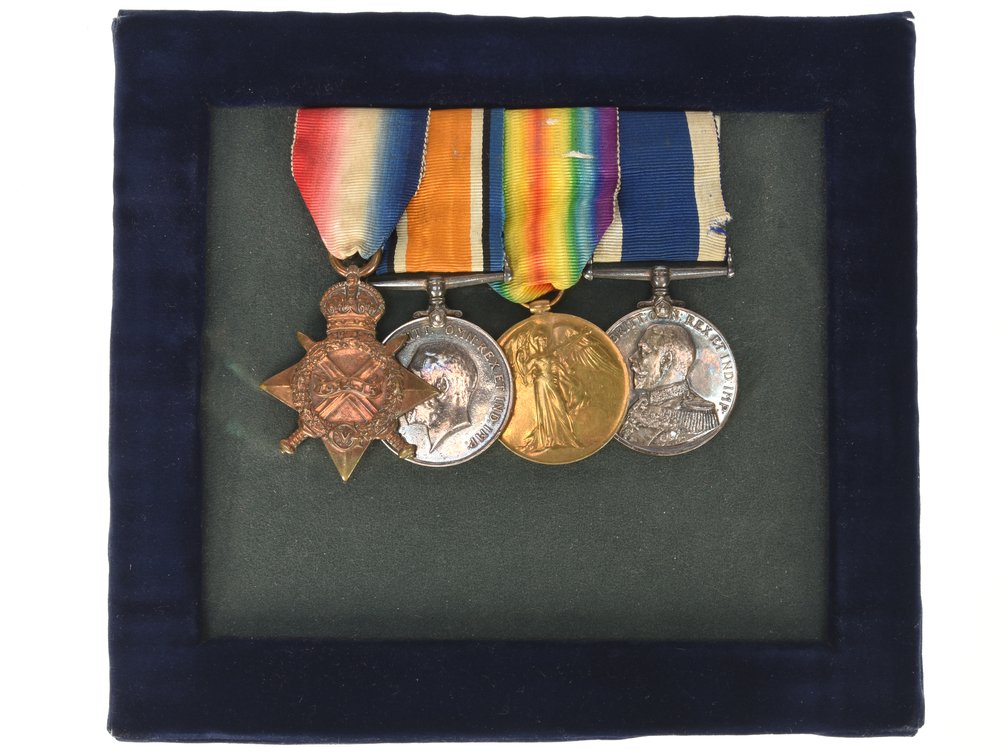
#221 • British WWI Medal Trio & Naval Long Service Medal to Royal Navy Engine Room Artificer Thomas Rosie
Part of British & World Medals (live auction by Bannerman Auctions)
High bid $120.00
Status: SOLD
British WWI Medal Trio & Naval Long Service Medal to Royal Navy Engine Room Artificer Thomas Rosie 1914-15 Star, British War Medal, and Victory Medal plus Naval Long Service and Good Conduct Medal named to Engine Room Artificer Thomas Rosie. His 1914-1915 Star, War Medal, and Victory Medal are marked "M. 4307. T. ROSIE. E.R.A.3..R.N."; and the Navy Long Service Medal is marked "M. 4307. T. ROSIE. E.R.A.2. HMS SPENSER". Naval Long Service medal is the George V version with non-swiveling bar. Medals have original ribbons, but these are glued to a Velour covered display frame. The Naval Long Service ribbon is torn at the lower right hand corner. Estimate $160 - $250 Historical Background: HMS Spenser, a Thornycroft-built Shakespeare-class destroyer leader completed in December 1917, spent the closing year of the First World War with the Harwich Force’s 10th Destroyer Flotilla, conducting North Sea patrol, escort, and strike operations against German naval forces. Early in 1918 she survived a collision with a sailing vessel and later that year took part in complex operations in the Heligoland Bight involving towed Coastal Motor Boats and repeated airship and aircraft attacks, during which she was bombed by Zeppelin L53 but escaped damage. In August 1918 Spenser helped rescue survivors from the torpedoed leader Scott and destroyer Ulleswater, and she remained in the 10th Flotilla through the Armistice, subsequently escorting surrendering German U-boats to Harwich in November and December 1918. The 1914-15 Star was authorized in 1918 and was awarded for service in specified theatres of war between 5 August 1914 and 31 December 1915. The British War Medal 1914-20 was instituted by King George V in 1919 to mark the end of the war and recognize the service given. The qualifying period of service between 5 August 1914 and 11 November 1918 was later extended to cover post-war mine clearance and service in Russia during 1919 and 1920. The medal was awarded for service in the Navy, Army, Mercantile Marine and other specified organizations. The Victory Medal was authorized in 1919 to commemorate the victory of the Allied Forces over the Central Powers. The Victory Medal was awarded to prescribed classes of persons who entered a theatre of war on duty between 5 August 1914 and 11 November 1918. The Navy Long Service Medal was awarded for 15 years of exemplary conduct.