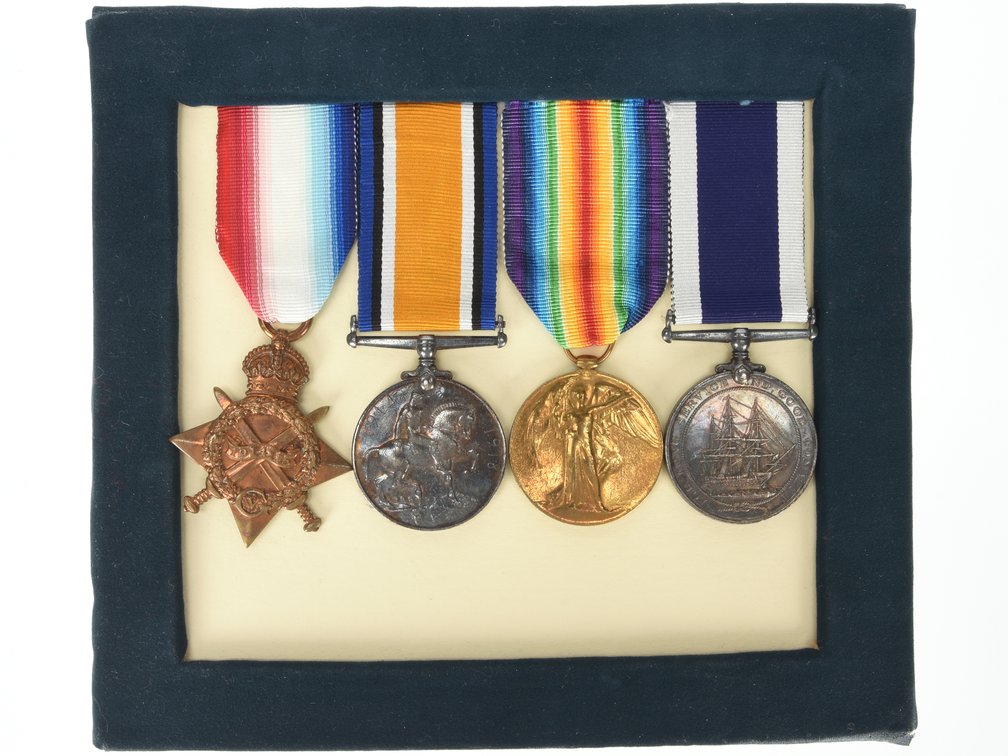
#222 • British WWI Medal Trio & Naval Long Service Medal to Royal Navy Leading Stoker John Henry Penfound
Part of British & World Medals (live auction by Bannerman Auctions)
High bid $110.00
Status: SOLD
British WWI Medal Trio & Naval Long Service Medal to Royal Navy Leading Stoker John Henry Penfound 1914-15 Star, British War Medal, and Victory Medal plus Naval Long Service and Good Conduct Medal named to Leading Stoker John Henry Penfound. His 1914-1915 Star, War Medal, and Victory Medal are marked "K.6660. J.H. PENFOUND. L. STO. R.N."; and the Navy Long Service Medal is marked "K.6660. J.H. PENFOUND. A-S. STO. HMS CONCORD". Navy Long Service medal is the George V version of the award with non-swiveling bar. Medals have replacement ribbons, glued to Velour covered display frame. Sherrell was stationed on board the HMS Thunderer (an Orion class dreadnaught battleship) from 1 December 1912 to 10 August 1917. The HMS Thunderer was present at the Battle of Jutland, 31 May, 1916. Estimate $100 - $200 Historical Background: HMS Edgar, lead ship of the Edgar-class first-class protected cruisers, was already an elderly unit by 1914 but still saw active First World War service with the Tenth Cruiser Squadron on blockade and patrol duties to the north of Scotland. In late 1914 her heavy guns were removed to arm newly built monitors, after which she was rearmed with 6‑inch guns, fitted with large anti-torpedo bulges, and employed for shore bombardment on the Flemish coast before transfer to the Dardanelles in May 1915. Edgar then served in the Gallipoli campaign and subsequent Aegean operations until 1918, providing naval gunfire support and presence rather than engaging in major fleet actions, before being withdrawn from front-line duty at the war’s end. HMS Concord, a Centaur‑subclass C‑class light cruiser completed in late 1916, joined the 5th Light Cruiser Squadron with the Harwich Force, working in the North Sea to protect the eastern approaches to the Channel and support destroyer flotillas on patrol and escort duties. Through 1917–1918 she took part in routine North Sea operations and convoy cover rather than set-piece fleet engagements, and after the Armistice she was employed on postwar tasks, including visits to Copenhagen and Northern European ports during the internment and repatriation phase following the surrender of German naval forces. The 1914-15 Star was authorized in 1918 and was awarded for service in specified theatres of war between 5 August 1914 and 31 December 1915. The British War Medal 1914-20 was instituted by King George V in 1919 to mark the end of the war and recognize the service given. The qualifying period of service between 5 August 1914 and 11 November 1918 was later extended to cover post-war mine clearance and service in Russia during 1919 and 1920. The medal was awarded for service in the Navy, Army, Mercantile Marine and other specified organizations. The Victory Medal was authorized in 1919 to commemorate the victory of the Allied Forces over the Central Powers. The Victory Medal was awarded to prescribed classes of persons who entered a theatre of war on duty between 5 August 1914 and 11 November 1918. The Navy Long Service Medal was awarded for 15 years of exemplary conduct.