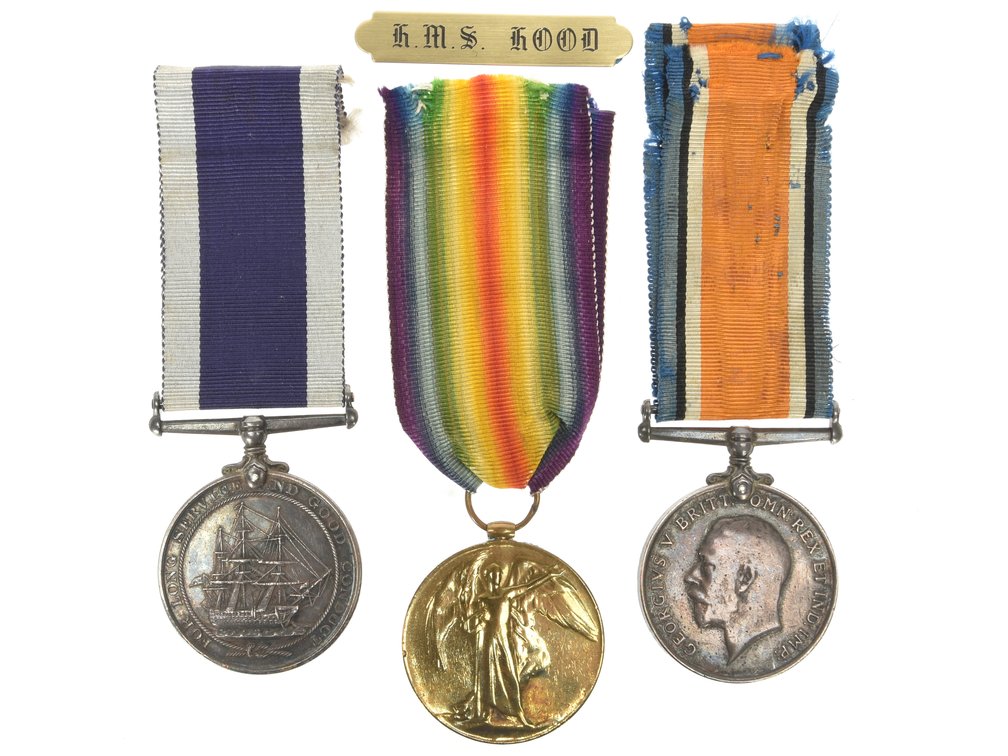
#215 • British World War I Medals: HMS Hood
Part of British & World Medals (live auction by Bannerman Auctions)
High bid $100.00
Status: SOLD
British World War I Medals: HMS Hood. Grouping of 3 World War I medals including: 1.) British World War I Victory Medal. Medal in named (impressed) on rim "M6838 J.W. RILEY. E.R.A.3 R.N.". Medal presents proper ribbon. 2.) British World War I Service Medal. Medal is named (impressed) on rim "M.6838 J.W. RILEY. E.R.A.3 R.N.". Medal presents proper ribbon. 3.) British Naval "Long Service and Good Conduct" Medal. Medal is named (impressed) on rim "6338 J.W. RILEY, E.R.A. 1, H,M,S, HOOD,". All three medals present glue on reverse from previous display mounting. Riley Served abord the HMS Hood battleship as an Electrical Repair Artificer during WWI. Estimate: $200 - $300 Historical Background: The "British World War I Medals-HMS Hood" refers to the set of medals awarded to service members who participated in World War I, with a specific connection to the battlecruiser HMS Hood. These medal sets often include the trio of campaign medals—the 1914 Star or 1914-15 Star, the British War Medal, and the Interallied Victory Medal. While HMS Hood, commissioned in 1920, is more famous for its role and eventual loss in World War II, WWI-era medals associated with the ship may belong to crew members who served on the vessel in its early years, or as part of family groupings where a relative served on the ship. The medals, such as those sometimes found in family "casualty" lots, provide a historical record of service during the Great War. For example, a WWI medal set might detail a relative's service who was later associated with HMS Hood. The 1914-15 Star signifies entry into a theater of war between August 5, 1914, and December 31, 1915, while the British War Medal and Victory Medal recognize general service throughout the conflict. These items serve as tangible links to the individuals who served and commemorate the immense sacrifices made by the Royal Navy during and immediately following World War I. HMS Hood, pennant number 51, was ordered during World War I and laid down in September 1916 as the first of the Admiral class of battlecruisers. Her design was heavily influenced by the lessons learned from the Battle of Jutland, which prompted the Admiralty to incorporate thousands of tons of extra armor to improve her survivability compared to earlier British battlecruisers. Despite being launched in 1918, Hood was not fully commissioned until May 1920, too late for service in the First World War. She was the only ship of her class to be completed due to high costs and the post war shift in naval priorities. For two decades, Hood remained the largest warship in the world and served as a global symbol of British naval strength, often referred to as "The Mighty Hood." Her high profile career included a famous circumnavigation of the globe with the Special Service Squadron in 1923 and 1924. While formidable, her WWI era design contained vulnerabilities, particularly concerning her deck armor, which were never fully rectified. This flaw contributed to her tragic sinking in May 1941 by the German battleship Bismarck, where she exploded and sank in three minutes with the loss of all but three of her crew.