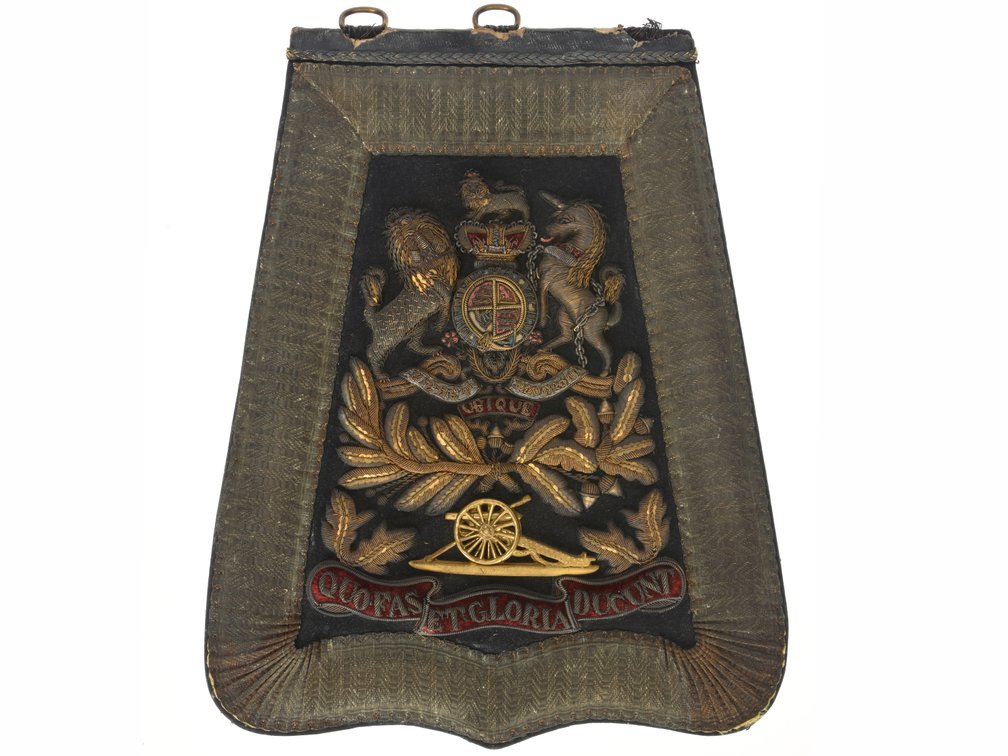
#201 • Victorian Artillery Officers Sabretache
Part of British & World Medals (live auction by Bannerman Auctions)
High bid $200.00
Status: SOLD
Victorian Artillery Officers Sabretache Victorian artillery officer's sabretache measuring 13" x 10.5" (not including hanging tabs). Sabretache presents an extensive bullion thread royal coat of arms over gilt metal cannon measuring 1.5" x3.5" above bullion motto in banner "QUO FAS ET GLORIA DUCUNT" . Border edge of sabretache presents a 1.75" border of gilt thread woven into a zig-zag design. Sabretache back is leather. Bullion thread exhibits some darkening/tarnish with sabretache exhibiting some wear and light leather loss at some seams. Estimate: $400 - $600 Historical Background: A Victorian Artillery Officers Sabretache is a type of decorative pouch carried by mounted officers of the Royal Artillery, particularly during the period of 1854 to 1900. Sabretaches were introduced into the British Army between 1806 and 1808, originally for carrying documents. The full dress pattern for Royal Artillery officers, which remained consistent after its adoption around 1855, often featured dark blue morocco leather with a front flap covered in dark blue cloth and edged with gold bullion artillery pattern lace. These highly ornamental items typically included embroidered scrolls, the artillery motto "UBIQUE" on crimson velvet, and beneath a wreath, the motto "QUO. FAS. GLORIA. DUCUNT," along with a gold field gun. The sabretache could also be an undress pattern, which was generally plain black leather with a gilt-die stamped badge, typical of the pattern used by the Royal Engineers and Infantry until the sabretache's abolition in 1900. For colonial forces, such as the Victorian Military Forces in Australia, officer's undress sabretaches were made of black patent leather, sometimes with a foul-weather cover. The Royal Regiment of Artillery, including the Royal Horse Artillery, began adopting dress sabretaches before 1823, but it was not until 1855 that they were widely adopted by mounted officers of the entire regiment, enduring throughout the Victorian era before being discontinued at the turn of the century.