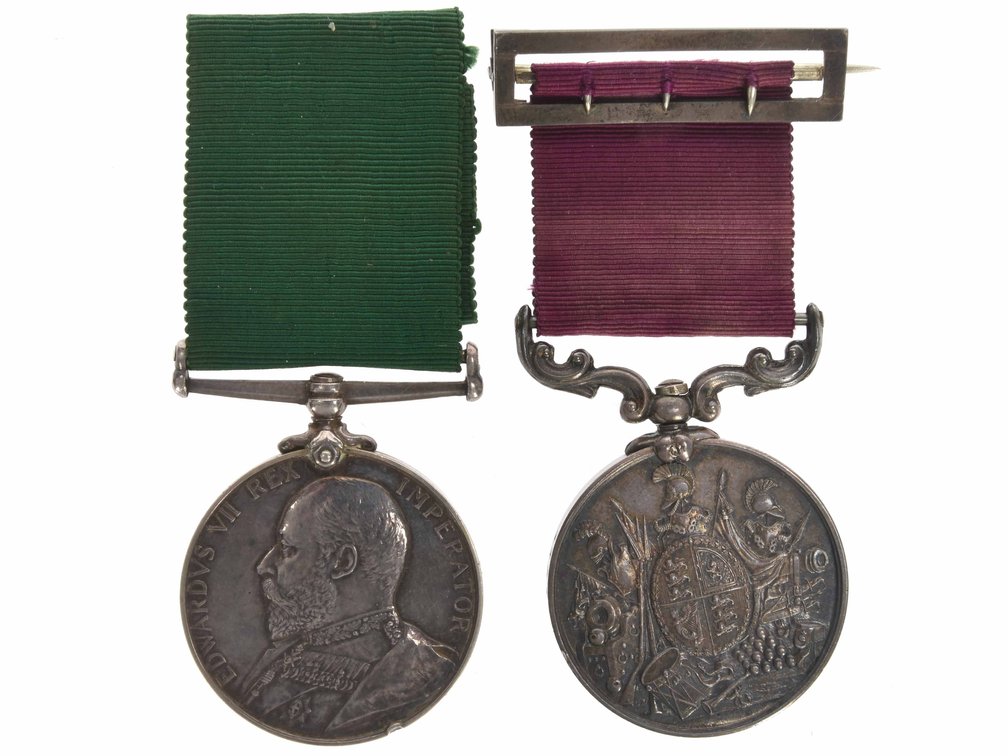
#267 • British Long Service Medals: Lot of Two
Part of British & World Medals (live auction by Bannerman Auctions)
High bid $170.00
Status: SOLD
British Long Service Medals: Lot of Two. Pair of British Long Service medals including; 1.) British "For Long Service and Good Conduct" medal. Medal named (engraved) on rim "1757 PTE. A. GIBB. HIGH: L.I." in block capital letters. Medal exhibits some surface abrasions, tarnishing, small rim knock at 9 o'clock obverse and wear, and is in fine condition. Medal presents proper ribbon with silver buckle pin at top for wear on uniform. 2.) British "For Long Service In The Volunteer Force" medal. Medal named (impressed) on rim "4419 L-SERJT: J. THOMSON. 1ST V.B. NORTH'D FUS: " in block capital letters. Medal exhibits some surface abrasions, tarnishing, small rim knock at 5 o'clock obverse and wear, and is in fine condition. Medal presents proper ribbon. Estimate: $300 - $400 Historical Background: British Long Service and Good Conduct Medals are a category of military awards given to warrant officers, non-commissioned officers, and other ranks in the British Armed Forces for extended periods of service and exemplary conduct, regardless of having seen active combat. These medals date back to the Army Long Service and Good Conduct Medal, established on July 30, 1830. Historically, these medals have been issued across the various branches of the military, including the Royal Navy, which received the Naval Long Service and Good Conduct Medal in 1848, and the Royal Air Force, which instituted the Royal Air Force Long Service and Good Conduct Medal in 1919. The design of the medals changed over time to reflect the reigning monarch. For instance, the Queen Victoria version, introduced in 1837, removed the Hanover emblem from the shield. Subsequent versions featured the effigies of King Edward VII in 1901 and King George V in 1910. The Army Long Service and Good Conduct Medal itself was discontinued in 1930. These awards are distinct from campaign medals, which are issued for service in specific theatres of war, and from gallantry or distinguished conduct medals, which recognize acts of bravery.